Huronia Museum – Looking Back 60 Years in North Simcoe – October 23rd to 31st, 1959

The photos found in this blog post are the property of Huronia Museum, Midland, Ontario. Any reproduction for commercial use without permission is prohibited.  Any other distribution must credit Huronia Museum.  Please contact the museum with any questions you may have. 

Click on photos to enlarge.The former skipper of the St Heliers, Capt. J. C. Patchell, who retired two years ago, left, chats with Capt. Basil Dube of Parry Sound in the chart-room of the new Alexander Henry, combined ice-breaker and buoy tender. The Department of Transport ship visited Midland last Wednesday. 

F. K. McKean, left, district agent, Department of Transport, looks on as Neville Keefe, general manager of the Georgian Bay Development Association, right, presents a barometer to Capt. Basil Dube of the Alexander Henry, new ice-breaker and buoy tender. The barometer will hang in the officers’ lounge.  (There was a battle going on at the time to ensure that the “Henry” spent the winter in Georgian Bay not Thunder Bay as had been rumoured. Perhaps the barometer was part of the wooing.)

Our “Red Lady of the Lakes” in Midland, late January of 1960. Note the Christmas tree on top and the fully-loaded CSL freighter at the Town House.

This was the condition of the home of Constant Desroches, Lafontaine, when Penetang Fire Brigade arrived Friday, Oct, 16. Along with Thunder Bay brigade, they concentrated on saving adjoining buildings. Farmers and spectators came from miles around and could only stand by watching as flames consumed the home. A large portion of the furnishings were removed from the house before the heat became too intense. Only a few feet separated Lafontaine Telephone exchange building from the burning home, Penetang and Thunder Bay firemen played hoses on homes on the far side of the burning building to keep the fire from spreading. 
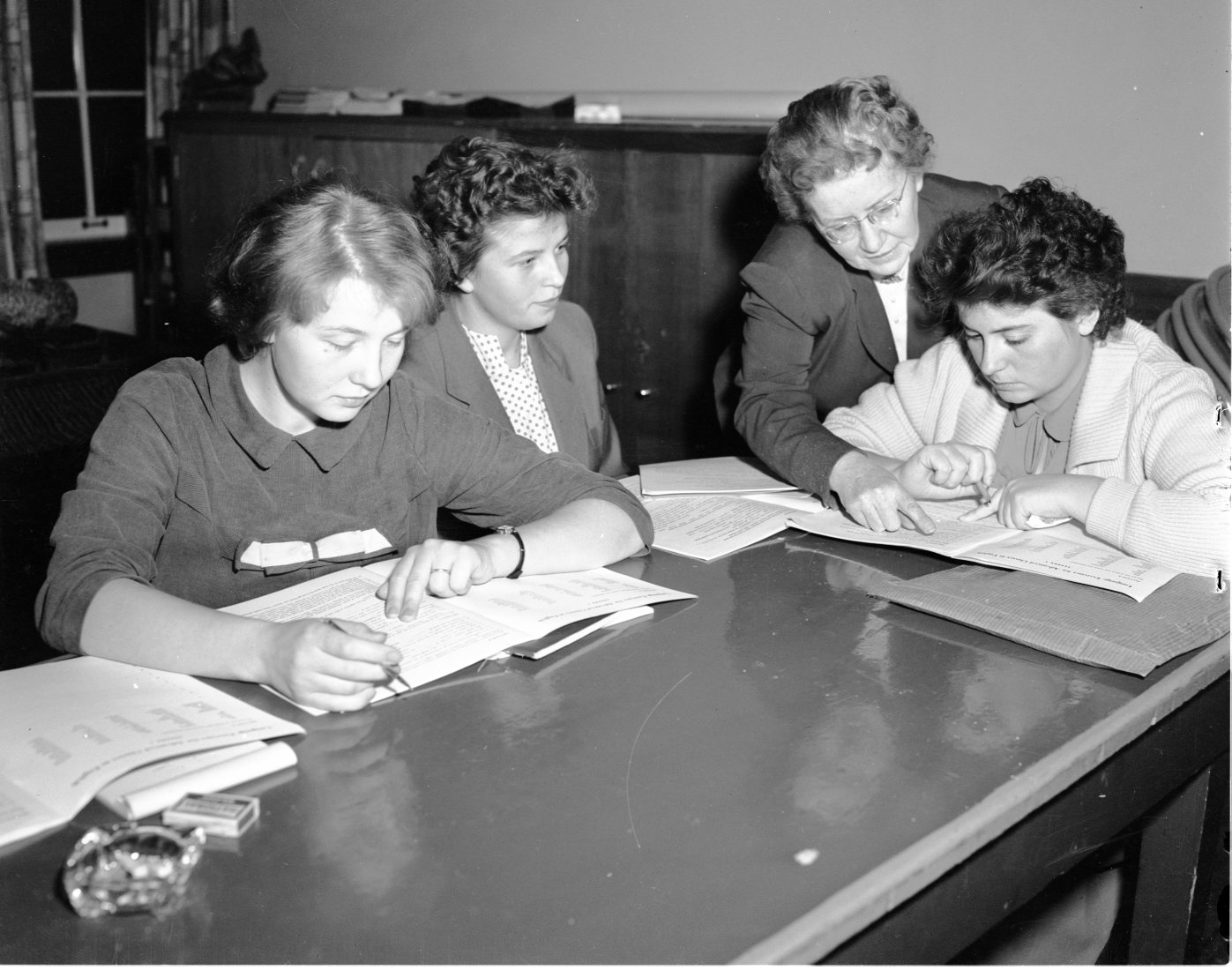
English classes for new Canadians, sponsored by Midland-Penetang District High School Board with the assistance of the Department of Education, are held weekly in Midland YMCA. Here Mrs. J. W. Smith, one of two instructors, explains a point to three students, Mrs. Karl Lehr, Mrs. H. Hildebrand and Mrs. Werner Moos, who attend the lectures. Canadian newcomers and their children also make use of other facilities at the ‘Y’, which this week is conducting its annual fundraising campaign. 

Little league hockey got underway again in Midland Saturday morning, with nearly 400 boys raring for action. Grant Forsyth doles out sweaters and goalies’ equipment to waiting lads. 

Little league hockey got underway again in Midland Saturday morning, with nearly 400 boys signed up. Start of a junior “B” game, finds, left to right, Willard Cadeau, Tigers, referees Mike Duval and Mike Robitaille, and Beehives’ Steve Burton all set for the first face-off of the season. 
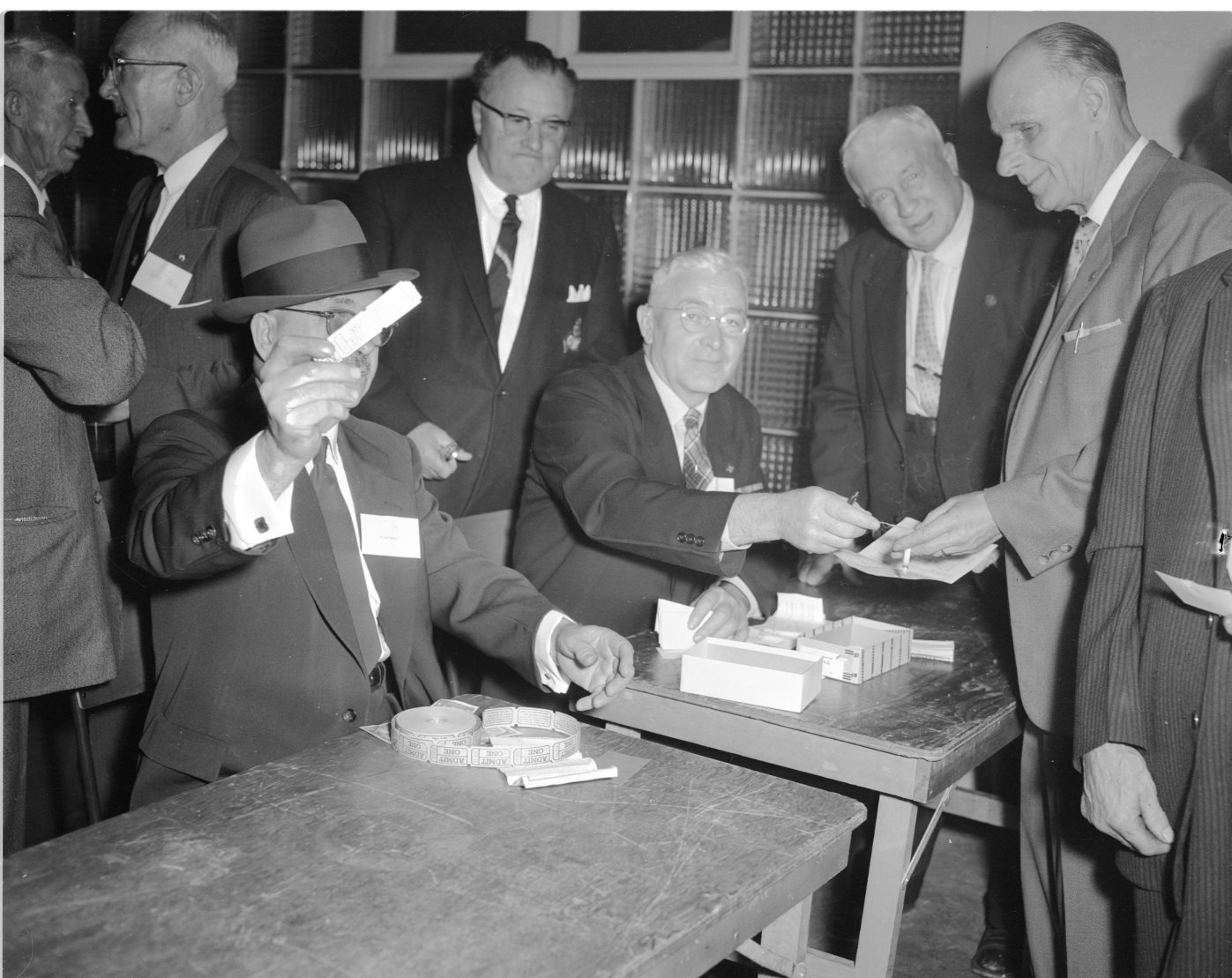
Nearly 200 veterans of World War I, all members of the 157th and 177th Battalions of the Grey and Simcoe Foresters, checked into Midland Armory Saturday night for their first reunion in 40 years. Handing out identification tags were Bill Bradley of Barrie (with hat) and George Parr of Midland. Two men at the right are Charlie Scott and Joe Martin of Penetang. 
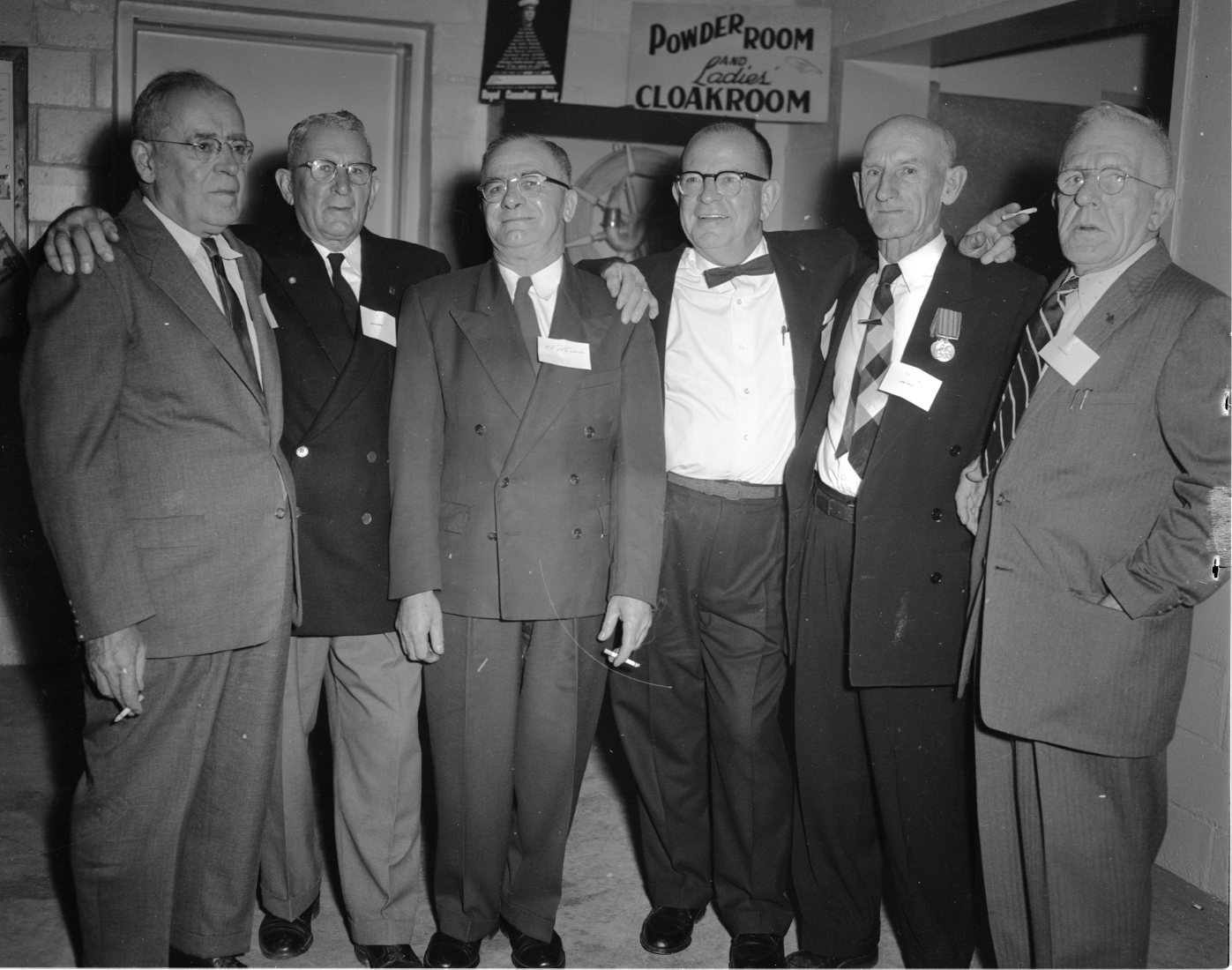
When the call went out for men to join the 157th and 177th Battalions of the Grey and Simcoe Foresters back in 1915, Penetang was quick to fill its quota. Among the men who “signed up” then and who were present for the reunion at Midland Armory Saturday night were, left to right, Bob Beaulieu, Henry Hamelin, Ed Patenaude, Wilfred K. Smith, Jim Dubeau and “Hec” Adams. 

Not vote gathering, but meeting old army buddies of 40 years ago, Hon. Leslie Frost is seen with Wesley Bolton, Tottenham, Jack Baker, Alliston, and another unidentified man as he attended the 157th and 177th Battalion reunion in Midland Saturday. Premier Frost was all for having the event made an annual affair. 

“We should pledge ourselves to meet every year until our gallant army melts away into the mists of time,” Mr. Frost told the vets who assembled to eat turkey and relive old times. Members of the Ladies Auxiliary of Branch 80, Canadian Legion, who catered for the event, said there were only three empty chairs at the big tables which filled the south end of the drill hall. Premier Leslie Frost, a veteran himself, one of the 200 veterans of World War I that got together Saturday night, thanks the cooks for the meal. 

Some of the many Midland veterans who gathered for the reunion dinner of the 157th and 177th Battalions of World War I at the armoury Saturday night are seen above with Mayor Charles Stevenson. Left to right are, front row, Tom White, Mr. Stevenson, Doug Wilson, Harold Sallows (Coldwater), Norman Leclair, Charlie English; back row — Jim Lediard, Art Balwill, John Noquet, Charlie Paradis and George Shakell. 

Not many calves get the attention this pure-bred Jersey does from the pupils in “ag. science” at MPDHS. Property of Bob Rawson of the Vasey 4-H Calf Club, this one (and a mate inside the barn) are used to give the pupils an idea of the body structure of a cattle beast, its feeding and management, and for pointers in judging classes. Seen with Warren H. Jacklin, head of the agricultural science department, the pupils are, left to right, Louise Bellehumeur, Bonnie Cheetham, Wayne Hutchinson, Jim Ironside, Paul Scott, Bill Snider and Dave Magloughlin. 

“There’s nobody here but us chickens”, says Louise Bellehumeur, a pretty slick chick herself, as she holds one of the sixty birds in the pens at MPDHS. All laying hens of the “Fisher 303” variety, they are used to teach controlled feeding and provide individual tests for egg-laying as well as other special tests by pupils of the agricultural science class at MPDHS. 
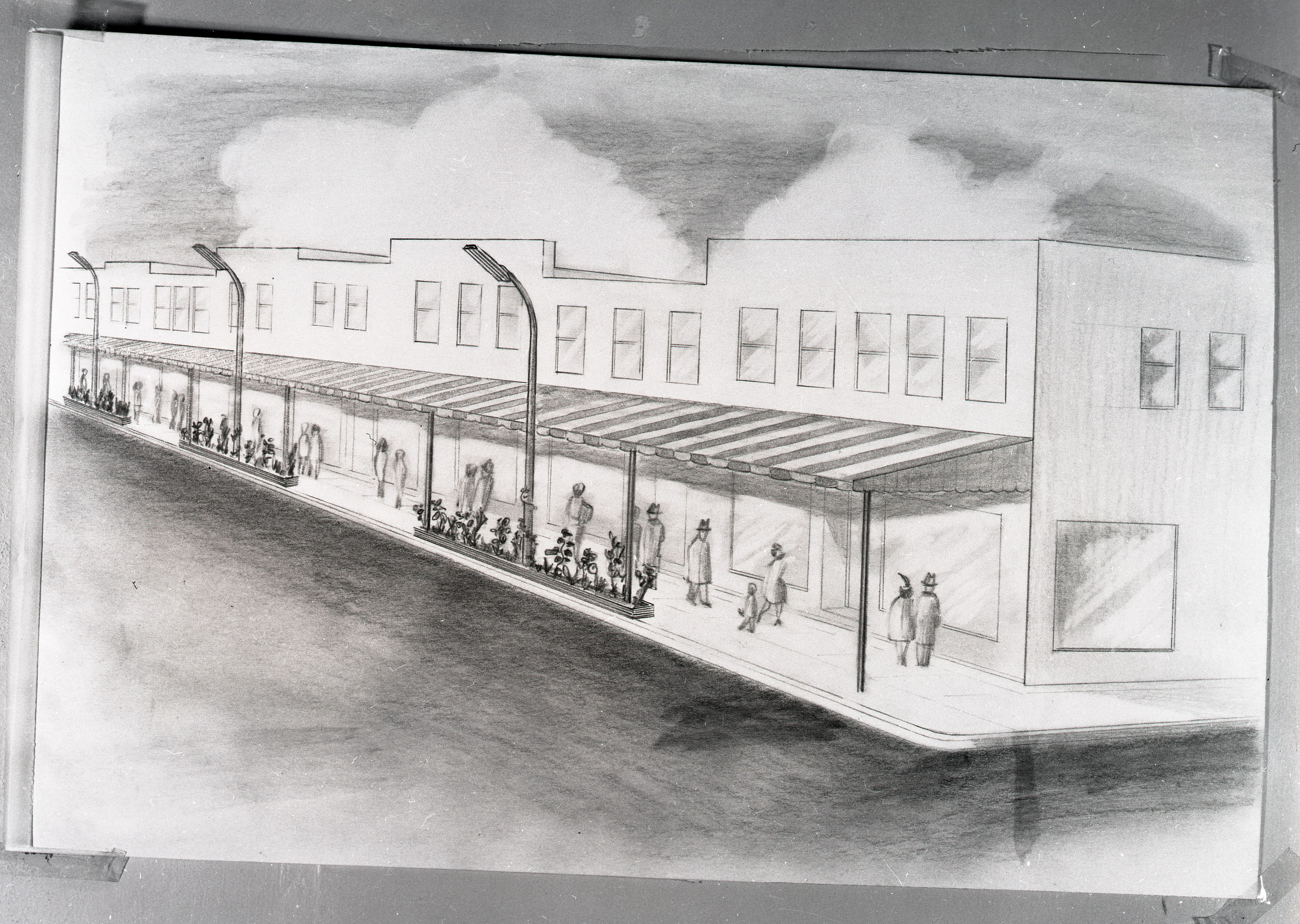
If present plans materialize, shoppers using Midland’s King Street may soon be protected from the elements by a canopy over the sidewalk, like the one in the artist’s drawing above. It is part of a big program of changes under consideration by the Chamber of Commerce and town officials, including new, narrower sidewalks and subsequent wider parking spaces for vehicles. 

Midland Guides and Brownies receive tips from Midland florist Ed Fox as they prepare to plant 1,000 golden tulip bulbs near the cenotaph in Town Park. The bulbs are part of a Guide and Brownie project to mark the 50th anniversary of their movement. 

This was a comparatively dull moment around the skate tables as Midland Home and School Association held its annual skate and clothing exchange last Friday afternoon. Earlier in the afternoon, the scene looked more like the bargain basement at Macey’s as Midland mothers tried to find a pair of hockey skates that would fit ‘Johnny’, or a good pair of figure skates for ‘Mary’. About 100 articles were sold. 
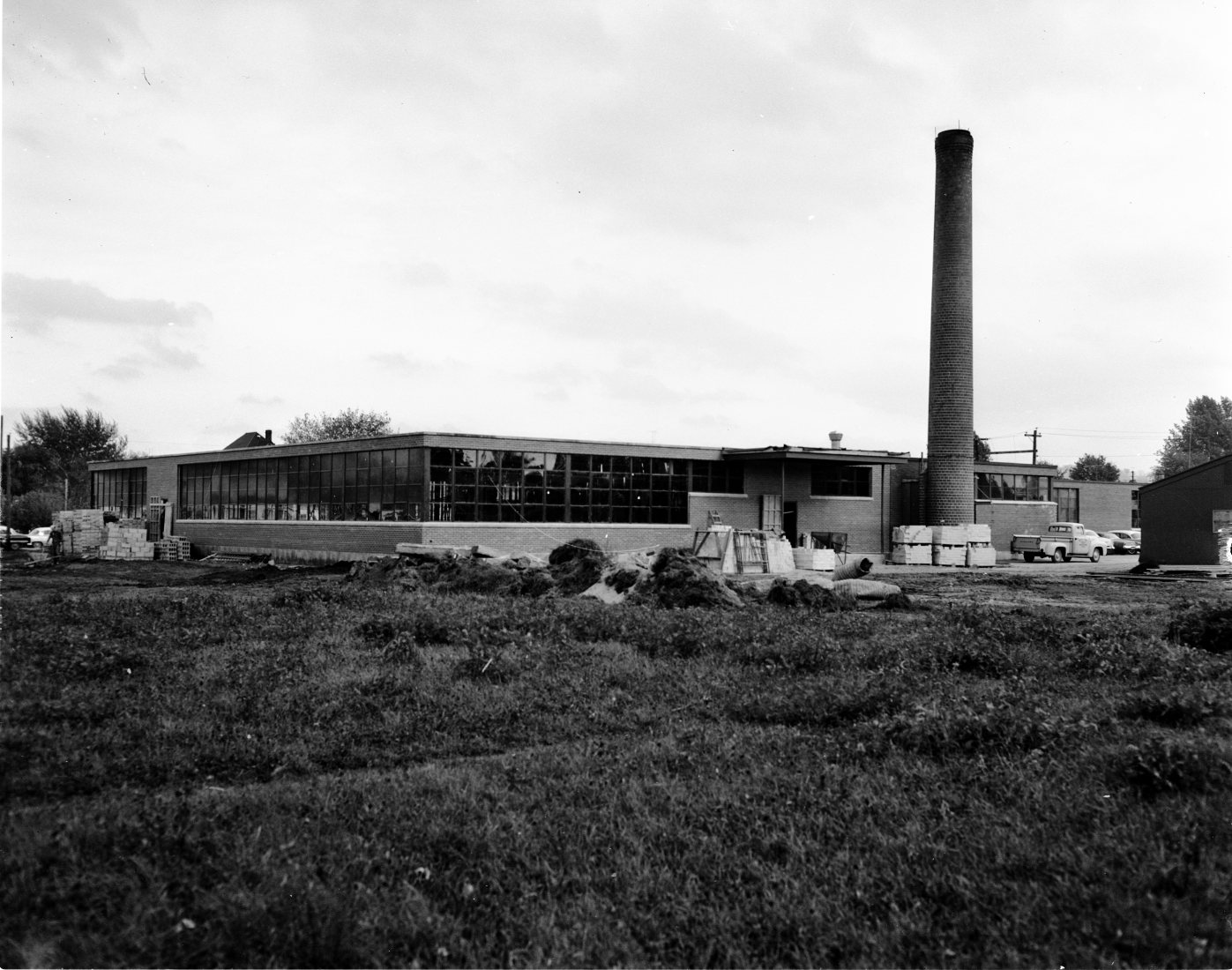
In a few weeks, the new addition to the Midland plant of Bausch and Lomb Optical Co. Ltd. will be ready for operation, according to Larry Curran, manager. This is an overall view of the old and new plants. 
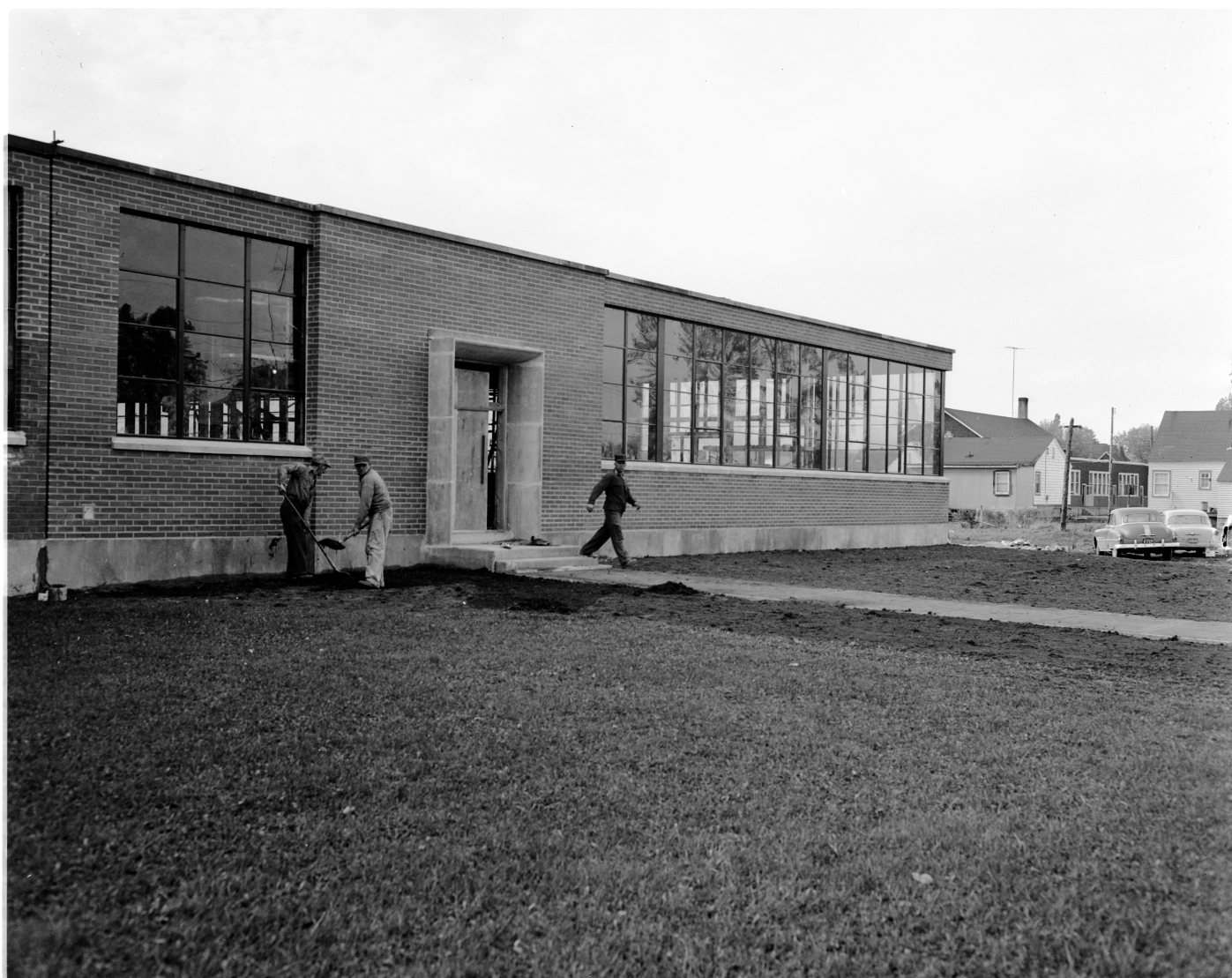
 Workmen are tidying up the front of the new addition, which blends with the front of the first plant, erected about ten years ago. 

Every day sees more progress on Midland’s new Scott Street in the Wireless Hill subdivision. Workmen guide the spout of a ready-mix concrete truck as they pour new curbing on the south side of the street. One new and two unfinished homes are visible in the background. 
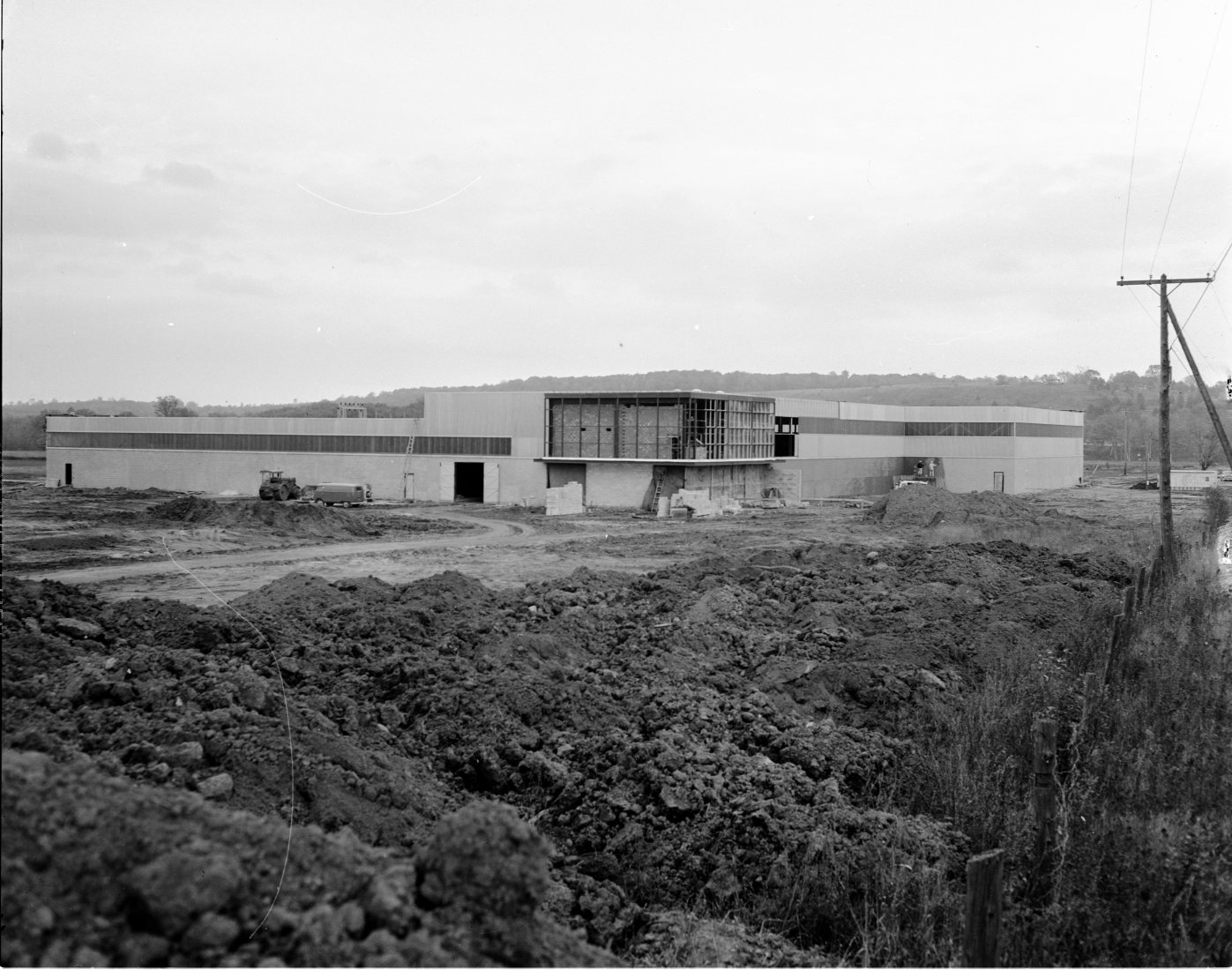
The new B. Greening Wire Co. plant is rapidly nearing completion. This photo gives an idea of the massive size of the new industry, located on industrial property in Midland’s southeastern outskirts, just off Highway 12.

Now in semi-retirement C.G.S. St. Heliers and crew have spent several days this week removing the floating docks in Midland harbour. Here one of the dock sections, towed to the ship by the two men in the barge, is hoisted out of the water. It was swung over to the main dock at the right and piled on top of others. Two sections seen at lower left are to remain in the water all winter. 

Chief George Wainman and Alderman James Mackie, chairman of Midland council police committee, commended pupils, teachers and the home and school association safety project Monday night. Here they cast an approving eye over some of the winning posters. 

  • County Herald headline of October 23rd, 1959; Plan Sweeping Changes for Town Business Area. If present plans under consideration by Midland council and the chamber of commerce materialize, the town’s main street will undergo a tremendous transformation within the next year or two. Net results would be to make King Street one of the most unique and outstanding main streets of any Canadian town or city, it was disclosed at a meeting of the merchants’ committee of the chamber Tuesday night. Under consideration by the chamber is the installation of a covered sidewalk, probably of plastic material, on both sides of King Street, from Elizabeth to Bay. This, of course, will require the co-operation of all property owners concerned in the two blocks. At the same time, town officials present said the council is considering the removal of two feet from the sidewalk width on each side of King Street. This, in effect, would widen the travelled portion of King Street by four feet and permit the continuance of angle parking.
  • Midland Free Press headline of October 28th, 1959; Report of Rail Closing Unfounded, Says Agent. Frank E. Whiteman, Canadian National Railways agent at Midland, said consideration is being given to closing a portion of the Midland subdivision of the CNR; but it is not the part of the subdivision between Midland and Orillia. Whiteman said it is the section of the line between Atherley and Lorneville that is now under question. In Midland at present, the CNR employs more than seventy men.
  • County Herald headline of October 30th, 1959; Assessment in Midland up $156,613 for 1960. Midland assessor Ian McLung revealed yesterday that the town’s total taxable assessment for 1960 is $165,613 more than the 1959 figure. Mr. McLung said that, as of Sept. 28 this year, the total taxable assessment amounts to $7,586,995. Included in this figure are the October and November additions to the tax roll for 1959 and assessments for 1960. He explained that in addition there is $45,510 in assessment on which school tax only is paid. This represents the fixed assessment granted Ernst Leitz Canada Limited, which expires in December 1962. Mr. McLung also revealed that the population of Midland had increased. As of Sept. 28 there were 8,402 people in the municipality compared with 8,356 in 1958.
  • Improved lighting for the main highway entrances to Midland came a step closer Tuesday evening when Midland Public Utilities Commission authorized the purchase of 67 mercury vapour lamps complete with ballast, lamp and bracket at a cost of approximately $7,800. The new lamps, which will give approximately five times the amount of light of the present fixtures, are to be placed on King Street south from Yonge Street to the town limits; from King and Yonge Streets west on Yonge to the town limits, and from Bay and King Streets west on Bay and north on Fourth Street to the town limits.
  • Penetang Police Chief  Jack Arbour admits he experienced no difficulty when called to discover the whereabouts of six cartons of popcorn, missing from a freight car at Penetang. The sealed car had been broken into sometime Sunday as it sat on a siding. Chief Arbour said it was quite a simple matter to follow the trail of popcorn from the boxcar to the home of six children where a number of empty boxes were noted lying outside the door. The six children, aged from 6 to 15 years of age, were all members of one family and will appear in juvenile court on charges being laid by the railway.
  • BIRTHS – BAZINET  – Mr. and Mrs. Joseph Bazinet, 53 Chatham St. Penetang, at St. Andrew’s Hospital, Midland, Sunday, Oct 18, 1959, a daughter, stillborn. BRASHER — To Dr. and Mrs. Peter Brasher 279 Sixth St. Midland at St. Andrews Hospital, Friday, Oct 23, 1959, a daughter. BREMNER— To Mr. and Mrs. Alvin Bremner 306 Second St. Midland, at St. Andrew’s Hospital, Tuesday, Oct 20, 1959, a daughter. COPECOG— To Mr. and Mrs. Willis Copecog, Christian Island, at St Andrews Hospital, Midland, Sunday, Oct 25, 1959, a son. CRUISE — To Mr. and Mrs. Lloyd Cruise, 255 Charles St., Midland, at St Andrew’s Hospital, Tuesday, Oct 20, 1959, a son. DENIS — To Mr. and Mrs. Joseph Denis, Midland, at St. Andrew’s Hospital, Midland, Saturday, a daughter. DONALDSON — To Mr. and Mrs. Norman Donaldson, Manley St. Midland, at St. Andrew’s Hospital, Tuesday, October 20, 1959, a daughter (Happy Birthday Victoria). EDWARDS—To Mr. and Mrs. Verne Edwards, 107 Elizabeth St., Midland, at St. Andrew’s Hospital, Friday, October 23, a daughter. FAGAN — To Mr. and Mrs. John Fagan, Midland, at St. Andrew’s Hospital,  Sunday, Oct. 18, 1959, a son, the baby died. GILBANKS—To Mr. and Mrs. John Gilbanks, 268 William St. Midland, at St. Andrews Hospital, Sunday, Oct 18. 1959, a son. HENDERSON — To Mr. and Mrs. William Henderson. Ninth St., Midland, at St. Andrews Hospital, Sunday, October 25, 1959, a daughter.
  • TEN YEARS AGO THIS WEEK – Midland Chamber of Commerce announced it would make a full-scale industrial survey of the Midland district. The survey was to include a study of employment prospects in each local factory, preparation of a list of available industrial premises for rent or purchase, and a list of possible industrial prospects. * * * The St. Heliers, in command of Capt. J. C. Patchell made a mercy trip to Hope Island with Dr. T. J. Johnston on board. The trip was in response to a distress call that the radio operator at the light station was in severe pain. The radio operator was returned to Midland and St. Andrews Hospital, where he was operated on that same day. * * * Members of Penetang Lions Club announced they planned to organize a band for boys 12 to 18 years of age. The club had asked Penetang council to assist the project financially. * * * The CSL tug Bayport got into difficulties while towing a 90-foot scow from Midland to Wiarton. High seas in the bay off Meaford snapped the tow line three times and several times the scow nearly rammed the tug. The third time the line broke; the scow drifted away and finally ran aground on the shore seven miles west of Meaford. * * * Norman Marchand, Penetang R.R. 3, was awarded the V. G. Edwards trophy as champion potato grower of the Lafontaine senior field crop competition for 1949. * * * A hen owned by a Medonte farmer had hatched a brood of seven chicks in a thicket at the edge of one of his fields. The day the chicks were born was one of the coldest of the fall. * * * Dominion Stores Ltd. had officially opened a new supermarket in Penetanguishene. The shopping area had 2,624 square feet.
  • JAMES PLAYFAIR – A 12-dollar-a-month lumber company employee became head of a lake shipping company. By W. R Williams                      James Playfair was born in Scotland and arrived in Toronto as a boy with his parents. In 1880, at 19, he became a 12-dollar-a-month employee of the Toronto Lumber Co., which had large timber limits in Simcoe County and mills at Collingwood. He began living in Midland in 1883, and in 1888 formed a partnership with his friend, D. L.  White Jr.  Lumbering contracts were the first activity of this partnership, but Mr. Playfair branched out in 1896 by entering the grain trade between Port Arthur and the lower lakes. He bought an 11-year-old wooden freighter, rebuilt and renamed her St. Andrew in honour of the patron saint of his native Scotland. Four years later she became a total loss on Lake Superior.   In 1901 Playfair and White incorporated the Midland Navigation Co., which had the steel canaller Midland Queen built in 1901 at Dundee, Scotland. They had the 366-foot Midland King built at Collingwood in 1903 and the 486-foot Midland Prince built there also, in 1907. With the operational profits from this company, Mr. Playfair in 1912 began buying old American steamers and formed his Great Lakes Transportation Co. The 324-foot Alva (ex Minetonka) which had been built in 1893, was his initial acquisition. She was given a new paint job and renamed Glenfinnan. Operational profits, as before, were used to buy an additional vessel, and so on, each one being given a new name with the prefix ’Glen’. All of them had their hulls repainted light blue-grey with white cabins and rose-red stack with a black top.    A shortage of saltwater shipping existed after World War I and in 1918 Playfair and White established the Midland Shipyard along with D. S. Pratt and W. J. Sheppard. It launched the following four steel steamers to fill government orders: War Fiend, Oct 24, 1918; War Level, May 1, 1919; War Fury, Oct. 16, 1919; Canadian Logger, June 8, 1921. With Midland Shipyard in successful operation, Mr. Playfair decided to build steamers there for his Great Lakes Transportation Co. fleet, instead of buying old American vessels. The following steamers were accordingly launched. Glenclova, Nov. 27, 1920: Glenelg, May 12, 1923; Gleniffer, Nov. 18, 1924: Gleneagles, August 26, 1925: A. M. German (tug), Nov. 4, 1925: Lemoyne, June 23, 1926; T. J. Scott (scow), July 19, 1927; City of Montreal, January 12, 1927.   (There appear to be some vessels missing from this list.) In 1925, Mr. Playfair organized a new company, the Great Lakes Navigation Co., which included all vessels purchased, as well as those built by Midland Shipyard. In 1926 he sold all his vessels to Canada Steamship Lines Limited. All told he had 38. There were nine canallers in Glen Line Ltd., six in Glen Steamship Ltd., and the remainder had been in Great Lakes Transportation Co. Ltd. They were sold with the understanding that one of them, the 582-foot Gleneagles should retain her christened name. For 34 years of busy and trouble-free service her name in vessel passage lists has reminded us of “The Playfair Fleet” and the days when Midland was very busy with grain and coal cargoes.
  • An extension will be added to the Bell Telephone Company’s building at Hugel and Midland Avenues this winter to provide additional space, for equipment needed to expand and improve telephone service here.
  • Two years after their last expansion. Penetang Bottling Co.’s Main Street plant again started bulging at the seams, and another addition has been started. Under construction at the southeast corner of the existing plant, the new structure will be 60 by 32 feet, and the same height as the last section built. It will be used for storage purposes. Mrs. Helen Booth, the proprietor, said the new section will leave for other use, a similar space in the old lower part of the plant. The vacated space will be partitioned off and used as a paint shop for advertising services, she said.
  • In 1957, the most recent year of record, there were 4,076,465 Canadians who paid personal income tax and the average taxable income was $3,834.
  • Although some hunters may be a bit unhappy about it, Tay council’s decision to prohibit the use of firearms in built-up areas in the township, north, west and southwest of Midland’s town limits, is a wise one. The district west of the corporation, especially, and the Sunnyside area have long since past the ‘wilderness’ stage.

Huronia Museum – Looking Back 60 Years in North Simcoe – October 16th to 22nd, 1959

The photos found in this blog post are the property of Huronia Museum, Midland, Ontario. Any reproduction for commercial use without permission is prohibited.  Any other distribution must credit Huronia Museum.  Please contact the museum with any questions you may have.  

Click on photos to enlarge. Another drive for funds for the operation of Midland YMCA gets underway shortly, and the objective this year has been set at $11,000. Long associated with the Midland ‘Y’ and it’s Camp Kitchikewana, J. “Win” Smith (centre above) goes over some of the details of the canvass with James Tully, left, and Charles Walton. 

Football is in full swing at Midland-Penetang District High School, where the junior and senior teams hope to repeat last year’s fine showing. Above, senior coach Doug Swales goes over some strategy with quarterback Romeo Lalonde, left, and fullback John Bell, right. 

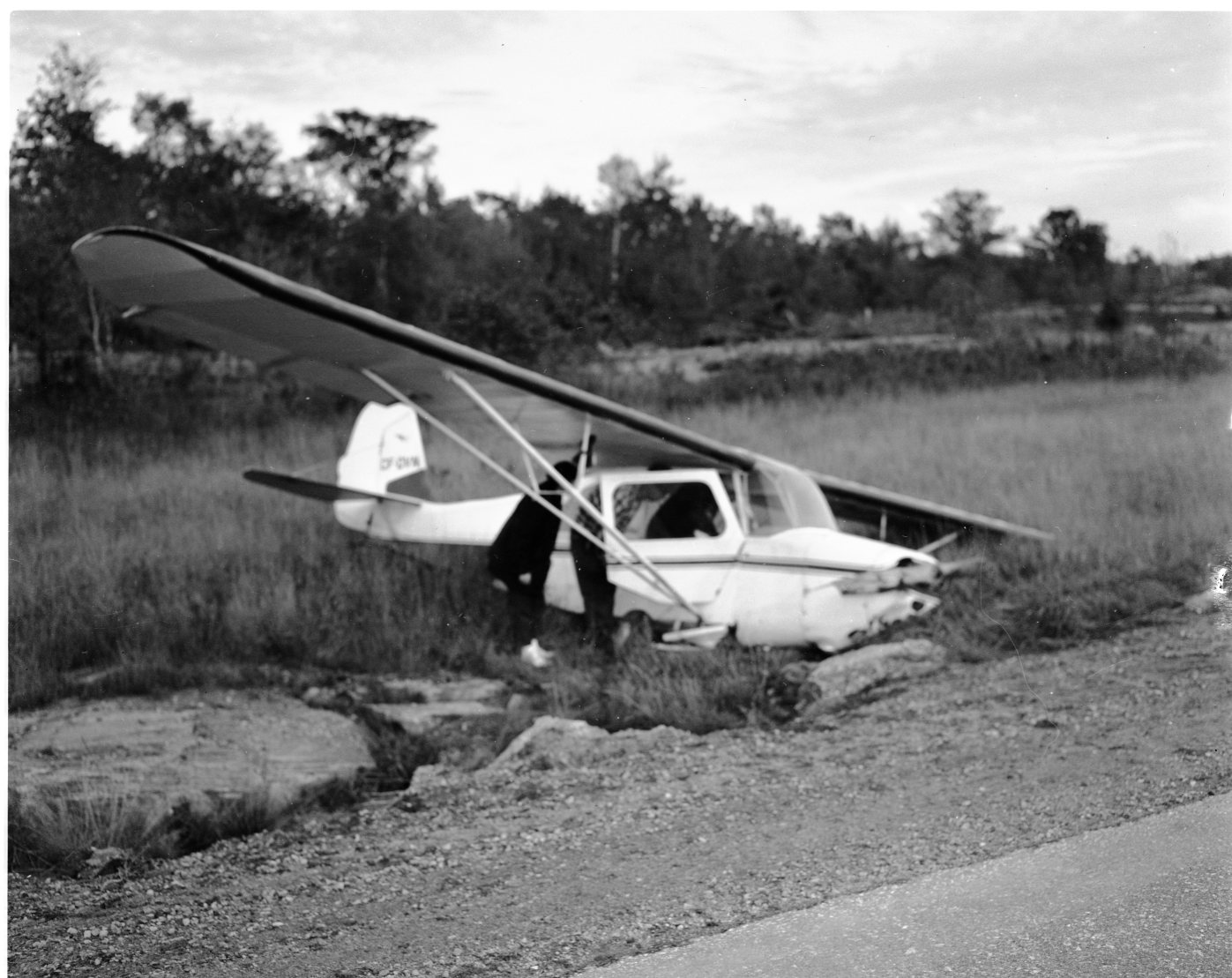
Motorists on Highway 103 were startled to see this light two-seater plane nestling in the ditch, Monday afternoon. Lost en route from Toronto to Muskoka, pilot Lou Roosen of Scarborough decided to come down on the highway and find out where he was. A gust of wind blew the plane off the roadway into the ditch, snapping propeller and undercarriage. 

Strange looking spud held by Aurelie Quesnelle, Penetang, came from one of Edmond Marchildon’s fields near Lafontaine. The Sebago variety, it tipped the scales at three pounds, seven ounces. 

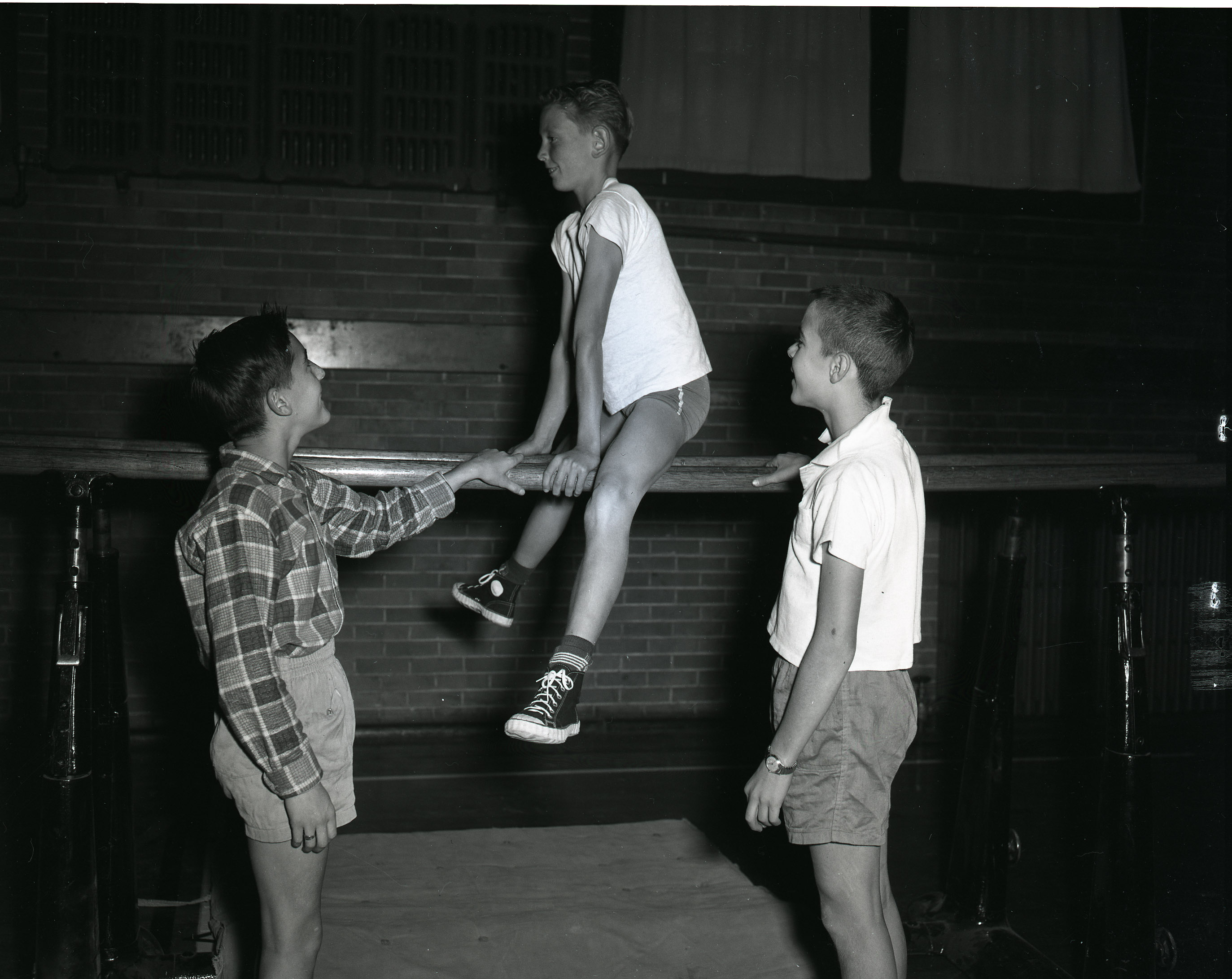
There’s activity for all ages at Midland YMCA, with the accent always on youth. Allan Cornell, left, and Gregory Somers watch Chester Graham perform on the parallel bars. It’s all part of the National YMCA Hi-Lo athletic competitions.

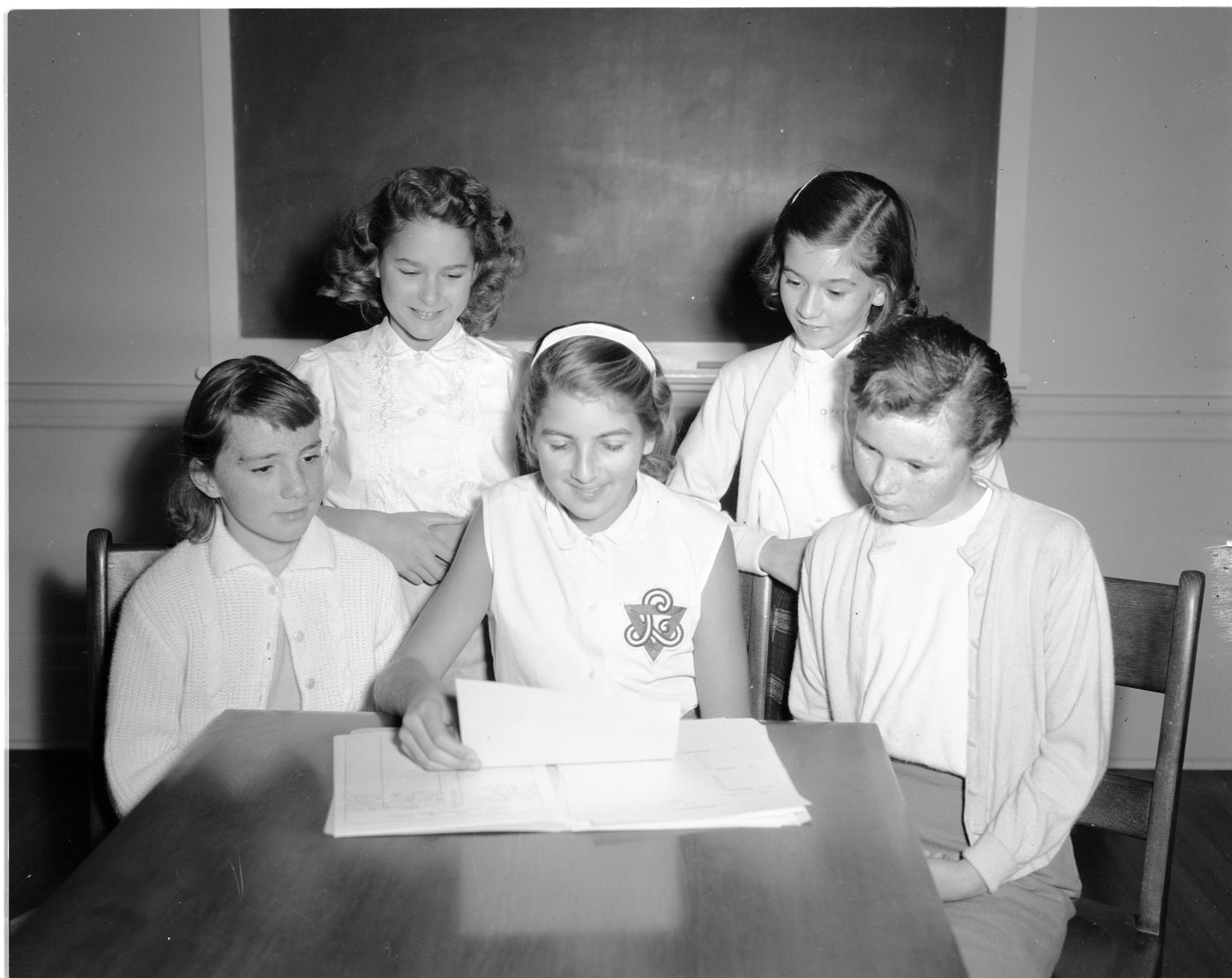
New members of Midland YMCA’s junior leader corps go over this year’s program with Wynne Gilmore, who has had two years’ previous experience in the work. Girls are, left to right, front row, Glenda Roduck, Wynne Gilmore, Judy Wilson; back row, Carol Launder and Judy Fitzgerald. Glenda Stewart, another junior leader beginner, was absent when the picture was taken.

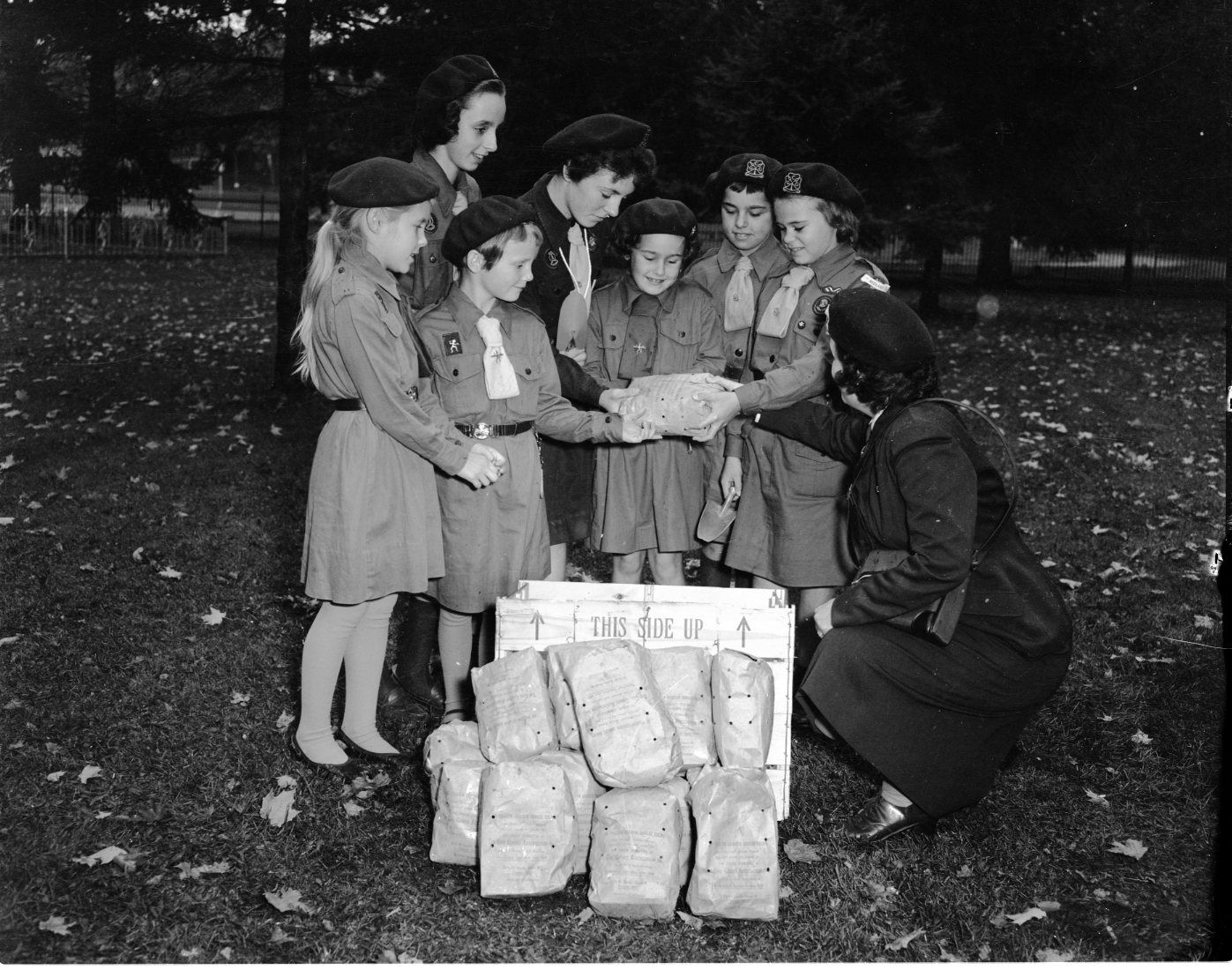
Marking the 50th anniversary of the Girl Guide movement in Canada next year, Guides and Brownies across the country are preparing a “river of gold” in tulip beds for next spring. Above, Mrs. J. E. Lawlor, district commissioner, distributes some of the 1,000 Holland bulbs to Midland Guides and Brownies for planting in a special bed near the cenotaph. Girls are Gail Lethbridge, Melanie Dyer, Vicky Guardhouse, Karen Greisbach, Marie Laughlin, Mary Ellen McCormick, Julia Ann Farewell. 

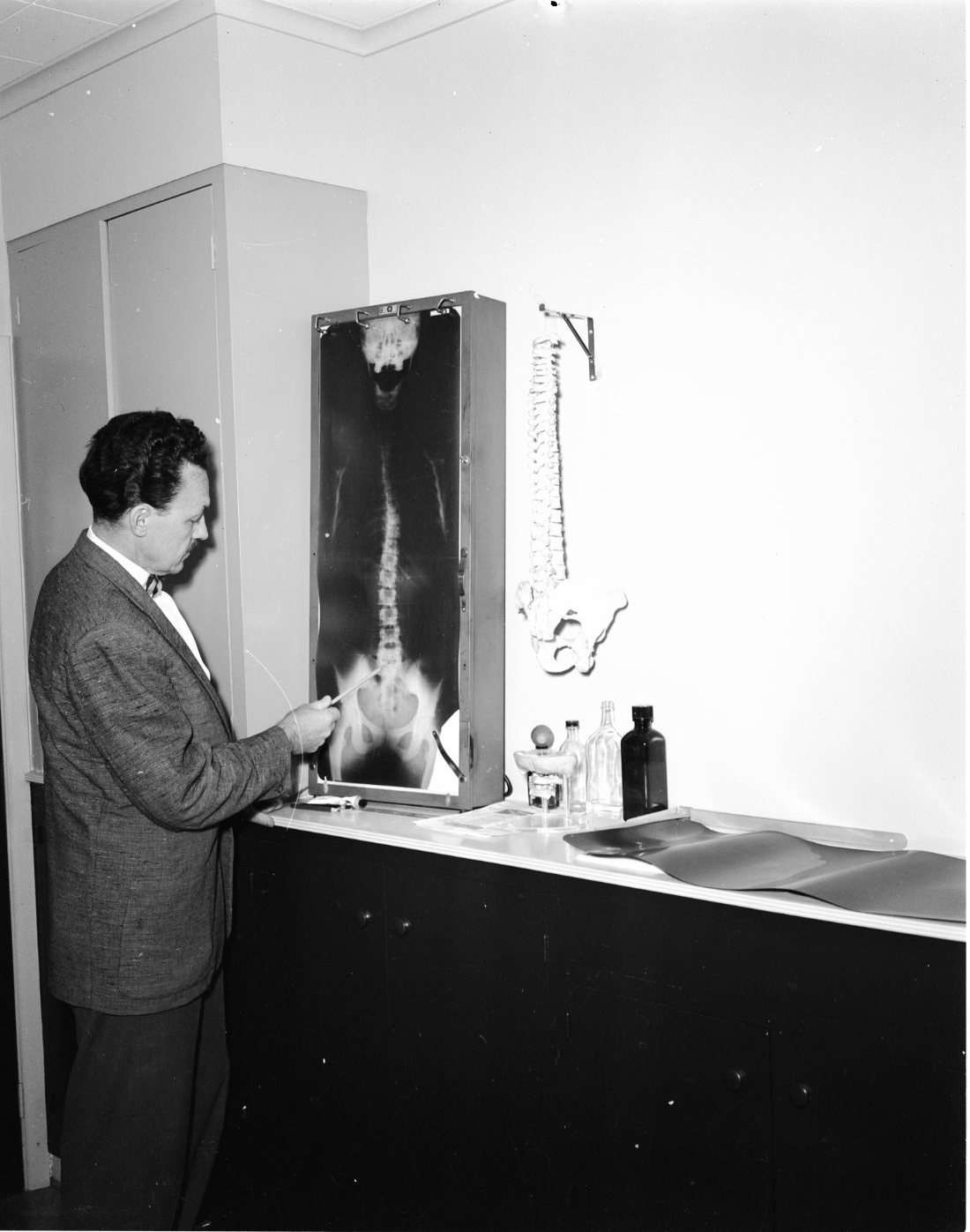
Modern chiropractic practices utilize many types of highly specialized equipment for the diagnosis and treatment of illnesses. At left, K. S. Lewis examines a print taken by the modern X-ray machine. All developing and printing of the pictures are done in laboratory and dark rooms located right in the building. This print is from a case in which the compensation board is interested. 

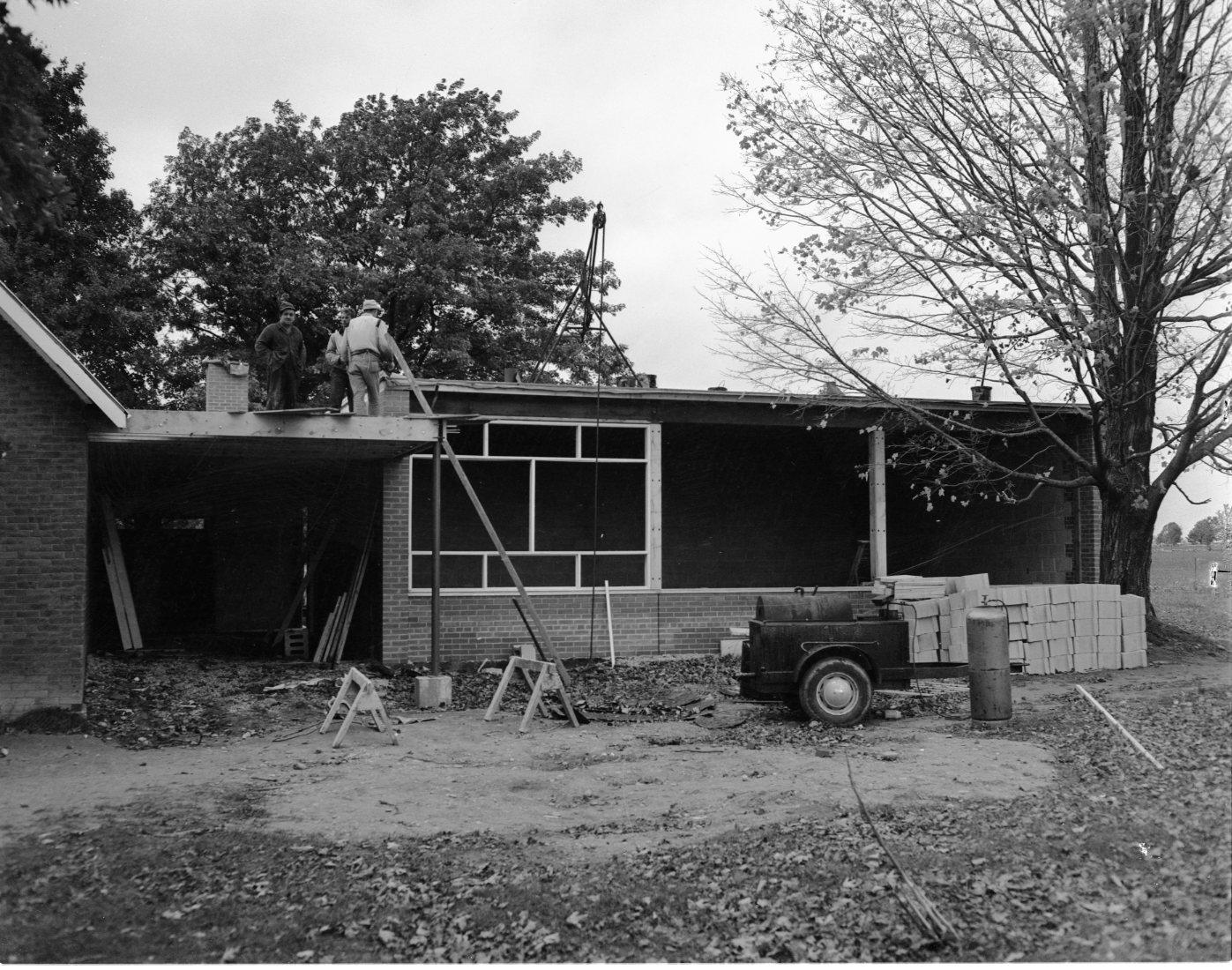
Big transformation has been effected in the appearance of the old town-owned band hall at the corner of Dominion and Midland Avenues. Now the offices of Kenneth S. Lewis, doctor of chiropractic, it will be the scene of an open house today. Two new apartments have been completed on the second floor. 

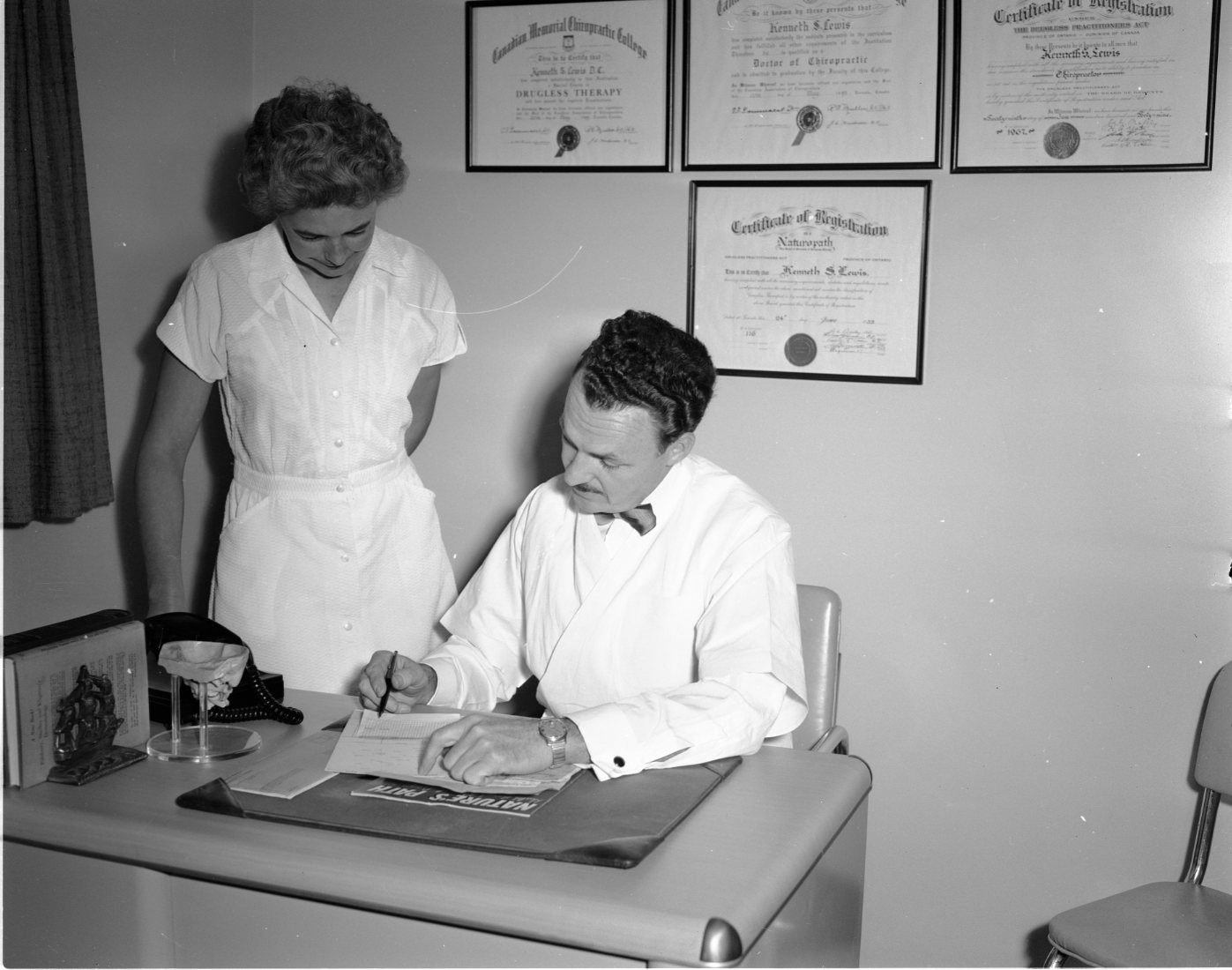
While preparing for “open house” today, the daily routine must go on. Here, K. S. Lewis, doctor of chiropractic, and his secretary, Mrs. Jeanne Keitel, go over the list of appointments.

  • Man Finds Nitro Cache, Believed Left by Yeggs; County Herald headline of October 16, 1961. Charles Trilsbeck, a labourer, considers himself be the luckiest man in Penetang today, if not in the whole world. Yesterday afternoon, he learned that a bottle he found under the corner of a barn, which he had handled somewhat roughly, contained nitro-glycerin. Trilsbeck was cleaning up around a barn owned by Mrs. W. Marchand, Main Street. S., Penetang, when he dug up the bottle with a pitchfork he was using. The bottle was wrapped in a handkerchief at the time and before he got it unwrapped; he dropped it on the ground. Besides the bottle, he found a cotton work glove in which was stuffed four detonating caps and a quantity of insulated wire. Mr. Trilsbeck took his find to the nearby Marchand Service Station and unscrewed the cap from the bottle in an attempt to discover what the white substance was. It wasn’t until another man saw the detonating caps that they decided it was nitro. The battle held about an ounce and a half of the highly explosive fluid.
  • Transport Board Letter Hints at Rail Closing; A letter, originating in the office of the secretary of the Board of Transport Commissioners for Canada and received by Tay Township council last week, has caused some consternation in North Simcoe municipal and business circles. The letter is the outcome of a request by Tay Township for automatic signals at a crossing between Port McNicoll and Victoria Harbour on Highway 12. Part of the letter read; “Since consideration was being given to the closing of this sub-division, all those present agreed that the matter of providing protection at this crossing should be held in abeyance for the present time.”
  • Son of Mr. and Mrs. Lloyd H. Kleist, 363 College Street, Midland, John Richard Kleist died in Zweibrucken, Germany, yesterday morning. The young airman, who was serving with No. 3 Fighter Squadron, and a companion were critically injured in a motor accident. They were travelling in a private car. His wife, whose family lives in Edmonton, was in Germany with him. She is expecting a child soon. A brother of the fatally injured man is serving with the RCAF in Ottawa.
  • 25 Years Ago This Week – A doe and two fawns spent a day in Midland munching on produce in gardens in the Yonge Street East and Manley Street area. One of the fawns became entangled in a fence and had to be released by a provincial police officer. * * * Mild temperatures in October brought a fresh crop of strawberries and raspberries and in the Lafontaine area Maurice Marchand reported that a Duchess apple tree on his farm was “loaded with blossoms“. * * * Mrs. Harvey Fallis of Vasey had several king-sized tomatoes in her garden. One of them weighed two pounds, nine ounces and measured 19 inches in circumference. * * * Following a series of serious accidents; the Ontario government had employed a crew of men to cut down and remove trees and other obstructions to vision at Firth’s Corners.* * * Three Midland children whose parents had refused to have them inoculated at public health clinics, had contracted diphtheria. The clinics were held in the district after a severe outbreak of the disease occurred in Penetang. * * * The annual meeting of St. Andrews Hospital was informed that the hospital had incurred a $1,550 operating loss on the year in spite of cuts in insurance, staff salaries and other expenses. * * * Midland women decided to organize a branch of the Ladies Auxiliary to the Canadian Legion. An organizational meeting was held October 17th and the charter and installation of officers was to be held Oct. 30. * * * Deluxe series of new model cars were being offered in Midland at $844, the standard models were being sold at $710. Neither price included tax.
  • A fire drill was held at Port McNicoll Public School, Oct. 16 under the supervision of Lyall Thorpe, principal, and Lloyd Cameron, Port McNicoll Fire Chief. The drill came as a complete surprise to the pupils and teachers and the entire building was cleared in less than 40 seconds, the windows and doors were closed and both basements and washrooms were checked by two older pupils. There were 207 pupils attending school the day the drill was held.
  • by JOSEPH LEA In the early days, the main business around the Orr Lake area was logging. The railway, which had been built to connect Elmvale and Hillsdale, passed through Orr Lake and built up a thriving business, for the little community. Thousands of logs were cut, hauled to the lake and piled on the ice at what was known as Nixon’s dump. It was located on the south side of the lake on Lot 6, Flos Township. With the advent of the sawmills, cottages and shacks were built as fast as the lumber could be cut. Eventually, there were some 40 to 50 buildings, including stores, taverns, and even a schoolroom. The latter was located in Sam Reid’s store. Maggie Carruthers was one of the early teachers, among others. The same room in Sam’s store, was the scene of church meetings, too. One sponsor was Miss Paulin, who later became Mrs. J. L. Archer. Salvation Army also held meetings there. The tramway built in 1879 was actually the North Simcoe branch of the Northern Railway. It stopped first at a large mill on Lot 70 of the old survey of Flos. Later it was extended to include other mills built nearer the Penetang Road. Some of these mills were: Shaw’s Mill, at the west end of Lot 79; Orr’s Mill, near the old Penetang Road; Hayes’ Mill, back of what is now Farmer’s General store; Cook’s Mill, another large and busy mill near the Penetang Road (now Highway 93); and in the 1870’s, a small shingle mill, built by Aaron Sheffield and Jim Gunn of Hillsdale. It ran for only a short time. There was also another mill, just south of the new dam at Orr Lake, which operated for a short time in the 80’s. Principal markets for the products of these mills were Barrie and Stayner. Orr Lake was a sports-minded community in the old days, with horse racing on the ice in winter and the best of fishing in the summer. Thousands of acres of poor, sandy land that once grew the huge, lofty old pines to feed the mills are now growing young trees again for some future crop.
  • PENETANG citizens apparently will have no cause to worry about the structural strength of the roof of the Memorial Community Centre this winter, according to information presented at Tuesday night’s meeting of Penetang council. A communication from Engineered Timber Products, a branch of A. S. Nicholson and Son, manufacturers of the trusses used in the rink, outlined work the firm is prepared to do in connection with deficiencies found in the structure. According to the letter, the company will commence work Nov. 2, which will require approximately two weeks to complete. They will work only during daylight hours so as not to interfere with night use of the ice surface. While the National Building Code today calls for a roof design capable of carrying a snow load of 65 to 70 pounds per square foot, this was not so at the time trusses were built for the Penetang structure, it was stated. Trusses supplied by A. S. Nicholson for the Penetang job were designed for a snow load of 40 pounds per square foot, and in its letter, they stated they are prepared to take all responsibility for the building up to that limit. In addition to the work they have outlined, which they are prepared to carry out at their own expense, the company will make a proposal for reinforcing the blank east wall of the building which has caused considerable concern to inspecting engineers. They said they propose to install a reinforcement framing for the wall.
  • Midland and Canadian National Railway police are investigating the theft of $1,500 worth of cigarettes and tobacco from a CNR boxcar over the weekend. Chief George Wainman said the seal on the car, standing near the CNR freight sheds, was intact at 1 p.m. Sunday. It was not until 9 a.m. Tuesday, following the Thanksgiving holiday, that railway workmen found the seal had been broken. Chief Wainman said that, after unloading the car, CNR officials found 10 cases of cigarettes and one case of tobacco were missing. They were consigned to Nap Laurendeau, a Midland wholesaler.
  • Ronald Gosselin, 13, of Midland escaped serious injury when struck by a car on Hugel Ave. as he was riding his bike home from school at noon Thursday. Police said the driver of the car involved was Langford Truax, 45, of Sunnyside. Mr. Truax had apparently passed Ronald and several other children on bikes as he drove east on Hugel Ave. When the car slowed down to make a right turn on to a side street, Ron’s bike became wedged between the car and the curb.
  • BIRTHS – DELL — To Mr. and Mrs. Robert Dell, 146 Bay St., Midland, at St. Andrews Hospital Sunday, October 11, 1959, a son. FISH —To Mr. and Mrs. Edward Fish, 57 Bay St., Midland, at St. Andrews Hospital, Tuesday, October 13, 1951, a son. MARKHAM – To Mr. and Mrs. Howard Markham; 247 Bay St., Midland, at St. Andrews Hospital, Friday, October 9, 1959, a son.
  • Obituary – MICHELE (MIKE) TERSlGNI Responsible for the beautiful flower gardens at the CPR docks, Port McNicoll since 1948, Michele (Mike) Tersigni died Sept. 30 following a collapse in the company greenhouse. Mass was celebrated at Sacred Heart Church, Port McNicoll, Oct. 3, with Rev. F. Sullivan officiating. Pallbearers were members of the Knights of Columbus, Raymond Belanger, Jos. Connelly, Ernest Cadeau, Gino Difrancesco, John Hartford and Mose Quesnelle. Mr. Tersigni, who was born in Sora, Italy, July 13, 1898, came to Penetang in 1924 and the following year moved to Port McNicoll. On Oct. 19, 1932, at Midland, he married the former Jean Catalano. He was a member of the Knights of Columbus, The Third Order of St. Francis, and the Holy Name Society. Besides his widow, he is survived by a son Joseph, attending the University of Toronto, three daughters, Mrs. Pauline Reid, Mrs. Rita Higgs and Mary. He is also survived by two brothers, Joe Tersigni of Penetang and John Bell of Port McNicoll, a half-brother, Tony Sarracini of St. Marys, and a half-sister Madelina, living in Italy. Burial was in St. Margaret’s Cemetery, Midland.
  • Hockey gets underway this week for 390 youngsters who so far have signed contracts to play in Midland Lions Club’s Little NHL.
  • by ALEX LAPERE Penetang’s Little NHL League is scheduled to open the season Thursday, Oct. 29 with the first game timed for 6.30 p.m. Juniors and AHL will get underway at 8 a. m. Saturday. Oct. 31. When the committee met Sunday afternoon they were faced with a total of 170 registrations which had to be assigned to teams. Juniors again will have four teams operating on Saturday mornings. Six teams will make up the American League, and heavy registrations in the NHL group will see an increase to six teams.

Huronia Museum – Looking Back 60 Years in North Simcoe – October 8th to 15th 1959

The photos found in this blog post are the property of Huronia Museum, Midland, Ontario. Any reproduction for commercial use without permission is prohibited.  Any other distribution must credit Huronia Museum.  Please contact the museum with any questions you may have.  

Click on photos to enlarge.Willing hands hold old up a crumpled plywood barrier in front of Jory’s drug store, Midland, as a Midland officer and Dr. W. F. Neale assist an elderly woman injured when a car jumped the curb and pinned her against the barrier Thursday morning. Man in the foreground is Jack Valliear of Midland.

Pictured is a good half-ton of Bull Moose, strung up by the heels in Charlie Stewart’s yard on Frederick Street. Mr. Stewart (right) shot the moose while on a hunting trip near Hearst last week with Midland constable Ed. Armstrong. Though he’s never tried it before, Charlie was successful in “calling” this one out of the bush and up a logging trail within shootin’ range. It was the only one they were destined to get a shot at during their stay in the north. 

Brownies, Guides, Wolf Cubs and Scouts from district troops and packs formed the colour party for the annual church parade of North Simcoe youth organization Sunday. Here they are formed up by DSM Jack Brownlee prior to joining the main, procession forming up in the background. Midland Citizens Band led the marchers. 

There were trophies, crests and a big chicken dinner for Midland’s baseball Indians as they held their final get-together of the season at Bourgeois’ dining room Saturday night. Left to right are, front, “Buzz” Deschamp, Ricky Lemieux, Joe Faragher, “Bun” Deschamp, Larry Greene, Court Brailey, and “Red” Nicholls; back row — Jim Lemieux, Dean Healiotis, Fred Rutherford, Murray Yorke, Gord Dyment, Jim Wilcox, Harold Jackson, Brian Lemieux, Ken Hipwell. 

Hundreds of North Simcoe district children paraded to Protestant and Roman Catholic churches in Midland Sunday afternoon to attend special youth services. Explorers, CGIT and their leaders leave Town Park on their march along King Street and Hugel Ave., as the procession moves off to Knox and St. Margaret’s Churches. 

Cubmaster in the lead, this Wolf Pack steps out smartly as the procession moves off to Knox and St. Margaret’s Churches. 

Tossing the basketball through the hoop is one of six events in the National YMCA Hi-Lo athletic contest being carried out at Midland ‘Y’. Paul Downer tries his skill under the basket. Paul and Lynda Duggan have 12 of the points necessary to win a National Hi-Lo crest. 

Long awaited addition to Mountain School, S.S. 16, Tiny is expected to be ready for classes around the first week of November. Workmen are putting the roof on the new structure. Some renovations are also slated for the old school and the new entrance will be between the two buildings. The school has around 40 pupils, with two teachers on staff. 

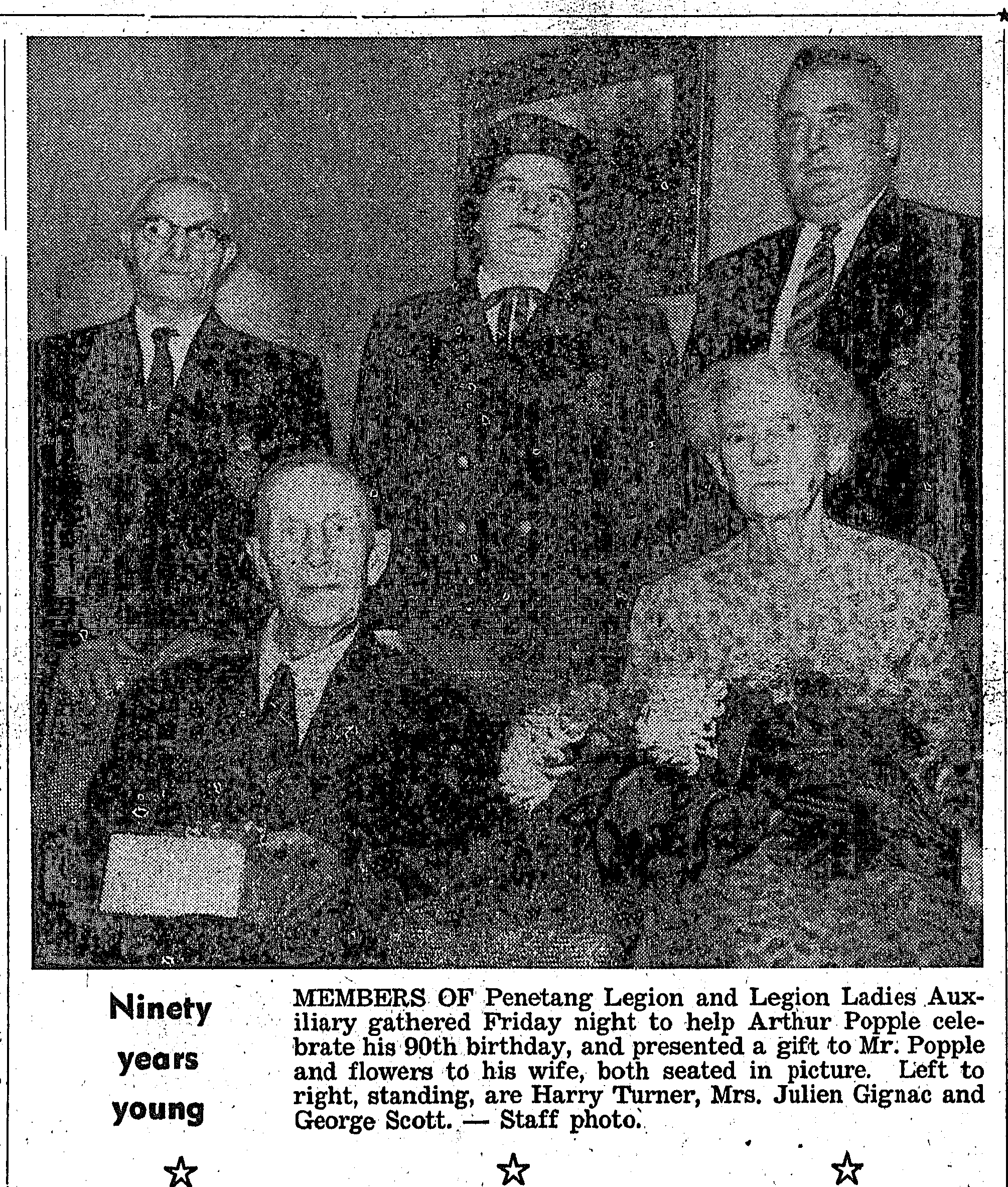
Friday, as he celebrated his 90th birthday, Arthur Popple, Penetang, sat in the living room of his daughter’s home recounting anecdotes of both the Boer War and World War I as though they were events which took place only yesterday. Mr. Popple was talking to members of the Penetang branch of the Canadian Legion and Ladies’ Auxiliary who had come to present a gift to him and flowers to his wife. Arthur Popple was a charter member of Penetang Legion, and is now a life member. Born in England, Mr. Popple was apprenticed to a draper. “That’s the dry goods business to you,” he quipped. He started out to serve his apprenticeship in South Africa, and finding spare time dragging on his hands, he joined the militia. “It wasn’t the same as you do today,” he said. “We really worked at it with drill several nights each week.” About a year later, he was told unceremoniously one morning that he was in the regular army, and was ordered to report immediately for duty in the Boer War. He told of being bottled up for long periods in various locations, with little to do but sit and wait. It was at these times his superior officers would send him to various units to entertain the men by singing. He recalled meeting one man in St. James’ on-the-Lines Cemetery who remembered his singing in South Africa. When he was discharged and finally returned to the store in which he had been employed, he was agreeably surprised to receive an envelope containing pay from his employer for the entire 18 months he had spent in the army. During his stay in South Africa, he made several trips home to England to visit his relatives. He remembers that on one of these occasions he took passage on a freighter which was going to England by way of Australia, New Zealand and the Suez Canal. We didn’t know exactly what ports we would be calling at, for this ship would carry cargo to one port, and receive instructions there to go to another. The Journey ended four months after he had left South Africa. Finally tiring of South Africa,  Arthur Popple returned to England where he spent some time before deciding to try his luck in a new country called “Canada.” He and his close friend, Gilbert Milton, arrived in Toronto 48 years ago — “a couple of hicks from England who hadn’t the foggiest notion what they were going to do. “Old Gilbert and I walked out of the Union Station and wondered what we were going to do in this new land. As we wandered along the street, I saw an employment office and asked if there were any jobs. The man said we could have one in Penetanguishene if we got on the train the next day. Because he couldn’t remember the name of the place they were to go, Arthur Popple and Gilbert Milton probably became citizens of Canada in a shorter time than most people. At Union Station the next day, they were trying to buy tickets for “Penang” or some such place, when a stranger took them in tow. This man finally figured out they wanted to go to Penetanguishene, and after assisting them in this way, took them to his office where, after asking a few questions, he declared they were Canadian citizens. On arrival in Penetang, the pair discovered the job was connected with the Breithaupt Tannery, and neither wanted to have anything to do with it. However, they were prevailed upon to stay and worked for some time piling bark in the yard. Eventually, they heard there was a great exhibition taking place in Toronto, so they went to see it. At the conclusion of their visit there, they headed for Western Ontario where they worked for a time. Then Arthur decided to return to Toronto where he obtained temporary employment. However, Penetang must have gotten into his blood, for it wasn’t long before he returned and secured a job in the stove foundry. When World War I came along, Arthur was one of the first to enlist, serving with the Canadian forces throughout that conflict. After discharge, he returned to Penetang where he had left his wife and family. He continued in his job at the stove foundry until his retirement about 20 years ago. Arthur Popple took an early interest in the historical aspects of the Garrison Church, and there are few people in Penetang who can recall more of its history than he. His interest led him to “Lines” cemetery, and on this, he is almost an authority. Following his retirement, he spent a number of years as caretaker of the church and cemetery. He recalls with pleasure the time Viscount Alexander came to visit this area. Rev. R. L. McLaren called me and asked me to meet the Viscount, as he couldn’t be there himself. Lord Alexander was scheduled to spend five minutes there, but I got him so interested he spent more than 25 minutes and would have stayed longer had not some other officials arrived and reminded him of other places he was to visit,” Mr. Popple said. Possibly a part of Mr. Popple’s love of garrison history stems from the fact that he lives in one of the old pensioner’s homes — a log cabin “on the lines,” better known as Church Street. Mr. Popple has been married twice, his first wife having died about 26 years ago. She was an English girl he had met during his stay in Toronto. The couple had five children, four of whom are still, living: Arthur of Weston, Robert and Thomas of Penetang and Nellie (Mrs. Vic Grigg), also of Penetang. Another daughter, Rose (Mrs. Norbert Marchildon), died in Penetang several years ago. There are nine grandchildren and one great-grandchild. Arthur Popple married his present wife, the former Mrs. Jas. Thompson, about 19 years ago, and the couple still maintain their own home. As the Legion group prepared to leave, Mr. Popple reminded them that Nov. 11 would soon be here. “And I’m looking forward to being with you then,” he said. 

The first member of Midland YMCA to complete the six events of the National YMCA Hi-Lo athletic contest, Nancy Higgs shows considerable promise as a high jumper. Watching Nancy go through her paces at left are Carol Launder and Pam Ellison. To date, 65 boys and 11 girls of the local ‘Y’ have participated in the contest. 

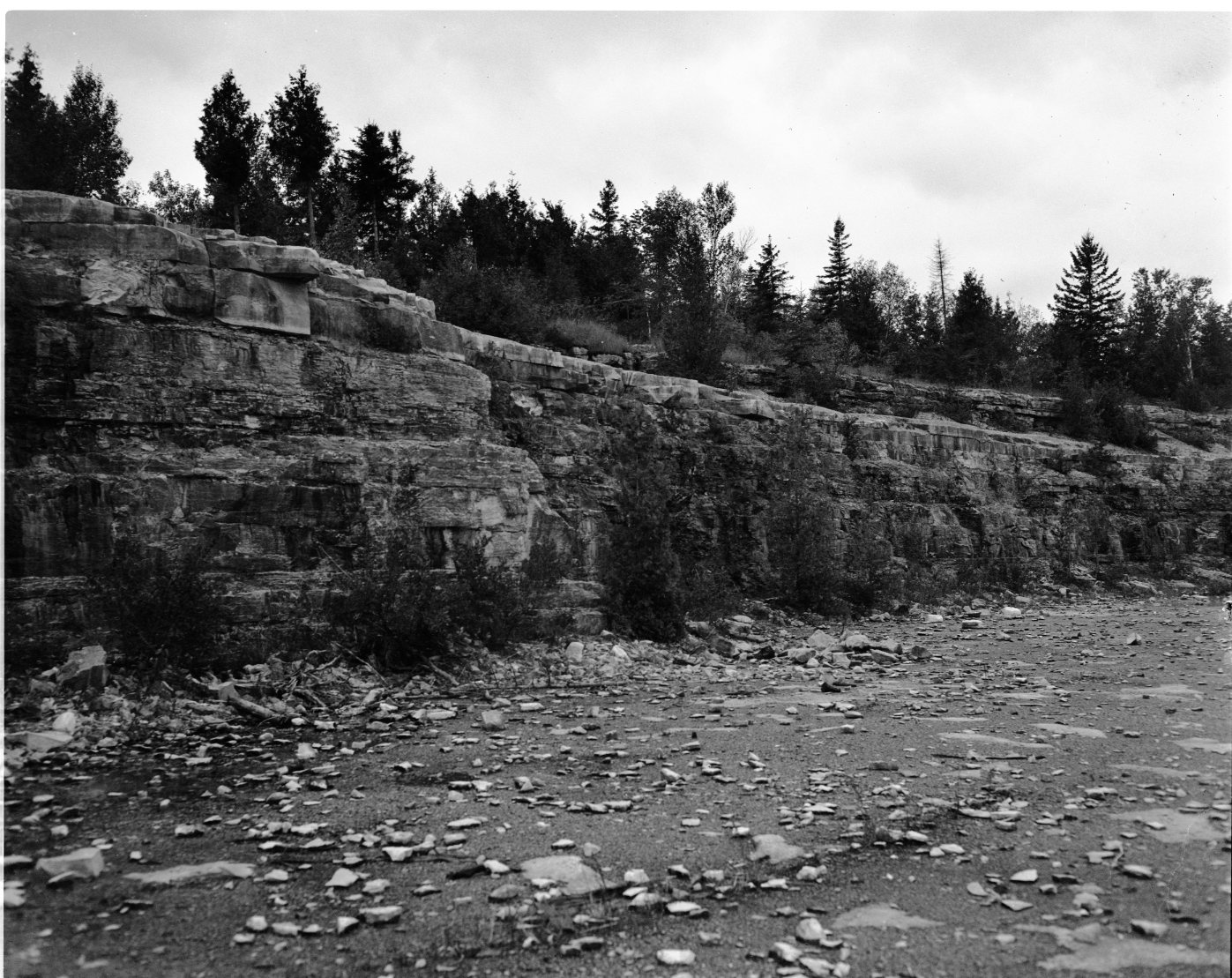
Almost forgotten by even the oldest residents of North Simcoe is the old stone quarry at Port McNicoll. The area was once known as “Flat Point” because the huge, flat slate of stone found here. The old quarry is commemorated by an historical plaque located at Patterson Park, in nearby Paradise Point. The floor of this old quarry is stone, many feet deep.

Inscription on the historical plaque at Patterson Park, Paradise Point; Although Port McNicoll was not founded until 1912 as the eastern terminus of the C.P.R. Upper Lakes steamships, its limestone was quarried in 1630 for Ste. Marie 1, the western terminus of the 800-mile fur trade route from Quebec. Transported by water three miles along the shore of Georgian Bay and up the Wye River, the limestone was used in bastion walls, fireplaces and the altar base by French master mason Pierre Tourmente. 

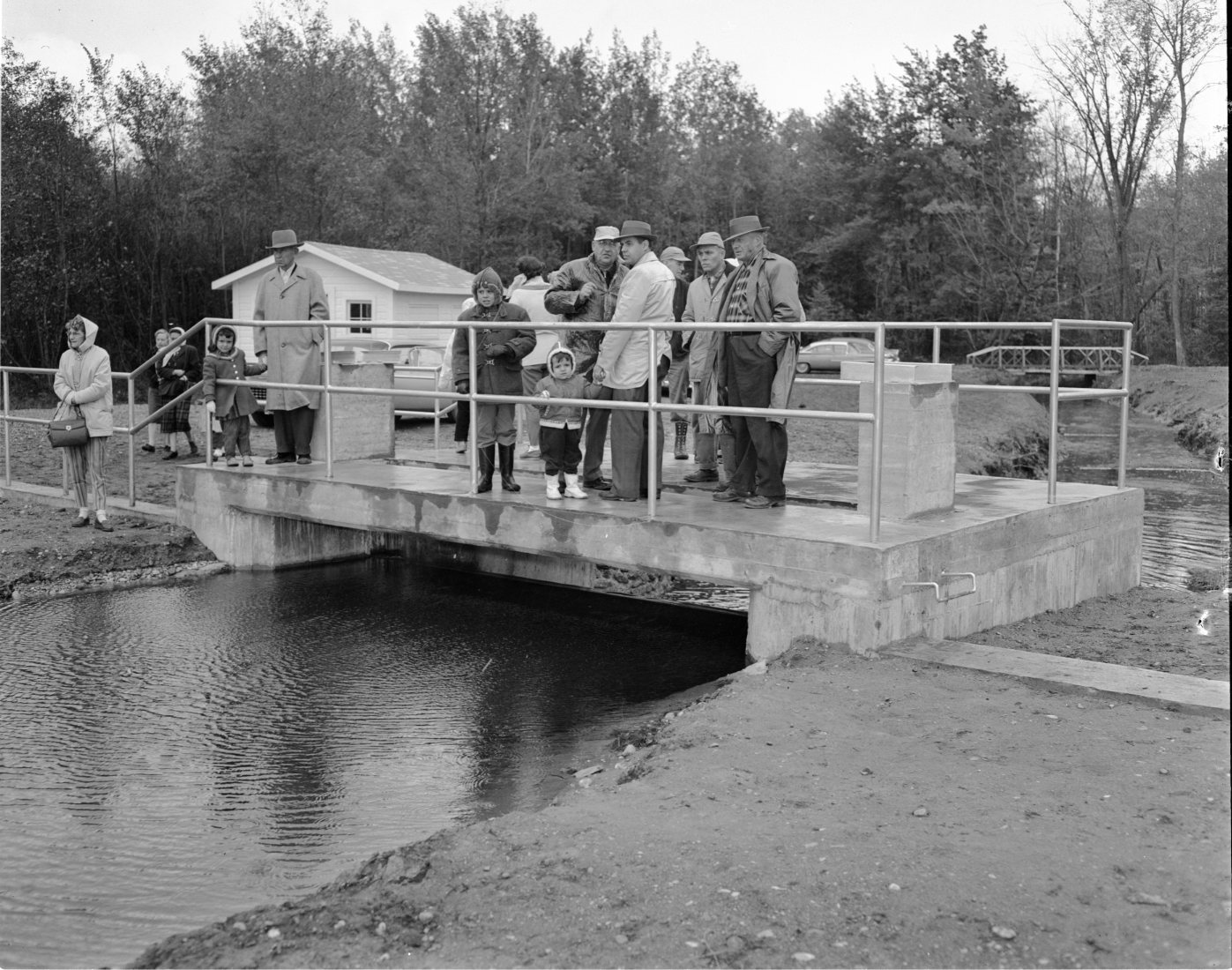
Built by men from the conservation farm camp in Medonte, this new cement dam will control the level of Orr Lake. It replaces a wooden dam weakened by Hurricane Hazel five years ago. Although the official opening of the dam will be Friday afternoon at 4 p.m., a number of officials turned out to inspect the work on a rainy, gusty Thanksgiving holiday afternoon.


  • Car Pins Elderly Woman in Freak, Street Crash”; County Herald headline of October 9, 1959. A 66-year-old Port Severn woman is in St. Andrews Hospital as a result of a freak accident which occurred on Midland’s King Street about 10:30 a.m. yesterday morning. Police identified the woman as Mrs. Delima Boucher of Port Severn. She had both legs broken and suffered severe shock, it was stated. Acting Chief George Wainman said Mrs. Boucher was walking down the sidewalk and was passing in front of Jory’s drug store when the accident happened. The chief said Mrs. Anne Annand of 124 Bay Street was driving south on King St. pulled into a parking spot at the drug store. But Instead of hitting the brake pedal, her foot apparently struck the accelerator and the vehicle climbed up over the curb pinning Mrs. Boucher against a plywood barrier in front of the store, now being renovated, he said. A student driver, Mrs. Annand was accompanied by Eldon French of 277 Eighth Street, Midland, an experienced driver who had been giving her driving instruction. The chief said no charges against the driver are contemplated. The injured woman was treated at the scene by Dr. W. F. Neale, and was taken to hospital by Midland-Penetang ambulance. In the crash, a section of the plywood barrier was caved in. It is believed this factor saved the woman’s life.
  • 75-Mile-Per-Hour Gales Maroon Cottagers on Bay”; Many residents of Toronto and other Ontario centers, who own cottages in the Southern Muskoka or 30,000 Island area of Georgian Bay, were late for work Tuesday morning. In fact, a goodly number of them who had gone to their cottages for the Thanksgiving weekend were unable to get back to the mainland at Honey Harbour and other district centers because of high winds. “One person here who has a wind gauge said the wind reached 70 to 75 mph Monday,” said Dave Milner of Honey Harbour Boat Works. Mr. Milner is one of several men at Honey Harbour engaged in transporting cottagers to points, “Up The Shore” or providing facilities, fuel, and repairs for their boats.  About 90 persons from 25 cottages in the Honey Harbour area were marooned Monday, Mr. Milner estimated.
  • Clarence Woods, 40, veteran Port Severn guide, has been transferred to Western Hospital, Toronto, for treatment of eye injuries received in a hunting accident Tuesday. Mr. Woods had been leading a party of Americans on a partridge shoot near Lovering when the accident occurred. He was struck in the face by pellets from a shotgun shell, one of them lodging In his eye. Rushed to hospital in Orillia, Mr. Woods was treated by Dr. G. W. Hall of Coldwater. OPP Const. George Winter, who investigated, said the men in the party had gone into dense woods and were stationed roughly a hundred yards apart. Apparently, Woods and Johnny Flannex of Warren, Ohio, had narrowed the gap to about 60 feet. When a partridge flew up, Flannex fired at it with a .12 gauge shotgun. Mr. Woods was in almost a direct line with the blast.
  • Known as the founder of Balm Beach, Robert John Finley died at St. Andrews Hospital, Midland, Oct. 7. He was in his 83rd year. He is survived by his wife, the former Lillian Bate, a son Vernon of Guelph, and two daughters, Mabel, Toronto, and Greta of Barrie. Funeral services were held in Barrie Saturday with burial in Cemetery Barrie Union Cemetery. Born on a farm near Bobcaygeon, he went to Peterborough as a young man to learn the baker’s trade. Later he went to near-by Lakefield where he operated a grocery store and bake shop in partnership with another man. It was there he met Lillian Bate, whose father also operated a grocery store a few doors away. Married Sept. 20th 1899, Mr. and Mrs. Finley celebrated their diamond wedding anniversary last month. For many years a resident of Barrie, Mr. Finley made his first trip to what was then called Tiny Beach in 1922. There was only one cottage there at the time, and the road (now County Road 6) stopped at the top of the hill, half a mile from the water’s edge. Struck by the possibilities of the place, Mr. Finley bought an entire half concession along the waterfront and added the other half to his holdings the following year. This gave him around 135 lots on the mile-long stretch of beach. In his first year at the beach, Mr. Finley sold only one lot, but by 1926 things were starting to boom. He was glad to get $200 each for the beachfront lots then. You would be lucky to get a beachfront lot anywhere now for under $1,500 if there were any left to buy. Mr. Finley shared the credit of giving Balm Beach its present name with Tom Preston and Ernie Robins, both of whom farmed near Midland at that time. He also operated the first store on the beach and his name is perpetuated in Finley Drive, which runs north from the main centre of the beach. During his years at the beach, Mr. Finley had long advocated more fire protection and more life-saving facilities during the eight terms he had served as president of Balm Beach Athletic Association. Unfortunately, there are still no permanent fire fighting or life-saving groups at the beach, even at this late date. The main Finley cottage, one of several he owned at one time, was given the name “Ya-Quah-Mook.” an Indian name meaning the end of the road. Which it was when Mr. Finley built it. Now cottages extend for miles up and down the beach, several streets deep in spots.
  • Obituaries – MRS. AMELIA YON – Six grandsons of Mrs. Amelia Yon were pallbearers at her funeral, Oct 1, at St. Margaret’s Church when Rev. L. Petitpas officiated at the mass. Pallbearers were Andy Bell, Francis Thiffault, Robert Thiffault, Frank Arbour, Allen and Louis Brodeur. Mrs. Yon, who had been a resident of Midland for 67 years, died in St Andrews Hospital Sept. 29. Born in Michigan, the U.S.A. in June 1894, Mrs. Yon, the former Amelia Bodie, married Lewis Yon at Sault Ste. Marie, Mich. Mr. Yon predeceased her in November 1941. Mrs. Yon is survived by a son, Frank of Midland and four daughters. Mrs. Edna Brodeur and Mrs. Albert Thiffault (Ethel), both of Midland, Mrs. Henry Arbour (Kathleen) of Toronto and Mrs. Fred Moreau (Florence) of Detroit. A fifth daughter, Mrs. Olive Thompson predeceased her in June, 1956. Burial was in St. John’s Cemetery, Waubaushene. WILLIAM GILBERT ELMVALE — Sunday, 13, district people heard of the unexpected death of William D. Gilbert who died in Penetang General Hospital. He suffered a heart attack at his home and died shortly after his arrival in hospital. Mr. Gilbert was a life-long resident of this community. He was born May 18, 1887, the son of the late Charles O. Gilbert and the former Sarah Jackson. He farmed on the 8th line of Flos and later retired to make his home to the village. He was a liberal and a member of the congregation of Jehovah Witnesses. Surviving are his sisters Etta (Mrs. T. B. Patterson) of Calgary and a brother Albert of Cochrane. Nieces and nephews reside in Elmvale. The funeral was held Sept. 18, at the Bishop Lynn funeral home with Mr. Robert Alliston conducting the service. The pallbearers were Fred Drysdale, Robert Ritchie, Art Jamieson, Alvin Greenlaw, Bernie Pilon and Howard Brown. Interment was in Elmvale Cemetery. MORRIS MINO – A resident of this district all his life, Morris Mino died in Penetang General Hospital, Sept. 23, following a lengthy illness. He was to his 43rd year. Funeral service was held at the Bishop-Lynn funeral home, Elmvale. Sept. 26. Pallbearers were Elmer Lumree, Cecil Lumree, Reg Morrison, Jack Murray, Russell Marshall and Duncan Barr. Born in Medonte Township. Mr. Mino was educated at Hillsdale and on July 6, 1940, at Dalston. Ont., he married the former Margaret Clara Buchannan. After twelve years as a freight handler for the CPR at Port McNicoll, he became a farmer at Vasey. He was a member of Waverley Loyal Orange Lodge No. 389. Besides his widow, he is survived by his parents, Mr. and Mrs. Geo. Mino, a son, Murray Keith at home, Surviving brothers and sisters are Aberdeen of Moonstone, Mrs. Wm. Douglas (Leona), William and Eldon, all of Toronto. Mrs. Duncan Barr (Alemma) and Merelyn of Vasey. Burial was in Hillsdale United Cemetery.
  • TEN YEARS AGO THIS WEEK – Two Midland citizens reported seeing a vivid blue flash that lit up the sky northwest of the town for four or five minutes. Scientists said they believed the flash was caused by an exploding meteor. * * * At its October meeting, Midland council decided to take the necessary steps to dispense with the ward system and to increase the number of aldermen from four to eight, half- of whom would be elected each year for a two-year term. The question was to be referred to electors in a plebiscite at municipal election time. * * * Construction of a $60,000 drive-in theatre off Highway 92, west of Elmvale, was underway. It was expected completed by Easter. * * * Dortna Crooke, a Victoria Harbour girl, was named campus queen at Midland District High School. The selection of the queen climaxed a two-day football jamboree. * * * Penetang court of revision faced a total of 190 against assessments. At its first sitting, the court was able to clear only 12 of the appeals. * * * Miss Mae Hilditch, superintendent of Arnprior and District Memorial Hospital, was appointed the superintendent of St. Andrews Hospital, Midland. She was to take over her new duties Nov 1. * * * Midland Boys’ Band played the first of a series of concerts in an attempt to raise funds to buy better quality instruments. Adjudicators had stated that, if the band had better instruments, it might have attained higher standing in events.

An article from the Midland Free Press, October 1938;

WYEBRIDGE PIONEER RECALLS
EARLY DAYS IN VILLAGE
Wye River Once Logging Stream—50 Years Of Storekeeping — Mrs. McRae’s Busy Life
By J. H. Cranston 
   For more than seventy years Mrs. Nelson McRae has lived at Wyebridge. She knew that lovely little village when it was the chief business hub of Northern Simcoe, when the farmers from twenty miles around brought their grain to be ground into flour at the Plewes’ grist mill, and when Midland was as yet unborn. In those days the Wye River was a noble stream down which huge logs were rafted instead of the placid little creek it has now become. Mrs. McRae saw Wyebridge grow from a tiny hamlet into a hustling village, and then gradually decline in importance while the new settlement on Mundy’s Bay, now Midland, aided by the fact that it had a fine harbour, increased in population and became the chief trading seat. Wyebridge is to Mrs. McRae, however, still the centre of the universe, just as it was in the days when she came there with her husband from Eastern Ontario away back in 1866. She loves the charming little settlement on the Wye with all her heart.
   It was a treat to chat with this remarkable woman concerning the early days in Wyebridge. Although in her 93rd year—she celebrated her 92nd birthday on June 4th last — Mrs. McRae’s mind is still keen. She amazes one by the quickness with which she recalls the names and even the initials of men who were in business in Wyebridge in the sixties, seventies and eighties. Possibly her remarkable memory for such details is due to the fact that she was the village postmistress for more than fifty years, and it was her business to know names both fore and aft.
OPENED GENERAL STORE    Cevila Ekins was the maiden name of this Wyebridge pioneer. Daughter of Edward Ekins, of Dickenson’s Landing, twelve miles east of Cornwall, she became a school teacher when she grew up and taught near Aultsville, in Roxborough and near Berwick. She gave up teaching to become the wife of Nelson McRae, Wyebridge, in 1866, where Mr. McRae opened a general country store on the west side of the street. Some years later he built the store on the east side now occupied by Mr. Rawn, and here Mr. McRae served the countryside until his death in 1915. Mrs. McRae, who had always spent as much of her time in the store as she could spare from her family, carried on the business until 1919 when she sold out to her son-in-law, Fred Lummis. The McRae store was during all this period the real social centre of the community. Here villagers and country folk came not only to buy supplies of all kinds but to get their mail, and gossip over the happenings of the district. When later the telegraph and telephone were added to the store’s equipment it was there the people gathered to hear the news of the outside world. On election nights the store was always jammed with partisans of both stripes, and many was the hot political argument that went on while the returns were being received over the wires. One could buy almost anything they wanted in the McRae store. A. G. Churchill, commercial traveller poet, who immortalized many of the businessmen of northern Simcoe in the seventies in his “Poetical Directory” had the following to say of the business house over which Nelson McRae presided. 

His grand supply on River Wye,
Is truly very splendid—
On shelves in store, from floor to floor.
And is politely tended;
Goods,  every kind that are designed for clothing men and women:
Keeps glass and delf upon his shelf,
All kinds of table trimming;
Keeps pork and flour that men devour.
Eggs, butter, cheese and fishes;
Keeps pepper, spice, salt, soda, rice
Mugs jugs and earthen dishes;
Keeps boot and shoe made clothing
too,
For Tay and Tiny border;
Without fail, will handle mail,
And telegraph to order.

SUPPLIES TEAMED IN    All supplies for the store had to be teamed in from Barrie by way of the Crown Hill road. There was no railway north of Allandale for many years after the McRaes arrived at Wyebridge. “I remember my husband sending a lad of seventeen to team a load of goods up from Barrie,” said Mrs. McRae., “On the way back a barrel of golden syrup was dumped overboard into the snow by a sudden bump in the very bad roads. The boy was badly frightened and did not know what to do. He came home to tell us about it and said the neighbours had come and helped themselves to all they could carry away.” Mrs. McRae recalled that more than once the spigot on the molasses barrel in the store had been turned by mischievous youngsters and the contents allowed to run over the floor. It was a big job to get the sticky mess cleaned up. When asked if much credit was given to their customers Mrs. McRae answered: “Far too much. I still have a pile of notes two inches deep which are not worth five cents for the whole lot.” Merchandising had its attractions, however, and Mr. McRae on two different occasions branched out. He opened a store at Wyevale but disposed of it after a number of years. He also came to Midland and took over a building at the foot of Main Street owned by Captain H. Wisden, which had been run us a book store. He sold groceries and other lines of general goods. That was before the trains came to Midland. The venture proved a losing one, it was too much trouble going back and forth from Wyebridge to Midland. So after two years Mr. Rae closed the store and took the groceries to Wyebridge. 
STAGE TO BARRIE    “In the early days a stage ran from Penetang to Barrie and back again,” said Mrs. McRae. The outgoing mail had to ready early in the ing we received our incoming mail towards evening. The stage driver drove his team from Penetang to Hillsdale, where he changed to a fresh team. He went on into Barrie, picked up the mail, and drove back to Hillsdale, where he changed to the original team which had been resting there; he covered 64 miles every day.
   “What opportunity was there for enjoying a bit of social life in Wyebridge in the early days?” I asked Mrs. McRae. “Not a great deal. The farmers had to work too hard. The young people did manage, however, to get together for an occasional dance. A hall over the driving shed was the only public building which we had and there were held any public meetings or social gatherings which did not take place in the churches. At one time we had a skating rink in the village, which Mr. McRae erected. It was a building 40 feet by 70 feet, but it had to be abandoned and torn down because it did not pay. “Horse races used to be held on the main street, and there was plenty of excitement. Before Midland was chosen as the regular site for the Tiny and Tay Fall Fair it was held alternately in Wyebridge, Midland and Penetanguishene, and we used to have some very good fairs in our village. 
HOW MIDLAND GOT THE FAIR   “And how did it happen to go to Midland.” One year the annual meeting was held on a very stormy day here. A big crowd of Midland members came down to Wyebridge for the meeting. None came from Penetang at all, and only three or four turned up from Tiny and Tay. A resolution was put to hold the fair regularly in Midland, and when it carried by a big majority the members came down to our store and bought all the brooms we had. They went home to Midland wildly excited carrying their brooms and shouting that they had made a clean sweep.
    “You would hardly believe when you look at the Wye River that it was once quite a good-sized river. We had a boat and a boathouse on our own property. It was possible to go in a canoe all the way from Wyebridge to the Old Fort. There was a dam here at Wyebridge which provided power for the grist mill. A freshet carried away the bridge and destroyed the mill in 1912. There had been a very heavy rain and dams and bridges all the way up the river gave way. The waters of Mud Lake were higher in those days than they are today. 
     Mr. A. Kemp, a Toronto manufacturer, bought all the property from the Old Fort to the high water mark, except that belonging to Mr. Casselmen, and kept it as a private shooting preserve for his friends and himself. He built the house down near the Old Fort, where Mr. Beatty now lives.”  
LUMBERING ON THE RIVER   “There was a lot of lumbering down in Tiny Township in the early days, and all the big timbers were floated down the Wye River to the mouth of the Wye and either to Waubaushene or Midland sawmills. There was a sawmill at Wyebridge which was run by water power and was owned by John Lummis. It did not handle the biggest logs, however, but was operated mainly to supply lumber to the farmers. “What other industries were there in Wyebridge in those days?” “There was the grist mill run by James Plewes,” replied Mrs. McRae. It was down the river at a short distance below the present bridge, where the stream bends. The wheat was ground between large round stones. (Now in the side yard of Huronia Museum) The farmers from Elmvale, Medonte and Hillsdale districts and all the way north to Lafontaine came to Wyebridge to have their wheat ground. 
THE WOOLLEN MILL    “Then there was the woolen mill run by William E. Cronkhite. They did spinning and carding but no weaving. They sold cloth of all kinds to the farmers.” In the “Poetical Directory” of the district written by G. Churchill appears the following verse telling of the factory, which subsequently fell into the hands of the Wallaces, father and sons. 

“Where the Wye River does constantly
flow,
Swift cards, shears and spindles,
and shuttle do go; 
picking and carding, they spin,
weave and full—
shearing and pressing, yarn
-—colouring or wool;
Their late burr extractor is noble
and grand.
Exceeds all the possible picking
by hand.
If farmers wash sheep or their
fleeces all clean,
To pass the burr picker and carding
machine,
They hint to their customers
dwelling all round.
Will pick grease and card wool
for five cents a pound;
Cronkhite can dress up a regiment
of men
At his mills and his stores in the
Wye River Glen
Domestic and foreign, all kinds
That they need
Overalls, coating, broadcloth and
tweed.
Pressed cloth and winceys for the
feminine train,
Stripes, changeable, checkered,
the figured and plain.” 

TWO BLACKSMITH SHOPS There were two blacksmiths in Wyebridge in the early days who are recalled by Mrs. McRae. They were Stephen Ganton and Peter McDonald. An idea of the kind of work a blacksmith was called upon to do in pioneer times is revealed in the rhyme written by Mr. Churchill with Blacksmith Ganton as his hero. Was the poet a prophet when in the last line he tells of the village smith making “many a thing” for -“the ear,” or was he only fitting in a word which rhymed with “bar?” Here are the lines: 

Will iron all, both great and
small.
That runs upon the wheel,
On runners too, will set the shoe,
Of iron or cast steel;
All farming tools, in modern rules.
Will mend as well as make;
Makes and mends chains and
takes great pains
 If anything should break—
They will repair with best of care.
Will hinge with barn and gate,
On racehorse too will set the shoe,
Of very fine steel plate.
Makes strong grub hoe, pickaxe
and fro,
The canthook and mill bar—
Bolt, band and ring, and many a
thing,
For carriage and the car.
 
ONLY SURVIVOR    Wyebridge always had one hotel, and sometimes there were two. Zacharias Casselman was the proprietor of one of them, and his son, W. A.  Casselman, who still lives in the village, is the only one of today’s residents who was in Wyebridge when the McRaes arrived. Mr. Casselman was then a little boy of about three years of age.
   “Did you know Mr. James Playfair in the early days?” I asked of Mrs. McRae. I understand he used to work in the bush near Wyebridge when he was a young man?”  “Yes, indeed, I remember him. He was a clerk in a lumber camp nearby and he used to come into the store and do quite a bit of buying.”
   The Anglican Church was the only religious body holding services in Wyebridge when the McRaes arrived. The rector came from Penetang. The McRaes, as might judge from their Scottish name, were Presbyterians, but they attended the Anglican Church until Presbyterian services were established. “The first Presbyterian services were held in our home in the large room above the store,” said Mrs. McRae. “The first Presbyterian Church, which was built in 1870, was of logs and the minister was the late Rev. H. McKellar. Later we had Rev. Dr. Gilray, who conducted worship at Penetanguishene and Wyebridge. He was a student then. In 1875, Rev. H. S. Scott was our first ordained minister.” 
A ROMANTIC STORY   “If I were to ask you the most interesting person you know whoever lived in Wyebridge, what would you say?” “I scarcely know,” replied Mrs. McRae, “unless it would be Catharine Grant. She was the youngest daughter of a Scot, John MacDonald, a factor of the Northwest Company of Montreal, who fought for the fur trade of the Canadian West with the factors of the Hudson Bay Company. He became chief factor of his company, but when the two rival companies were amalgamated he lost his position. He came back to Ontario, then known as Upper Canada, and settled on the east side of the Penetanguishene Road, a mile north of Kempenfeldt Bay. “Mr. McDonald had married an Indian girl who had saved his life when it was in danger from some of her tribesmen and they were a very happy family. They gave their children the best education that was available. On his death, Mr. McDonald’s property passed to his youngest daughter Catharine. It consisted of 6000 acres along the Penetang Road which had been given him by Crown grant.  Catharine McDonald was taken to Glengarry County where she was given a good education and met and married Angus Grant. With her husband, she came back to Wyebridge and they took up farming on 200 acres on the east side of the village just south of the Wye River. Catharine Grant was a very fine woman.”
    Four members of Mrs. McRae’s family of six children are living. The living are Mrs. J. C. McMullen of Midland, Mrs. F. H. Lummis of Balm Beach, Mrs. E. H. English of Wyebridge and Miss Nellie McRae who lives at home with her mother.