Huronia Museum – Looking Back 60 Years Ago in North Simcoe – May 1st to 7th, 1959

 We have found a couple of original photos from last weeks post to update the “cut & paste” photos used then.The music goes round and round at Midland Y’s Men’s Club’s 13th annual music festival, this week, and where it comes out is up to the judges. Several lads who took part in the instrumental competitions Monday study a score. Left to right are Neil Craig, Paul Davidson, Harry DeVries, Dave Bissette, and Jerry Hamilton.

Catherine Richardson earned the flowers being presented to her by Ruth Davidson at MPDHS auditorium Friday night on behalf of the Y’s Men’s Club. As in many previous years, Mrs. Richardson was the accompanist for literally hundreds of young singers and instrumentalists at the 13th annual music festival last week.

The big sign pretty well tells the story as Ed (left) and Bill Jeffery survey the plans for their new hardware store to be erected at Dominion Ave. and First Street. They hope to have the new store open for business by mid-July. 

Maybe the secret of being a good trout fisherman is to smoke a pipe and look contented, like Hugh McGillicuddy, left, and John Power. But then almost anybody would look happy with the catch (20 speckles ranging from nine inches to 1.5 lbs.) these two “old cronies” landed on opening day May 1. Hugh was a former YMCA staffer in Midland. 

Seems like just about everybody was “in the chips” at the banquet for Midland Ontario AHL champions at Parkside Inn Monday night. Wearing new jackets and holding pen sets presented by Midland Lions Club are, left to right, Doug French, Keith Bath, and Bobby Clayton. They’re admiring the world’s champion hockey trophy held by ex-Toronto Leaf coach Billy Reay. Billy served as general manager of the Belleville MacFarlands when they won the title at Prague in March. 

“It’s a bit too small around the waist,” admits Midland’s “Mr. Hockey”, George S. Dudley, as he tried on John Swan’s new jacket at the hockey banquet in Parkside Inn Monday. John, left, Dennis Abbott and Wayne Holden were presented with the jackets by the town for winning the Ontario AHL championship at Welland last month. 
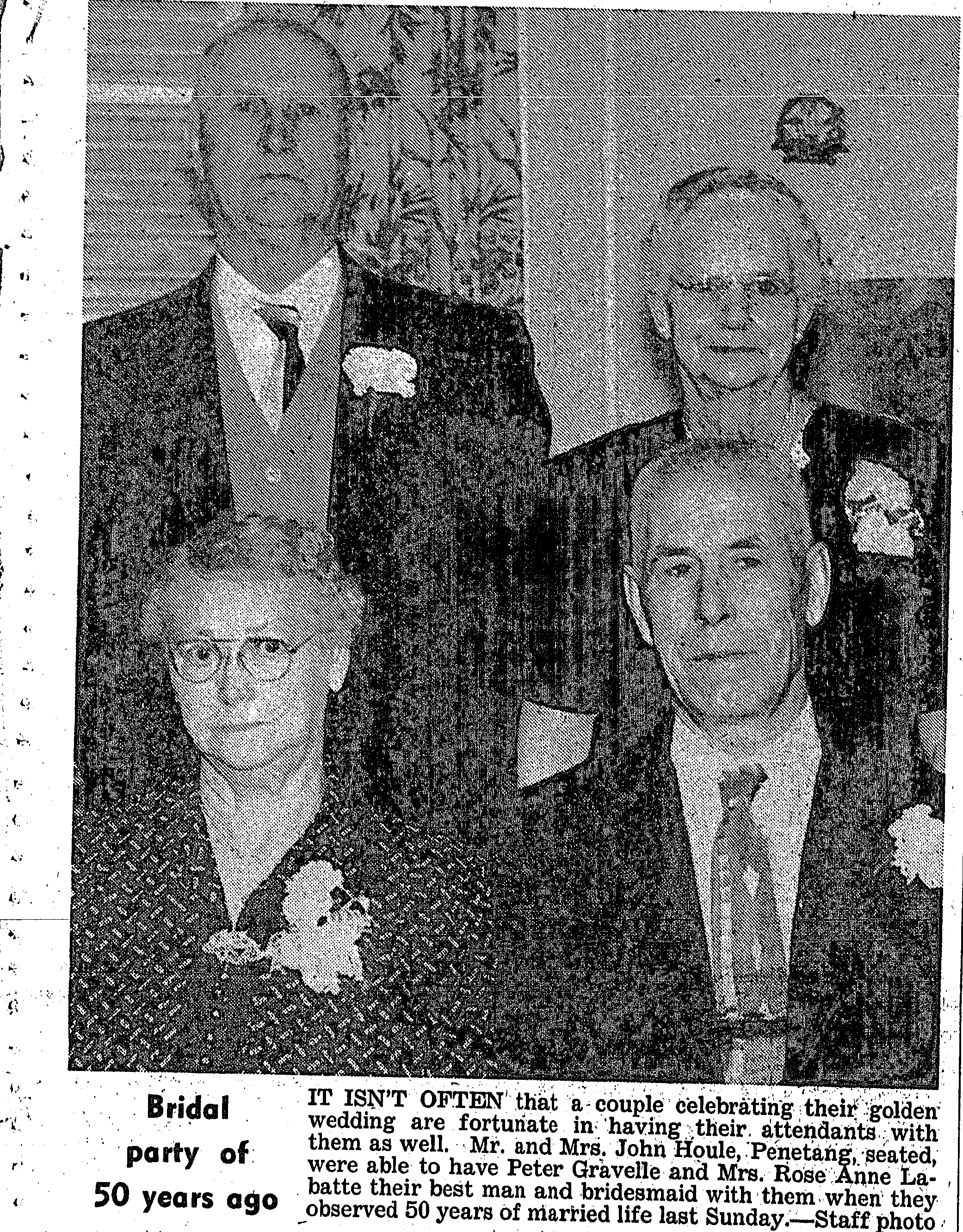
 

  • County Herald headline May 1, 1959; Forecast Major Invasion of Tourists in Huronia. Indications of a bumper tourist season for this section of Huronia this year are seen in numerous inquiries for information and requests for accommodation being received by Penetang and Midland Chambers of Commerce. Ken Macdonald, secretary of Penetang chamber, told a directors’ meeting Wednesday night he is being “swamped with letters asking for information on available cottage accommodation”. The secretary said most people sending queries appeared to have families, and they are generally looking for safe beaches. “Not too many of them are even mentioning boating facilities in their letters,” he stated. Mr. Macdonald’s summary of requests received to date was that one and two-week holiday periods seemed to be the rule. Many of the letter’s named specific locations, with all of them being in this area, he said.
  • Free Press Herald headline of May 6, 1959; Hardware Firm to Build $100,000 Building. Adding fuel to Midland’s current building boom, the erection of a brand new store, and warehouse for F. W. Jeffery and Sons Ltd, dealers in hardware in Midland for more than 60 years, was made official this week. The estimated cost of the new building, located at Dominion Ave. and First Street, one block west of the present location, is around $100,000. Nap Beauchamp Construction Company, Midland, is the contractor. Names of the successful sub-contractors have not been announced as of yet. The main store portion of the new building will be of one-storey cement block construction, measuring 50 by 100 feet. The warehouse, forming the foot of an “L” at the northwest corner, will be two storeys and will measure 40 by 20 feet. Weir-Cripps and Associates are the architects. The layout of the main store has been planned by the Versa-Flex Company; specialists in the hardware store field. Work got underway the last week of April on clearing a portion of the site of the ancient trees which have sheltered Dominion Ave. for generations. The warehouse is scheduled for completion May 31 and the main store by July 15. Also to be torn down to make way for the outdoor selling area and the parking lot is the old Ingram house, another Midland landmark for several decades. Work on tearing down the huge old home will not start until June. Founded sometime prior to 1900, the firm erected its own building at Dominion Ave. and King Street in 1901. In 1914 the present company of F. W. Jeffery and Sons Ltd., was founded. The sons were the late Edward Jeffery Sr., Todd Jeffery, and the late Fred Jeffery. In 1954 the building was sold to the Jeffery Holding and Development Co. Ltd. Actively heading the firm at present are Mrs. Hazel Jeffery as president and her two sons, William and Edward, as secretary and vice-president, respectively.
  • For more than 7000 Grey Nuns throughout the world, including branch communities in Penetanguishene, Midland and Victoria Harbour, Sunday, May 3, will be an important occasion. Their foundress, Mother Marie Marguerite D’Youville, will be beatified at St. Peter’s Basilica in Rome. Representatives of 325 houses, of the Grey Nuns, will attend ceremonies and later special services at the Church of The Canadian Martyrs, Rome. A number of members of the Canadian hierarchy, led by His Eminence Paul Emile Cardinal Leger, archbishop of Montreal, will attend the beatification rites. In Midland, special services will be conducted in St. Margaret’s Church at the 11 a.m. mass Sunday in honor of the new “BEATA?’. At 9 a.m. Monday a special mass will be celebrated for the children of schools taught by the sisters. Marie Marguerite Dufrost Lajamerais D’Youville was born Oct. 15, 1701, at Varrens, 15 miles from Montreal. Widowed while still a young woman, she became the first Canadian to establish a religious community, “The Sisters of Charity”, who became known as the Grey Nuns, because of the color of their religious habit. “Dedicated to serving the poor and the sick in the social field and in education, the Grey Nuns spread rapidly after their establishment in 1738. There are at present over 7,000 living members belonging to this community or branch communities formed since, which owe their beginning to the original Montreal foundation.
  • A meeting which filled Craighurst community hall to capacity last week received assurance that action would be taken to have Highway 93 from Craighurst to Crown Hill paved. The road is part of Simcoe East riding served by Lloyd Letherby, MPP. The meeting was called to protest the fact that the stretch of highway, as a graveled road, provided poor service during most of the year.
  • Officers for the ensuing year were elected at the April meeting of the Woman’s Christian Temperance Union, held in the ladies’ parlor of St. Paul’s United Church, with the president Mrs. W. Farquhar, in charge.
  • MPDHS Hi-Sterics by David Maheu; Wednesday morning’s assembly was an outstanding one. Contributing to its success was the Glee Club which led off its presentation of negro spirituals and popular songs with a beautiful interpretation of God Save the Queen. During a break in the program, a member of the Students’ Council gave away a free ticket to the prom. The lucky girl was Lenore Faragher. This year’s prom will be called South Sea Serenade. In charge of the main part of the assembly program was Grade I0C. Introduced by MC Don Popple, John Carpenter read a humorous letter which had been given to him by a newly-enlisted soldier. It was signed “Elvis”. His selection was followed by a song presented by guitarist Roy Leclair. A humorous skit, portraying activities in station SLOB, was presented by Harry DeVries, announcer, and Winston “Liberace” Schell who played “Music to eat by”. Winston also filled in as weathercaster following the “newscast”. Guests “interviewed” were a boxer named Slugger and a tennis star, Hazel Condolis. A hit number was the Lloyd Preston Quintet comprised of Lloyd Preston, Milt Budarick, the two French boys and Murray Fagan. Lloyd demonstrated his ability by playing the piano, the violin, and the saxophone. This musical aggregation was followed by the Five Peppers, who sang. “I’ve Had It”; and two of their originals “Whisper Some”, and “What Did I Say, What Did I Do? Lloyd Preston and his band and Harry DeVries, Winston Schell, Kevin Rodgers, Roy Leclair teamed up for the finale.
  • BIRTHS –  DAY—To Mr. and Mrs. Charles Day, London, Ontario, at the Victoria Hospital, on Friday; April 24, 1959, a son. JACKSON—To Mr. and Mrs. Edward Jackson, 1 Gervais Drive Midland, at St. Andrews Hospital, Friday, May 1, 1959, a daughter. RINTOUL — To Mr. and Mrs. C. P. Rintoul, Victoria Harbour, at St. Andrews Hospital, Midland, Saturday, May 2, 1959, a daughter. SILVEY — To Mr. and Mrs. John Silvey, 291 Russell. St., Midland, at St. Andrews Hospital, Wednesday, April 29, 1959, a son. SIMMONDS—To Mr. and Mrs. Edwin Simmonds, 215 Russell St., Midland, at St. Andrews Hospital, Wednesday, April 29, 1959, a daughter. WHITE — To Mr. and Mrs. Douglas White, 102 Elizabeth St., Midland, at St. Andrews Hospital, Friday, May 1, 1959, a son. YORK — To Mr. and Mrs. Charles York, Vindin St., Midland, at St. Andrews Hospital, Monday, May 4, 1959, a daughter.
  • DEATHS – ISAAC N. WOOD A life-long resident of Tay Township, Isaac Nicholas Wood died in Penetang General Hospital April 11 after a lengthy illness. He was in his 85th year. Funeral service was held at St. John’s Anglican Church, Waverley, April 13 with Rev. A. G. Fairhead officiating. Pallbearers were Keith, Lawrence and Neil Wood, Ross Withall, Douglas Brooks and Bill Marcellus. Mr. Wood was a member of the Anglican Church and an honorary member of LOL No. 589 Waverley. His wife, the former Mary A. Thompson, predeceased him in 1956. He is survived by two daughters, Mrs. Spurgeon Brown (Cora) of Elmvale, Mrs. Wm. Withall (Hazel) of Wyevale, and two sons, Percy, and William of Wyebridge. * * * MRS. ALICE SIBBALD Born and educated at Waverley, Mrs. Alice Eleanor Sibbald, who had resided practically all her married life in Midland, died April 20 at St. Andrews Hospital in her 84th year. The funeral service was held April 23, at Nicholls funeral home with Rev. W. L. Morden officiating. Pallbearers were Harold Boyd, Uno Gabrielson, Allan Drinkell, Arlie Sibbald, Reginald Drinkell and Phon Sibbald. Mrs. Sibbald had been associated with many organizations of the United Church. She married the late John Alphonso Sibbald Oct. 4, 1901, at Waverley. Mr. Sibbald predeceased his wife in 1931. She was the daughter of the late Mr. and Mrs. Joseph Drinkell. A brother and sister predeceased her some years ago.  Sibbald is survived by a brother Walter Drinkell of Waverley and a niece, Miss Zelma Drinkell, and two nephews, Reginald and Allan Drinkell, all of Waverley. Burial was in Waverley United Church Cemetery.
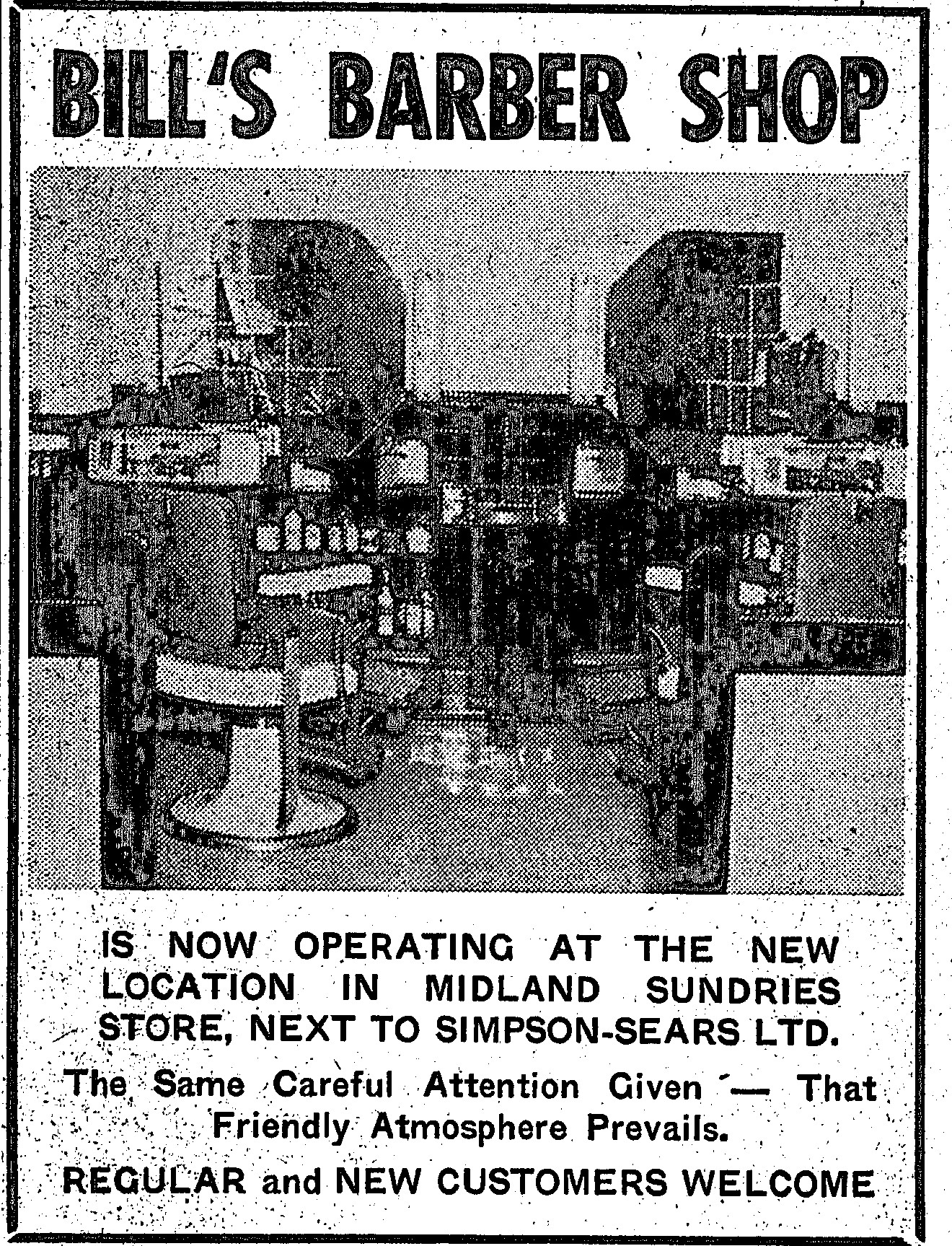
  • After ten years in the same location on the east side of Midland’s King Street, Bill’s Barber Shop has recently opened in a new stand almost directly across the street, in the rear portion of the new Midland Sundries store. The new shop, operated by Bill and Eleanor Leitch, has been specially designed to take up as little room as possible but at the same time afford’ its customer’s even better service. There’s a place for everything and everything, is kept strictly in its place. The shop also features new ultra-violet ray sterilizing equipment, where clippers, shears, combs, razors and every item used on the customers are stored while not in use. The very latest of its type, the new sterilizer is the only one of its kind in use in this area. Another new item is the latest in lather service equipment which provides ready-mixed lather for all shaving needs, The new shop is also designed for easy and quick cleaning, with vinyl flooring and plastic tile walls. A barber for 15 years, Mr. Leitch was joined six years ago by his wife Eleanor. Theirs is the only husband-wife operation of its kind in the area so far as is known.
  • 25 YEARS AGO THIS WEEK – Two Sixth Street School pupils, Marvin Gilbert and Kenneth Butler, made an important discovery at the Wye River. They uncovered two silver crosses, eight gold rings and several silver ornaments believed to have been owned by early Jesuit missionaries in Huronia. * * * Simcoe County amateur radio operators held an organizational meeting in Coldwater. Mord S. Millard of Coldwater was named the ident of the newly-formed group known as Simcoe County Radio League. Radio operators from Penetang, Midland, Orillia, and Coldwater attended the meeting. * * * In an address in the House of Commons, a Conservative member demanded that industrial profiteers be prosecuted and that some of the legislators and cabinet ministers be eliminated from the public payrolls as a means of lessening taxation. * * * Department of Highways announced that dangerous curves would be removed and the surface paved on Highway 12 between Midland and Orillia. It was estimated that the work would cost between $6,000 and $7,000 per mile. * * * A total of 789,000 bushels of wheat, oats, and corn were brought to Midland elevators in two days by ships which were loaded at the head of the lakes. CSL’s Town House received 344,000 bushels alone. * * * A move by several Midland merchants to have Wednesday half-holidays abolished during July and August was defeated. They were unable to get the support of a majority of their colleagues to have the council amend the bylaw. * * * Gasoline was being offered at one Midland service station for 19 cents a gallon, plus government tax. There was no indication that it was the forerunner of a price war.
  • What might have been a major tragedy was narrowly averted at Hillsdale Wednesday when the family home of Mr. and Mrs. Andrew Townes was completely destroyed by fire. Inside at the time the fire started were eight of the Townes’ children. The children’s father was in a nearby bush cutting wood. Their mother was away shopping accompanied by Francis, 12, the eldest son. Hero of the near-tragedy was Kenneth, 11, who managed to get a younger brother and six sisters to safety. Barbara, 8, had also helped by snatching Violet, 4 months from her crib as they fled the burning building. The fire apparently started when Kenneth attempted to relight a wood stove in the kitchen, with the aid of coal oil. Sparks leaped from the stove into a can of gasoline used to operate a washing machine. Smoke and embers surrounded the children as they fled the gas-fed flames. A neighbor, Duncan Barr, who happened by at the time, made certain none of the panicky children tried to get back in the house.
  • The people of Ontario have two big Jobs to do concerning the advancement of mental health. One is fighting stigma and the other is fighting lethargy. So said Hon, M. B. Dymond, minister of health for Ontario, as he addressed the final meeting of St. Paul’s United Church Men’s Club for this season. Pointing out that one person in 10 in this province will need treatment for mental or emotional disorders at some time or other, Dr. Dymond said that even in 1959 people “still talk in whispers” when they mention mental illness.

 Looking further back;

CHARLES HARTMAN’S reflects on his 37 years in the hardware business in Midland as told to Herbert Cranston and published in the Midland Free Press Wednesday, May 3rd, 1939.

     Fifty years is a long time in any man’s life. It was fifty years ago, on Monday, May 1, 1889, that Charlie Hartman entered the hardware business. Thirty-seven years of that fifty have been spent in Midland. This town has a no more deservedly popular citizen than the said Charlie, who all this week has been receiving the congratulations of his friends. W. D. ‘ Bill ’ Ross, who has kept store next door to him for the past fourteen years, says that there is not a whiter man in all Simcoe County. “If Charlie Hartman gives you his word that’s all you need,” says Bill. And no higher tribute could be paid to any man.

    It was on September 5th, 1870, that the stork left a third boy baby at the farm home of John W. Hartman, eight miles southwest of Meaford, in St. Vincent township. The little lad was christened Charles Edward. All four boys born to John Hartman and his wife, Susan Machell, are still living. Joseph, the oldest, is farming in St. Vincent township. Frank is in the hardware business in Thornbury, and William, better known as “Bill,” who for many years was a partner with Charlie, now is Midland’s deputy reeve. Charlie Hartman loves to tell tales of his boyhood. He attended a country school in S. S. 11, St. Vincent, until he was sixteen years of age and like other boys, he played “hookey” when the weather was too fine to be indoors. He remembers one teacher by the name of Frizell, who used a rung from a maple chair in place of a strap. “When he got through you didn’t want anymore,” said Charlie, as he reminiscently looked at his hands which had tasted that chair rung many times.

NEARLY SMOTHERED

    “He was a bad actor, that Frizell.” continued Mr. Hartman. There was a big cupboard in the schoolroom in which we used to put our lunches. One day we had an exam in geography and there were three of us who didn’t know the answers. As punishment, he shoved us into the cupboard, locked the door, and went home to supper. There was so little space that we could not move. When Frizell got to his farm boarding place he gleefully told the farmer what he had done. “You will smother them said the farmer.’ Let them smother.’ said Frizell. The farmer ran to the school and let us out, and just in time. We could not stand up and collapsed on the floor,  in fifteen or twenty minutes more we might have been dead.” “The boys make much trouble for the teachers”, continued Charlie. “We did have a lot of fun however. There were two gangs, the “uproads” and the “downroads”, depending upon which way we came to school, and when winter came we had many a snow fight, which usually ended in a fist encounter.

MEAN TRICK

    “I must tell you about a mean trick some of us played on a farmer neighbor, old Richard Belshaw, who was so lazy he wouldn’t cut his lambs’ tails off at the proper time when they were very small, but let them grow until they were quite big. One day a bunch of us decided to teach him a lesson. On the way home, we cornered two or three of the Iambs and cut off their tails. Next day Mr. Frizell asked the boys who went north to stay in after school. We knew what was coming, and we declared we knew nothing about what had happened. So Frizell went to see another chap who had been with us but was not at school that day. He did not know what we had said, and as he was not coming back to school, he told the truth. The next night we got a whaling that I shall never forget. Of course, it was the wrong thing to do. The lambs might have bled to death, or their tails might have been infected as the weather was warm. But we were not thinking about the lambs. We were just playing a prank on old Belshaw.”

     At seventeen Charlie Hartman decided the time had come to prepare himself for his life’s work. He went to Owen Sound and tended business college for months, getting a training bookkeeping. He boarded with an uncle, a carpenter, who secured a job for him with T. I. Thompson, a hardware merchant. So when his course was over young Charles began his apprenticeship. “I was general kickabout” said he. “The first year I got $2, the second $4 and the third $5. I worked under an oral agreement and the hours were 7 a.m. till 9 or 10 o’clock every night in the week, but I did not complain. I was tickled to death to get a job. Father and mother, of course, helped me, for I could not pay my board on $2 per week.

WENT TO BUFFALO

    “I liked it in Owen Sound. There were a lot of lovely people there and I got along fine. At the end of the three years, Mr. Thompson claimed he had not guaranteed me any advance, although I certainly expected to receive a clerk’s pay when my apprenticeship was up. So I quit. Times were just as bad as they are today, If not worse, and there nothing to be had. I took a trip to Buffalo to see if I could get a job, but I could not find one in my trade. Finally, I got a chance at carriage and wagon painting. I stuck it out for three months and then decided to go back to Canada. Mother was anxious for me to come home and had got a job for me in a Meaford hardware store. The morning I left Buffalo was very hot, and as the train passed through fields of Ontario clover I thought I had never seen anything lovelier, nor had fresh air ever seemed so refreshing. I swore I would never go back to a city to live. It was while working for William Butchart that young Charles Hartman met the young woman who was to be his wife. She was Margaret Edwards, daughter of Albert Edwards, proprietor of Meaford’s grist mill. Charlie lived in the Edwards’ home during his four years in Meaford and got a chance to become well acquainted with the lady of his choice. He did not marry her, however, until he had purchased the hardware business of Thomas Carscadden at Thornbury, and set up in business for himself. ”I wasn’t going to make a fool of myself and marry before I was in a position to take care of a wife like so many young fellows do today,” he said.

CAME TO MIDLAND

    After five years in Thornbury Charles Hartman came to Midland and in partnership with his brother William bought out the hardware establishment owned by William Peters. It was a little old frame building and occupied the same site as the present Hartman store. When he purchased the property a few years later Mr. Hartman tore down the old Peters building and erected the present store in 1913. “Bill and I never had a partnership agreement,” said Charlie. “He had had no previous hardware training. He came direct from the farm, but we shared everything on a fifty-fifty basis. He was with me for eighteen years and we always got along splendidly together. The partnership was dissolved on his initiative. He never cared much for the business, and he saw the boys coming along. In half an hour we settled all the details as to dissolution. In 1933 my two sons Albert and Wells became my partners. Each of us now owns a third. My other boy Ainsley also worked in the store, but as yet he has no partnership interest in the business. Those boys pull together wonderfully. “Some of your clerks have been with you a long time, have they not?” l asked. “Oh yes. Bill Stephens, who drives and delivers, has been with us for 21 years, and Mrs. Norman Chew has been bookkeeper off and on for nearly 25 years. Watson Battrick has been with us for twelve years.”

MANY CHANGES

    “You have seen many changes in the hardware business in the past fifty years?” I suggested. Indeed and I have. There has been a great improvement in the finishing of goods, such as stoves and kitchen utensils. Old barn framing tools, blacksmith tools, lumbermen’s tools, and most of the heavy hardware has disappeared. Vises, anvils, and machinists’ tools have little sale. Not nearly as many lanterns are sold as in the old days. The old cut nails have gone. We never see them now. All nails are wire, and they are better nails. They should be for they are dearer. We used to buy a keg of nails for 31.90 which today costs us 3.50 “We did the greatest volume of business in the years 1915 to 1929. Those were the days when the lumber yards, the shipyards, and the elevators were flourishing. There was a lot of building in those days. Today there is practically none. “The greatest change is, however, in the hearts of the people. When things were going well and there was lots of work people seemed to be happy and contented. When things went bad in 1930 and men started going on relief it was terrible. So many people who had saved a little, were soon drained of all they had. Some nearly went crazy when they found themselves dependent upon public aid. It used to be that if people kept you waiting a while before they paid their bills they would say they were sorry. Today, however, they make you wait and they never apologize. If you ask them for money they get angry and ask how you can expect them to pay when they have no work. It is the most regrettable change I have seen. “Credit is consequently not as good as it used to be and we do not give as much. The people have spoiled their own credit. If they are not as honest it is because of conditions and not all their fault. They have to scheme more to get along. The younger generations are more careless than their fathers.”

PUBLIC SERVICE

    Charles Hartman was brought up as a Methodist but became an Anglican after he married. He was churchwarden of St. Mark’s for some years, and on the Y.M.C.A. Board of Management while it was being built. He served as a member of the town council for four years, the last in 1913, and it is his boast that in those days the debt of the town was only $350.000 as compared to $1,500.00 of today. All payments on principal and interest were up to date. “No members of the council, not even the mayor, got any money then,” he said. The mayors I served under were Richard Horrell, J. H. Craig and John McDowell. The way I got into the council was this, there were some people trying to pass a law which would bring liquor into the town, I was asked to stand as an opponent of liquor and I was elected. I still believe Midland is far better off without booze, and that the people would vote against it if they wore asked to do so today. It is close enough in Penetang.” Mr. Hartman served on the school board for three years but was never chairman. “I never wanted any high position,” said he. “I don’t mind helping, but those jobs are a lot of worry. People are after you all the time. I never enjoyed feeling important.”

BUSINESS HIS HOBBY

   “What is your chief hobby?” I asked of Mr. Hartman. “Staying with my business. I like it. I try not to overdo it, but one must be constantly awake to keep up-to-date.” “Don’t you ever go fishing or shooting?” “Oh yes. I am fond of duck shooting, and I used to go out every year when the season came round. I have also done quite a bit of deer hunting, and there is nothing I like better than a motor trip. I have seen quite a bit of eastern America from my automobile.” “How do you feel about the future of Midland?” I shot this final question at Mr. Hartman who has seen the town in alternate boom and depression periods. “That’s hard to answer,” he replied. “This world is in such a topsy turvy state at the present time, and business has been at a standstill for so long that one sometimes wonders if things ever will come right again. However, I’ll say that if things ever become normal again I see no reason why Midland should not forge ahead. We have lost some industries forever, but the tourist trade is steadily increasing in importance. This is a good center. It has many facilities, and it will come out on top yet.”

Huronia Museum – Looking Back 60 Years Ago in North Simcoe – April 22nd to 30th, 1959

Nearly an hour was required from the time this concrete structure was raised from its prone to its upright position at the front of St. Mark’s Church. Here workmen bolt and cement it to the foundation. The tower is in memory of Capt. and Mrs. Ed. Burke, the McCartney family and Bob Thomas.

  • County Herald headline of April 24, 1959; New Industrial Water Line Cuts Town Load One-Third. Midland’s raw water pumping system, in full operation since April 15, has brought about a major reduction in the consumption of water from the town’s domestic supply. Alex Macintosh, the chairman, of the Midland Public Utilities Commission, told a joint meeting of the council, chamber of commerce, planning board and the PUC Monday night that the industrial system has cut the drain on the domestic supply by one-third. At the present time, only Midland Industries is using industrial water. Mr. Macintosh felt when other water-using industries were hooked on to the raw water that the drain on the town reservoir would be cut by an even greater amount.
  • Free Press Herald headline of April 29, 1959; Penetang Docking Point in New Royal Tour Plan. Royal tour plan for this area, now reportedly receiving serious consideration by tour committee officials at Ottawa, calls for the Royal Yacht Britannia to dock off Penetang Point July 4, with the Queen, Prince Philip and the royal party arriving at Penetang dock aboard a tender from the yacht. It is understood the proposed new schedule would permit the Queen to spend about 20 to 25 minutes in each of the towns of Penetang and Midland before she leaves the latter by train for Orillia. The royal party after a half hour stop in Orillia would then leave by train for Gravenhurst, arriving there shortly after the supper hour, it is reported. This newspaper also understands that Her Majesty would move from Gravenhurst to Torrance by car, rejoining her train there for the trip to Parry Sound. It is understood that on her arrival in Parry Sound, the Queen will tour the town by car, spending about 20 minutes in that center before she embarks on a tender to board the Britannia, awaiting her off Red Rock outside Parry Sound harbor.
  • The 1959 navigation season opened in the Bayports today with the arrival of the CSL’s Sir James Dunn at Tiffin Elevator, Midland, at 7.15 a.m., and the same line’s Coverdale at Port McNicoll a short time later.
  • Students at Midland-Penetang District High School will have a new sidewalk to serve them on Hugel Ave. west as the result of a decision of Tay Township council. Work on the five-foot-wide sidewalk, now underway, is being supervised by Councillor Laurence Olimer under the federal-provincial winter works program. It is hoped that Midland will complete the sidewalk from the township boundary to Hugel and Eighth Streets in the town.
  • Philip Blake of 161 Yonge Street, Midland, is all done “workin’ on de railroad”. Mr. Blake’s employment with the CNR — 22 years in the car department at Midland — officially came to an end yesterday on his 65th birthday. Actually, Mr. Blake worked 27 years on the railway in all, including five with the old Grand Trunk system before it was incorporated into the CNR. Born in Ottawa, Mr. Blake was a son of the late Mr. and Mrs. Philip Blake, Sr., who brought him to Midland when he was 12 years old. Blake Sr. was a lumber inspector for the old Turner Lumber Co. and later served as a foreman for a number of Midland firms. Upon leaving school, young Phil Blake sailed for a couple of years before deciding his future didn’t lie on the Great Lakes. He then worked for a number of Midland stores before joining the car department of the Grand Trunk in 1920. After five, years with the GTR he quit becoming a policeman at Little Lake Park. He also was employed as a driver-salesman for a bread firm here for a number of years. Mr. Blake joined the CNR as a car helper in December 1937 and was promoted to car man in June 1943. He held that post until his retirement this week.
  • Each Wednesday evening at Midland YMCA during the winter, gym classes for married women were held under the direction of Mrs. W. F. Neale and Mrs. John Courtémanché. In the main, the project was organized by former members of Hi-Y girls’ gym classes. At one time during the winter about 30 young women and one grandmother were taking the exercises. Music for the floor work was provided by pianist, Mrs. Laverne Wright. It was a cosmopolitan crowd, for some of the young women originally came from Italy, Belgium, and Germany, while others had home towns in every province from Newfoundland to  Saskatchewan.
  • When Hubert Patenaude decided to open an electrical, plumbing and heating store in Penetang, he remembered his own yen for “do-it-yourself” projects, and immediately resolved to give assistance to do-it-yourselfers so far as his own lines of business are concerned. Although Hubert’s business venture is to be known as Patenaude Electric, he is selling plumbing and heating appliances as well. In addition, he will continue his electrical contracting work, along with plumbing and heating.
  • Opening day of his new store Thursday is one that will be well remembered by Hubert Patenaude. Along with the usual excitement of the opening day, he had to deal with a serious fire in the building. It caused several hundred dollars damage. Smoke was noticed at the rear of the store about 5 o’clock, and investigation revealed flames licking up the side of the frame addition. Firemen found the fire was burning in the back of the Patenaude store and a shed behind a restaurant next door.
  • Tay council has decided to explore opening up the 9th concession south from Highway 12 to permit access to Steve Gratrix’ property, adjacent to the former township dump.
  • John Power – Outdoor Diary; Heard some talk about all the camping on Beausoleil Island is prohibited with the exception of the site at the park headquarters. I understand they are dividing this into lots and, if you want to camp on the island, this is where you have to do it. The reasons for these drastic steps? Because they couldn’t control it otherwise. Too much wood was being wasted and too many people getting away without paying, as all the sites couldn’t be patrolled often enough to collect from everyone before they left in the mornings. I was under the impression this wasn’t a money making project but a project to give people the pleasures of camping outdoors.
  • OPEN HOUSE, Ontario Hospital, Penetanguishene. The Superintendent and staff cordially invite the public to visit and inspect various facilities during Open House, Wednesday, April 29, from 1.00 to 3.30 p.m.
  • St. Margaret’s rectory was the setting for the wedding of Anne Mary Shiels, only daughter of Mr. and Mrs. Wilfred Shiels, to Joseph Edward Faragher, the only son of Mr. and Mrs. Lorne Faragher. The 2 p.m. ceremony, April 4, was conducted by Rev. F. Voorwerk. The bride, given in marriage by her father, chose a satin brocade dress with long sleeves, bateau, neckline at the front and, a deep scoop at the back ending with a large bow and falling into a bouffant skirt. She wore a matching coronet headpiece with seed pearls, a fingertip veil and carried two mauve orchids, with sprays of stephanotis. The matron of honor, Mrs. Ron Shiels, and bridesmaid, Lenore Faragher, wore matching dresses of cocktail-length white organza embossed with blue forget-me-nots over white taffeta. They had scalloped necklines, scalloped capped sleeves, and pleated cummerbunds ending with bows at the back. They also wore matching headdresses, mittens and shoes and carried sprays of blue and white carnations. Ron Shiels, brother of the bride, was best man and Jim Lemieux was attendant. The reception for 125 guests was held at the Knights of Columbus Hall. Mrs. Wilfred Shiels, the bride’s mother, received the guests in a sheath dress of beige peau-de-sole, matching accessories of beige contrast, and a corsage of coral baby roses. She was assisted by Mrs. Lorne Faragher, the groom’s mother, who wore a sheath dress of romance blue shirred crepe, matching accessories and a corsage of yellow baby roses. For her wedding trip to the northeastern United States, the bride wore a rose-beige stroller suit, dark brown accessories and her flowers were coral sweetheart roses. Out-of-town guests attended the wedding from Toronto, Barrie, Orillia, Victoria Harbour, Mount St. Louis, Penetang and the surrounding district. They are residing at 148 Robert Street, Midland. (A much loved and respected couple, our condolences to Joe and the Faragher family.)
  • The principal of Midland – Penetang District High School since its inception in 1954, Lorne M. Johnston resigned last week to accept a position with the Department of Education. Now a resident secondary school inspector, Mr. Johnston, and his family will make their home in Belleville. He will have 30 high schools and collegiate in his large territory which includes the cities of Belleville and Peterborough, and the counties of Halliburton, Hastings, Lennox-Addington, Northumberland and Durham, Peterborough and Prince Edward.
  • Ten Years Ago This Week – Coldwater firemen announced plans to hold professional wrestling bouts in the village skating rink during the summer months. The brigade had approached the rink commission to obtain a rental agreement. * * * One of Midland’s newest business establishments — Canadian Tire Associate Store — was preparing to open its doors to the public. The proprietor was David J. Finch, and store manager, Murray McComb. * * * National Employment Service office in Midland reported there was a drop of 57 percent in the number of persons seeking employment in April. The number of jobless men declined from 572 to 238, and the number of unemployed women dropped from 49 to 29. * * * It was announced that the S.S. City of Cleveland would dock at Midland June 14 with 200 members of the Grand Rapids Chamber of Commerce on board. * * * Temperatures throughout North Simcoe remained warm with a high of 86 being recorded. This thermometer reading was said to have been the highest in a number of years for so early in the season. * * * Huronia Council, Knights of Columbus, received its charter at a ceremony in St. Ann’s Church, Penetang. George Mead was named grand knight of the new council. * *  * A survey of Simcoe County farms revealed that spring seeding was completed on half of the county’s farms. It also noted that fall wheat and winter rye had suffered very little damage from the cold weather. * * * Canada was preparing for a federal election June 27. Enumeration of voters’ lists was to get underway early in May. 

Happenings in Midland, March 19, 1903.

– The public library has been closed for the past two weeks, but will probably be open on Saturday.
-The ice on the bay is becoming dangerous and there are notices up warning people against crossing the ice.
-Mr. F. J. McCallum has purchased the fine residence on Dominion street, at the head of First street, from Mr. E. Ganton.
-Some $22,000.00 have been placed in the estimates by the Dominion Parliament for the dock at Midland and for dredging in the harbor. There is great activity about the boats and tugs that are wintering in the harbor. Men are overhauling the craft preparatory to the opening of the season’s work.
-Spring millinery opening commencing March 26 and continuing
the two following days. Everybody welcome. Don’t forget the dates, Mrs. J. A. MacDougall.
-Engineer Smith has made for the fire brigade a very neat and light hose reel which can be easily operated by a few then. This will be an improvement to the fire fighting appliances.
-Messrs. W. H. Hacker & Co. have built eight fine skiffs and canoes during the winter, and have two more on the way now. This firm intends to build several gasoline launches during the spring. The boats they turn out are well made and of good stuff.
-Easter Term—The Easter term in the Central Business College, Stratford, Ont. commences April 1st. Mr. W. J. Elliott, the Principal of the College, will be pleased to mail a beautiful catalogue to all who wish to secure a business or shorthand education.
-Mrs. W. F. Campbell received word last week that her father Mr. A.
Christie, residing near Rogersville, had died on Tuesday. He had been ill for a long time, Mr. Christie had reached the fourscore years. Dr. and Mrs. Campbell left on Wednesday for the bereaved home, returning on Saturday.
-The Women’s Auxiliary, of the Midland and Penetanguishene General and Marine Hospital, intend holding a bazaar and entertainment in aid of the building fund of that deserving charity. The public is earnestly requested to help, and contributions of useful and fancy articles will be most gratefully accepted. The contributors will kindly leave their work at Mrs. Raikes’ house as soon as possible. The sale will be held on Tuesday and Wednesday of Easter week April 14 and 15.
-The By-law to raise the sum of $20,000 for the purpose of purchasing the electric light plant, removing the same, erecting new machinery, buildings, etc. which was voted on by the ratepayers on Friday last, was carried by a majority of 169 votes. It will be seen that very little interest was taken in the matter when out of a possible 600 votes only 208 were cast, the votes being 188 for and 17 against the by law, or 11 to 1. This is an improvement in one respect on the vote taken two years ago on the same thing. The vote then was 102 for and 64 against.
-There was organized here this week a new marine company which will be a decided acquisition. The Midland Palace Scow Co. is the name by which the new concern will be known. The shareholders are prominent businessmen. The purpose of the company is to build and operate palace scows on the Georgian Bay. There is an increasing demand by wealthy tourists for palace scows, or houseboats and good prices are paid for their use during the holiday season. The company will begin at once the construction of a palatial houseboat and will follow it by as many others as the demand warrants.
-The local pastors and Sunday-school workers have decided upon holding a convention of town Sunday school workers during the month of April. Three sessions have been arranged for, to be held on Monday, Tuesday, and Wednesday, April 6, 7 and 8. The sessions will be held in the Baptist, Presbyterian and Methodist churches. The program which has been arranged promises to be interesting and instructive. This is the first convention of the kind ever held in the town, and for that reason, it will be of special interest. All Sunday school workers are invited to attend and take part, though the meetings will doubtless be open to all who are interested.
-What might be called the crowning act in connection with the erection of the new Presbyterian church was performed on Thursday last when the new bell; which was procured through the efforts of the young men of the congregation, was placed in position, and on Sunday morning it pealed forth its sweet tones, reminding the citizens that the hour to assemble for worship had arrived. The bell is an excellent one, has a splendid tone, and is a credit to the church and town. In fact the building in all its aspects is a splendid structure, and the rumor that was current when the contract was awarded, and which originated outside the town, that there were no mechanics in Midland sufficiently capable of doing the work, was groundless because close scrutiny reveals the fact that the masonry, carpenter work and painting deserves equal praise, and each alike has been performed with care and skill.

Huronia Museum – Looking Back 60 Years Ago in North Simcoe – April 15th to 21st, 1959

Penetang’s Little League Hockey entry in the provincial playdowns lost out in the championship by a slim margin but came back to win the consolation series at Welland, April 4. Kneeling with the trophy is Don Deschambault; standing, left to right, Stan Leclair, coach; Michael Dubeau, Jos. Lamoureux, trainer, Paul Maheu, Bill Lepage, Donald Light, Ian Dick, Ted Mason, Paul DeVillers, Doug Scott, Martin Robillard, Jim Martin, Paul Cordes, Gerald Gignac, Fred Scott, manager, Ron Robillard, Peter Berry.

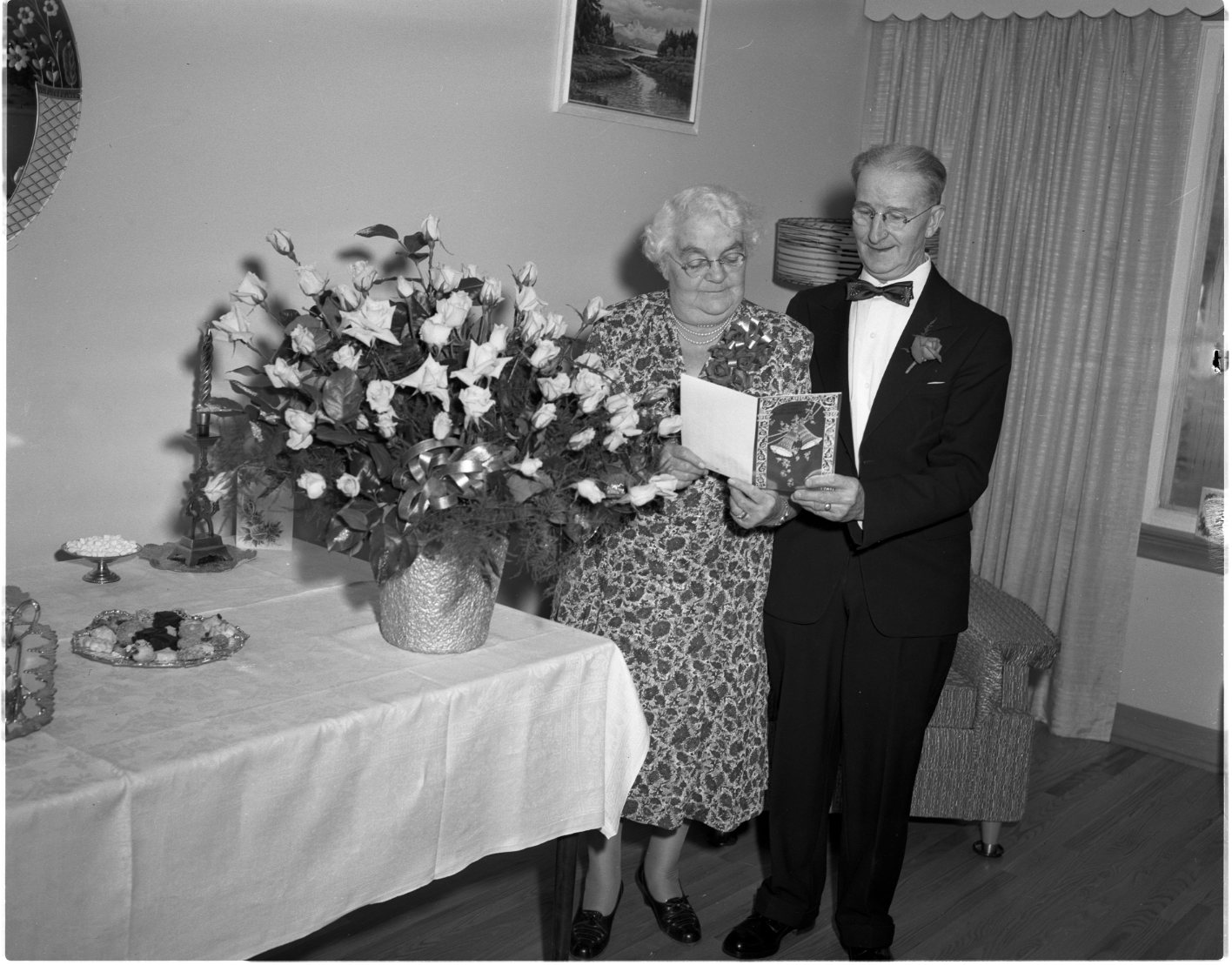
A host of friends and relatives greeted Mr. and Mrs. Charles Goodfellow Saturday afternoon and evening when they celebrated their 50th wedding anniversary at the home of their daughter, Mrs. Ray Maughan. Story on page 18. 

(I almost didn’t go back and read the story on page 18 as noted by the cataloguer who described the artifact. I would have missed an excellent insight into old Midland, reproduced below.) 

   Two long-time residents of Midland who played and attended school together in their younger years, celebrated their 50th wedding anniversary April 12. The couple, Mr. and Mrs. Charles Goodfellow of 363 Midland Ave. (Now 467), received a host of gifts, flowers and congratulatory cards and messages from their many friends and relatives. More than 90 attended the “at home”, held at the home of their daughter, Mrs. Ray Maughan, Saturday afternoon and evening. 
    Born in Sarawak, Grey County, near Owen Sound, the son of Mr. and Mrs. J. F. Goodfellow, Charlie moved to Midland with his family when he was eight years old. A native of Elmvale, Mrs. Goodfellow is the former Mary Louisa (Dollie) Smith, daughter of the late Mr. and Mrs. John Smith. The Smiths moved from Elmvale to Penetang, where they remained for a year, and then to Midland where Mr. Smith was head miller for the Copeland Milling Co. It was in Midland where the two first met as playmates. Then they attended the same school, the first being a school housed in the old Baptist Church on Manley Street. Miss Truman, whose father was town clerk at the time, was one of their first teachers. When the old church was torn down and the new school built on Manley Street Charlie and Dollie attended it. R. G. Nesbitt was principal of the school at that time. From public school, Charlie went to Midland High School for three years. Among his school mates were the Strathearn boys, whose father owned the jewelry business that still flourishes on Midland’s King Street. He recalled that Mr. Simpson was principal of the high school, and the mathematics teacher was Mr. Glass.
    During the summer holidays, Charlie got his first taste of printer’s ink in the printing and publishing business operated by his uncle Charlie and his father. The Free Press and job printing plant were located over Peter’s Hardware Store (later purchased by Charles and William Hartman). One of young Charlie’s duties was to carry wood slabs up two flights of stairs, cut them up and stoke the steam boiler that provided the power to operate the presses. Later this power plant was replaced with a gasoline engine.  When it refused to run, men were hired to turn the presses by hand cranks, Charlie recalls. A few years after Peter’s hardware was sold, Mr. Goodfellow senior bought the King Street building where the Free Press Herald is now located. The building was owned by John Wallace. Electricity was coming into its own as a source of power at that time, so the printing equipment was converted to electrical power. Another new piece of equipment then was the Rogers Typograph, the forerunner of the modern linotype machine. Young Charlie was the first in Midland to operate this newfangled gadget which his father bought from an uncle in Bradford. The budding young printer was 17 years of age when he began to work in the newspaper plant on a full-time basis. The firm employed eight persons.
    The couple who celebrated 50 years of married life Saturday were not quite 20 years of age when they were wed April 12, 1909, in Penetang at the manse of Rev. F. W. Gilmour of the Presbyterian Church. They kept their marriage a secret for three weeks, then told their parents.
      Around 1920, J. F. Goodfellow sold his printing and publishing business to a stock company comprised of Midland businessmen. Charlie continued to work for the new firm until 1927. He joined Osborne and Johnson for a time and then moved to Toronto, where he was employed by the Consolidated Press for 19 years. They returned to Midland in May 1945, and have remained here ever since. Charlie still operates a linotype machine, at the Free Press.
    Both remember the old boardwalks and unpaved streets. The latter generally became a quagmire each spring. Some of the roads on the outskirts of the town were so boggy they had to have a log base to keep them from sinking. A member of the Odd Fellows Lodge and of the Canadian Order of Foresters, Charlie has held every office in the latter fraternal organization and served as financial secretary for years. He liked to play ball and still has the last ball batted out in the series when he quit playing the game. The Midland team played Orillia, Victoria Harbour, Penetang and Barrie. During their teens and early married life, Mr. and Mrs. Goodfellow enjoyed skating and snowshoeing. In this, they were frequently accompanied by another couple, Mr. and Mrs. Howard Wadge. Mrs. Wadge is deceased.
    Mr. and Mrs. Goodfellow are members of the United Church and Mrs. Goodfellow is a member of the Woman’s Association. Of Mr. Goodfellow’s three sisters, only Mrs. J. A. Seager (Bella) of Orillia is living. His other sisters, Laura and Pearl, died some years ago, Mrs. Goodfellow, is one of two children in her family, her brother William died of pneumonia when he was a young man of about 21. (Below is a 1954 picture of Charlie at work.)
 
Free Press employees. Charles Goodfellow has served nine years as a linotype operator under the present management but is a veteran to the business as he worked with Bill Cranston’s father who owned and published this paper. The photo was also used in the May 1, 1957, Free Press on page 10 with this caption; Veteran linotype operator at Midland Printers Limited, Charles Goodfellow celebrated his 68th birthday April 30. Mr. Goodfellow first started to work on the paper in the summer of 1898. In June of that year, his father, the late J. F. Goodfellow, and his Uncle Charlie bought the Free Press. 

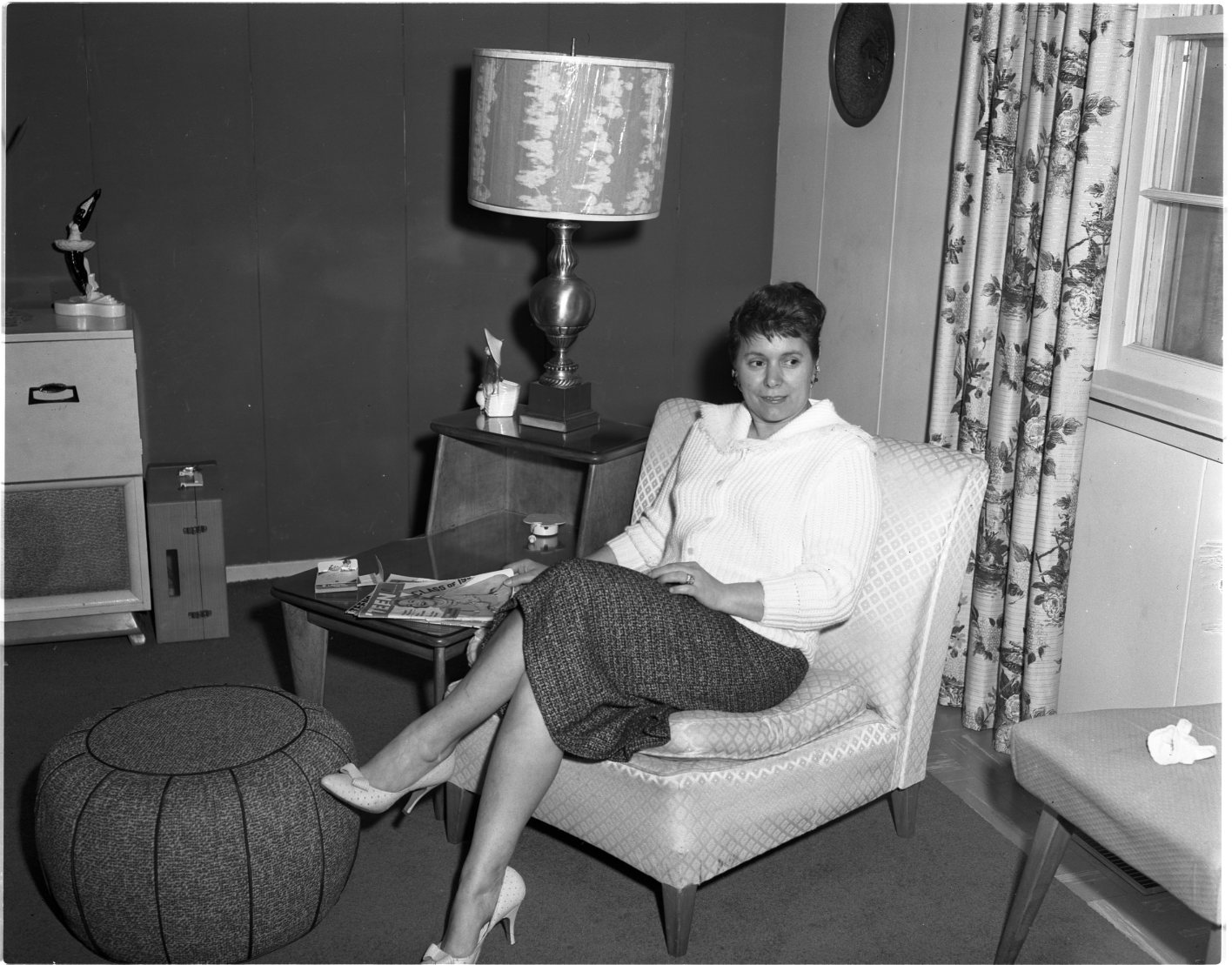
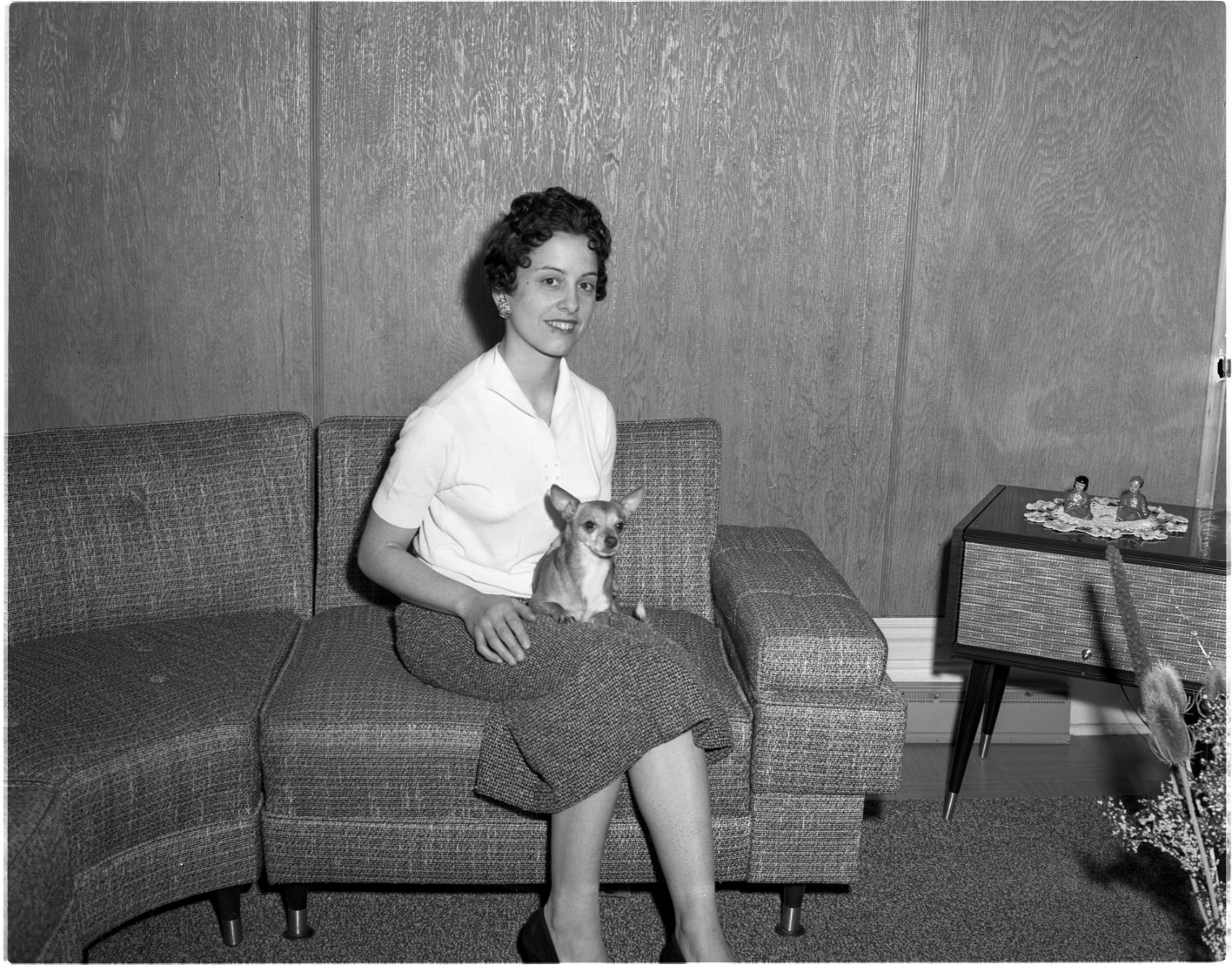
For several weeks the newspaper has been sponsoring a fashion contest. Six fashion photos are published and the public is asked to pick their favourites and mail their choice to the Free Press. A professional panel makes their selection and anyone who matches them can win up to $300.00. Below are some of the winners. 

A winner in the Free Press Herald’s “Pick the Fashions” contest seen relaxing in her Midland home, is Mrs. Elsie Colling, 212 Elizabeth Street.

A winner in the Free Press Herald’s “Pick the Fashions” contest seen relaxing in her Midland home, is Mrs. J. Lesperance òf 381 Bay Street.

One of the prize winners in the Free Press Herald’s “Pick the Fashions” contest was Mrs. Ray Trew, seen here relaxing from her housewifely duties at her home, 189 Colborne Street, Midland. (“housewifely duties” not surprised that phrase didn’t catch on!)

2006 0020 6241

The ladies of Port McNicoll are style conscious too, as witness the two winners from that village in the recent Free Press Herald “Pick the Fashions” contest. Pictured in their Port McNicoll homes are Mrs. C. Willock, bottom, and Mrs. W. H. Shaw.

  • Midland Free Press headline of April 15, 1959; Ask Engineer to Study Industrial Site Proposal. Midland council Monday night instructed its consulting engineer, James Knox of Canadian-British Engineering Limited, to commence a study for the proposed installation of water and other services on the industrial property on the southeastern outskirts of Midland. Mr. Knox was asked to discuss the proposal with R. B. Moffat secretary-manager of the Midland Chamber of Commerce after the latter had told the council that a major industry was planning to locate in the area. Reviewing the industrial development proposal, Mr. Moffat reminded council that a chamber of commerce deputation had asked the council about two months ago to provide water to the Tay Township site, in the event an industry decided to locate on that property. “We are now reasonably sure that a firm will be going in there in about two weeks or so,” Mr. Moffat said. He revealed that the firm previously had planned to locate on the western end of Midland Bay, but tests had shown the ground to be unsuitable.
  • County Herald headline of April 17, 1959; Sanction Booster Pump, PUC Agrees to Tay Plan. Midland Public Utilities Commission concurred, at their meeting Wednesday night, to a proposal submitted by Tay-Township council concerning a booster pumping station located at the Seventh Street standpipe in Midland. However, the motion by Commissioners O. H. Smith and Wm. Logan included seven conditions: The move is seen as the answer to current water problems for township residents on the western outskirts of Midland, and especially those in the high school area. The commission also authorized its chairman A. Macintosh, and manager Stewart Holt, to sign the necessary documents authorizing the amalgamation of locals 1032 (Midland) and 1647 (Orillia) of the International Brotherhood of Electrical Workers.
  • Mother of three young children Mrs. John D. Bugg, 21, died instantly early Saturday night when she fell down a flight of stairs in Midland’s Queen’s Hotel. Relatives said Mrs. Bugg and her husband, 24, were moving from an apartment on the third floor of the hotel to a new home on William Street when the accident occurred. It is believed that Mrs. Bugg, carrying a chair or some other article; made a lunge to save her son, Brian, 3, from falling. Instead, she herself fell, the full length of the stairs to the second floor. In addition to Brian Mrs. Bugg was also the mother of Sharon, 5, and David, four months. Her husband is employed in the paint shop of Canadian Name Plate Company. Also surviving are her parents, Mr. and Mrs. Gilbert Quesnelle of Sunnyside, Midland, and several brothers and sisters.
  • Midland Y’s Men’s music festival, which starts next Monday, has approximately 600 entries, the largest in the festival’s history. There are an especially large number of entries from Penetang, a festival official noted. The festival which runs from Monday to Thursday of next week will conclude with a “Stars of the Festival” concert Friday evening. Ken J. Ellis is chairman of the festival committee.
  • Quick work by Midland police Corporal Ernie Bates led to the recovery of a stolen car before it was reported stolen in Toronto. A 1950 Monarch car being driven without lights on Bay Street aroused the suspicion of Corporal Bates and he gave chase to the car Monday about 10 p.m.
  • BIRTHS – CORBIER — To Mr. and Mrs. Donald Corbier, 64 Ontario St., at St. Andrews Hospital, Midland, Wednesday; April 8, 1959, a daughter. CORNELL—To Mr. and Mrs. Edward Cornell, 173 Hugel Ave., at St. Andrews Hospital, Midland, Thursday, April 9, 1959, a daughter. DORION—To Mr. and Mrs. Russell Dorion, 303 First St., at St. Andrews Hospital, Midland, Friday, April 10, 1959, a son. DUPUIS – To Mr. and Mrs. George Dupuis, 280 Second St., at St. Andrews Hospital, Midland, Friday, April 10, 1059, a daughter. GARDINER — To Mr. and Mrs. Ray Gardiner, 153 Sixth St., at St. Andrews Hospital, Midland, Friday, April 10, 1959, a daughter. GRANT — To Mr. and Mrs. David Grant, 295 Bay St., at St. Andrews Hospital, Midland, Monday, April 13, 1959, a son. LAURIN — To Mr. and Mrs. Ovide Laurin, R.R. 3, Penetang, at St. Andrews Hospital, Midland, Tuesday, April 7, 1959, twin daughters. LEDUC — To Mr. and Mrs. Lawson Leduc, Victoria Harbour, at St. Andrews Hospital, Midland, Wednesday, April 8, 1959, a daughter. MOREAU — To Mr. and Mrs. Urbain Moreau, Highland Point, at Penetang General Hospital, Friday, April 3, 1959, a daughter. SANDY —To Mr. and Mrs. Edward Sandy, Christian Island, at St. Andrews Hospital Midland, Saturday, April 11, 1959, a son. WAGG — To Mr. and Mrs. William Wagg, 317 First St., at St. Andrews Hospital, Midland, Friday, April 10; 1959, a son. WEISSFLOG — To Mr. and Mrs. Erhard Weissflog, 105 Ruby St., at St. Andrews Hospital, Midland, Monday, April 13, 1959, a daughter.
  • A parcel of town-owned, waterfront property, approximately 300 feet square has been sold to Bev Keefe of Midland for $l,000. The sale was incorporated in a motion approved by Midland council Monday night. Council also agreed to lease another easterly 200 feet of the property to Mr. Keefe for $50 annually. Riders to the motion requested that Mr. Keefe, who proposes to build a marina on the site, submit any changes he plans to make to the town engineer for approval; that Mr. Keefe be given the first chance to buy the easterly 200 feet, if council decides at any future date it wants to sell this part of the property. The town solicitor is to be instructed to draft the lease for the easterly lot. Mr. Keefe is currently negotiating with CNR officials for adjoining property, to which the railway claims title under letters patent issued May 18, 1906, but which were never registered.
  • Ten Years Ago This Week – Four young Midlanders, Ted Courtemanche, Bob VanStone, Wally Hook and Tom Berthelotte, spent all night in line at Maple Leaf Gardens, Toronto, to get tickets for the Leaf-Red Wings finals. A Midland student at the University of Toronto loaned them a camp cot for their night-long vigil. * * * Tenders had been called for the construction of an addition to the Bell Telephone Company building in Penetang. In Midland, Bell lines east of King Street were to be redesigned, shifted or renewed during the summer. * * * Victoria Harbour council struck the 1949 tax rate for the village at 48 mills, eight mills more than the levy in 1948. The increase was caused by a 12 mill levy to meet debenture charges on the village’s new water system. * * * Dale Miller, Grade 8 pupil at Mount St. Louis School, won the Ontario finals of the public speaking contest sponsored by the Ontario Trustees and Ratepayers Association in Toronto, during the Easter convention of the Ontario Educational Association. He was one of eight contestants in the contest. * * * First ship into Port McNicoll harbor in 1949 was the S.S. Royalton, which arrived April 15. The Royalton’s skipper was Capt. J. Walton. * * * Two hundred Indians representing the Huron, Iroquois, Algonquin, and Cree tribes and members of the Jesuit Order were to lead a pilgrimage over the three-mile massacre trail from St. Louis to St. Ignace. The pilgrimage was to form part of ceremonies scheduled for July 9 and 10.
  • Obituaries – Death came unexpectedly to KENNETH ETIENNE CORRIVEAU, Sunday, March 29, as the result of a heart seizure. Mr. Corriveau, who would have been 49 at the end of this month, died at his Church Street home. Born in Lafontaine, he had lived there and married Helen DeVillers in 1953. They moved to Penetang about five years ago. Besides his wife, he leaves four brothers, Marcel, Lafontaine; Augustin, Perkinsfield; Herman, Penetang, and Albert, California; five sisters, Mrs. Marion Noonan, Florida, Mrs. Angeline Sandford, Toronto, Mrs. Annie Sauve, Capreol; Louise Corriveau, his twin sister, Abitibi Canyon, and Blanche Corriveau, Barrie. The funeral service was held Tuesday, Mar. 31, from Beausoleil’s funeral home to St. Ann’s Memorial Church where Fathers Ramsperger, Robitaille and Petitpas officiated. Interment was in St. Ann’s vault. Pallbearers were Raymond Grenier, Jos. and George Corriveau, Robert and Maurice Laliberte and Clifford Leduc. * * * MRS. EVA M. CARPENTER A native of Matchedash and a resident of Midland for 53 years, Mrs. Eva Maude Carpenter died in St. Andrews Hospital, April 2, after a prolonged illness. She was in her 85th The funeral service was conducted by Rev. J. L. Self, April 6, at A. Barrie and Sons funeral home. Pallbearers were Captain Sam Bell, Ben Cowie, Clifford Laughlin, William Logan, Douglas Swann and Russell Switzer. Mrs. Carpenter the former Eva Maude Hall, married Charles E. Carpenter at Coldwater Jan. 4, 1906. The couple had celebrated their golden wedding anniversary three years ago. Besides her husband, she is survived by two daughters, Mrs. Edwin Jardine (Annie) and Mrs. Clinton Smith (Agatha); and three sons, Murray of Collingwood, Walter of St. Catharines and Herbert of Midland.* * * A resident of Midland for 42 years, ARTHUR JOSEPH ROBITAILLE died at Penetang General Hospital April 8 following a lengthy illness of a year and a half. Mr. Robitaille‘s nephew, Rev. Kenneth Robitaille, celebrated the mass at St. Margaret’s Church, Midland, April 10. Pallbearers were five sons and a son-in-law. They were Louis, Andrew, Arthur, Leonard and Raymond Robitaille, and Eric Holden. Born and educated at Lafontaine, Mr. Robitaille married the former Leona Laurin there, in 1914. Besides his wife, Mr. Robitaille is survived by four daughters, Mrs. Ernest Rodway (Theresa), Red Deer, Alberta; Mrs. J. Abbott (Eva), Midland; Mrs. Marcel Moreau (Lucy), Toronto, and Mrs. Eric Holden (Margaret), Toronto; and six sons, Louis and Andrew of Hamilton; Leonard and Edward of Toronto, Raymond of Streetsville and Arthur of Midland. Four brothers, Ernest, Midland; Edmund, Toronto; Joseph, Windsor, and Israel, Penetang, also survive.
  • A native of the Penetang area and now a Kingston surgeon, Dr. R. B. Lynn recently opened a human heart and removed a tumor the size of an orange from the interior of the heart. The patient was a middle-aged man who, today, is in excellent health. This operation, the seventh successful one of its kind in the world, was performed by Dr. Lynn in Kingston General Hospital about a month and a half ago. It was the first open heart surgery performed in Kingston. Dr. Lynn, a comparative newcomer to Kingston, is an associate professor of cardiovascular and thoracic surgery in the faculty of medicine at Queen’s University, he also holds the position of a thoracic surgeon at both Kingston hospitals and is surgeon-in-chief at Ongwanada Sanatorium.
  • After at least two lengthy closed sessions, during which allegations against the chief of police were investigated by Midland council late Tuesday afternoon agreed to withdraw its request that Chief Robert Cameron submits his resignation. Council indicated, however, that it intends to “give further consideration to police matters with the hope of resolving any difficulties.” Chief Cameron has stated that regardless of council’s action he may resign in the near future. The motion calling for the chief’s resignation was precipitated by a discussion of police affairs at a special meeting of council March 26. At that meeting, it was charged that the chief was not carrying out the duties that were required of him and, because of this fact, that he no longer enjoyed the confidence of the men who served under him.
  • Midland council Monday night decided to up its welfare payments to people on relief in the town. Alderman Clinton Smith, chairman of welfare, asked that the town adopt the provincial standard of payments. He said he felt, in view of the increased cost of living, that current payments were too low. He said close scrutiny would be kept on the expenditures. Council was informed that under the present system a married man, his wife, and one child receive $12.35 weekly for food, milk, etc. The provincial grant for these welfare expenditures is now 80 percent, the council was told.

 Taking that further step back to 1939 and a Free Press article written by Herbert Cranston about the career of Ganton Dobson.

Taken from the Midland Free Press, Wednesday, April 29, 1939, Page 3.

David Ganton Dobson has considerable claim to be styled “Midland’s First Citizen.” No other present resident of the town who was born here can boast so long a period of continuous residence. It was 73 years ago that he opened his eyes on the old Dobson homestead on Mundy’s Bay and he has spent nearly every year of his life since then in this locality. That alone sets him aside from other old-timers who have lived here for forty, fifty, sixty and even seventy years. In previous issues, I have told some of the facts and stories about early life in Midland which I gleaned during the course of a chat with Mr. Dobson. This week I propose to tell the tale of Mr. Dobson’s own career.

    It was the coming of the railway that gave young Dobson his first chance to earn a dollar. He carried water for the railway builders, at thirty cents a day, and was happy to get it. His next job in Sam Chew’s sawmill pushing lumber on the rollers in the yard brought him fifty cents a day. That only lasted a month, and then the lad decided to go farming with his uncle Benjamin Ganton down in Medonte Township. Mr. Ganton, by the way, is still living retired down at Hillsdale. He is 80 years old. As a lad of fourteen Ganton Dobson got a job in H. H. Cook’s sawmill, working all summer from spring thaw till freeze-up. During the winter he picked up what jobs he could in the surrounding lumber camps. One winter he cut wood at the Old Fort for 40 cents a cord long wood and 60 cents for short wood. “When I was just a boy I cut wood with a crosscut saw on the back of our old farm, which constituted a large part of what is now Ward One in Midland, built a sleigh and pulled it down to the farmhouse and kept the stove going all winter,” said Mr. Dobson. One wonders how many lads who live in town now would like to have that as a winter chore.

LEARNED THE USE OF TOOLS. 

    His next job was with an English cabinet maker, Thomas Offer by name. “There I stayed for six months.” said Mr. Dobson, “and I learned a lot about tools which has been of great value to me through the years. I was paid $8 a month, and I took my wages in trade. I made furniture and took it home to mother. The only money I had in those days I made by carving out boats with a butcher knife and selling them to the other boys.” A summer was spent in a mill operated by M. M. Nickerson at Victoria Harbor, after which the voting (typo perhaps) fellow took a job with Jas. Davenport, a contractor, for a couple of years, and helped him put up houses, barns, and sawmills. Next, he was in the employ of John Munro, another contractor, and assisted in the erection of a number of Midland houses which are still standing. It was while he was working for Mr. Munro that the Presbyterian Church in Penetanguishene was built. After a short time with Mr. Nickerson at house building, Mr. Dobson branched out for himself and erected quite a number of Midland dwellings. He also helped Mr. Munro put up the Baptist Church in Parry Sound. For a short time, he went south to the Oakville district and helped Peter Heuser erect a number of homes in that vicinity. The next move was to Collingwood where he accepted a job in the Wilson Bros., sash and door factory, and worked there for two and a half years. While there he did some work at the shipyards and got his first knowledge of ship construction. Coming back to Midland he worked on the remodeling of the residence of the late James Playfair after that gentleman had purchased the H. H. Cook mill. He also built a house for Ed Letherby which is still standing and designed and built a house for Mr. McKee which is now owned by William Steggles.

LEARNED DRAUGHTING

    I was not satisfied with the education I had,” said Mr. Dobson. “The key of the door of knowledge is the knowledge of one’s own ignorance”. I commenced burning the midnight oil. I took a course in draughting from the International Correspondence School at Scranton, Pa., and got a diploma. My wife was a great help to me. If it had not been for her encouragement I doubt whether I would have stuck at it, for I was usually pretty tired when I came home from a day’s work. However, I learned to make designs and drawings of houses to scale and to make blueprints, and to this day I make my own working drawings of all boats that we build in our yards. “When it came to the tougher problems of mathematics I was halted for a while. It so happened, however, that when doing some repairs on the Western Island lighthouse a young man, not long returned from the South African war,  asked for a job, which I gave him. I found he had taught school before the war and at night we worked together, and he taught me square root, cube root, etc. This was tough sledding, for after working outside all day in temperature around zero, one was inclined to go to sleep rather than study when he got into a warm house. However, I was doing my best to make amends for the time I had wasted as a boy when I neglected my studies and forgot the sacrifices my father was making for my education. “And how did you get into the boat business?” Just about that time, the Owen Sound Dredging Company was dredging in the bay. They used to call me in to help repair their dredging plant. I rented our present site on the waterfront from the government and put in some ways so we could haul the scows up for repairs. That was about 36 years ago. From then on the business just grew on me. More and more work came my way. In 1903 I went into partnership with William Carson as the Georgian Bay Shipbuilding and Wrecking Company, but after a short time I bought him out. For some time I kept up house building on the side, and I erected quite a number of summer cottages and docks. “I have owned the Midland Boat Works twice. I bought it first from Fred Hacker’s father and sold it to John Gidley. Then when he died I bought it from his widow. Later I turned it over to Newton K. Wagg in 1924. While I owned that plant we put together many small power boats and canoes.” 

HIS ART GALLERY

    “What are some of the interesting boats that I built?”    Mr. Dobson took me on a tour of inspection around his art gallery. On the walls of his office are a number of framed photographs of steamers, tugs, launches, and sailing ships, as well as some wrecked ships which are just showing stems or sterns out of the water, or being floated between pontoons and towed to repairing yards. Each photo recalls a story for Mr. Dobson. “There’s the ‘Aubrey C.’ said he, pointing with pride to a picture of a trim white boat he had built for the late Manley Chew. “They used to tell me she was the smartest little tug on the Great Lakes. I think it is down near Montreal now.” The “Eva Belle” was the first ship he built. He sold it to Capt. Bill White. The “Beaver” was the first boat of his own design. It was made for Chew Bros. Then there was the “Clipper”, a tug made for Manley Chew, the “Lynn B” for the Boone Dredging Co., the “Con Lynch” for Canada Dredging Co. and the “Elsie Doris” for the Department of Marine and Fisheries. Mr. Dobson reconstructed the passenger steamer “Normac” for the Owen Sound Transportation Co., and he also reconstructed the “Alice,” later known as the “Hibou.” for John Tackaberry, who sold her to the Dominion Transportation Co.

    In the Magazine of Industry published in 1911 the following paragraph appears relative to the company operated by Mr. Dobson: “During the past two years, the company have built two large dump scows, rebuilt a dredge, and done a large amount of repair work to the outfit of the Owen Sound Dredge Company. They have built the tug “Audrey C”, and have rebuilt the hull of the yacht “Siesta” owned by Mr. Waldie of the Victoria Harbor Lumber Co. They have built a dredge and rebuilt two dump scows for Russell and Brooks of Toronto. Rebuilt the tug “Midland,” owned by the Canada Iron Corporation. Rebuilt the yacht “Minnicog,” owned by D. S. Pratt. Rebuilt steamer “John Lee” of Penetang. Done extensive repairs for the boats of the Canadian Dredge Company. Built at Victoria Harbor two lighthouses for the Dominion government. (type missing here) wrecked the Schooner “Ariel” and the barge “Benson” at Owen Sound.”

HONEYMOON YACHT

    The boat Mr. Dobson is the proudest of however is a forty-foot launch built for Dr. Paul Morgan Ogilvie, a New York newspaperman who named it “Beatrice” after his sweetheart, Miss Beatrice Hill. The “Beatrice” was 31 feet and had a beam of 10 feet, and was most complete in every detail. It was built in Midland after the designs of Dr. Ogilvie, who took it from here to New York through the Great Lakes, the Erie Canal, and the Hudson River. There it was loaded on a transatlantic liner and taken to Marseilles. Dr. Ogilvie and his bride then travelled on her on an inland waterway trip across Europe, ending up at the Black Sea, after travelling on the Rhone, the Rhine, and the Danube. Thence they came back to Marseilles through the Sea of Marmora, the Dardanelles, the Aegean Sea, and the Mediterranean. When this unique honeymoon trip was concluded Dr. Ogilvie sold the “Beatrice” in Egypt, where so far as Mr. Dobson knows, she is still plying the waters of the ancient Nile. “Dr. Ogilvie was even more proud of the “Beatrice” than I was,” said Mr. Dobson. “He complimented me very highly on the quality of the workmanship. I assured him that I could not have given him so satisfactory a job had it not been for the fine staff of conscientious workmen in my employ. Including Len and Frank Cowdry, Fred Hacker and Hamilton Gidley. And while I mention these men in connection with the “Beatrice” I am not unmindful that whatever success I may have had has been largely due to the loyal men who have stood by me throughout the years. They have always given me splendid support.”

    “In the winter I was asked by a firm of New York brokers to tender on six trawlers about one hundred feet long”, said Mr. Dobson, I felt there was little use in trying, but that it was good experience and advertising. So at some expense and trouble, I made up my tenders and sent them in. I was informed that they could be built in Holland for fifteen percent less. The engines could be bought much cheaper there, and besides, there was a government subsidy. I was complimented on my position in the race. Had I been successful I would not have been financially strong enough to carry the job through. The contract would have run about $600,000. It seems to me that it would pay the Canadian government better to subsidize the shipbuilding industry, and employ hundreds of men rather than keep them on relief, to say nothing of the better effect on their morale.

MARINE RAILWAY

    The Georgian Bay Shipbuilding and Wrecking Co. are equipped with a marine railway on which the bow or stern of a boat can be pulled up 100 feet out of the water, and a floating dry dock two hundred feet in length. During the year from ten to sixty men are employed according to the amount of work in hand. The prospects for the 1939 season are very fair.

    Mr. Dobson had a warm spot in his heart for the late James Playfair. “I miss him very much,” said he. “He was always willing to help with work in any way that he could. He was a great friend of mine, why I do not know. Another man who has been a good friend to me is D. S. Pratt. These two and D. L. White were three of the finest gentlemen I ever knew. They were always absolutely white in all their dealings with me. They sent work to us whenever they could, and they put us next to many good jobs.”

MIDLANDS FUTURE

    “How do you feel about the future of Midland?” I asked. Here was a man who had seen Midland through all its history of ups and downs, and his views should be interesting. ”I have seen the town go down a lot of times and I have always seen it come back,” said Mr. Dobson. “If the proper kind of legislation is passed and the proper support is given to industry, by the town council and Chamber of Commerce I have every faith it will come back again. I believe that if the government had been awake to the interests of Canada we would never have lost the smelter. We might also have saved the Fibreboard factory buildings, if not the industry itself, if the town had been alive to what was going on. Things have taken a turn for the better of late, and the town is in better shape than It has been for years. Midland is not the only town in Ontario that has been hard hit. I can see no reason at all why Midland should not some day before long be again enjoying prosperity.”

(Midland was just emerging from bankruptcy, the province had been controlling its affairs.)