This historic plough came to the Museum from the Clubine family, and has a long history in the Elmvale area. It is a single furrow walking plough, entirely iron and steel. It is marked three times, on the plough beam, on the coulter and on the plough share: “J. Gray, Glasgow near Uddingston”. It also bears a very rare mark on one of the bracing cross bars “Glasgow”. This is not a maker’s mark, but a mill-mark used by the mill that made the iron bars that Gray used to build the plough. Such marks are rare, as they were usually destroyed in the manufacturing process.
The firm of John Gray, apparently a successor to George Gray, was a prominent manufacturer of ploughs and other agricultural implements in Scotland in the 1850s and 1860s. The successor firm was established in New Zealand. The British manufacturers developed their steel  ploughs at the same time as John Deere and the Oliver company were developing American steel-share ploughs. The British firms remained competitive because, until well into the last half of the 19th century, American manufacturers had to use English or Swedish steel, as the American product was inferior. If the steel had to be imported, it could be imported as a plough as cheaply as in stock form, and Britain was well supplied with expert and cheap skilled labour. The Gray ploughs had an added advantage in that they could be dis-assembled for shipping.
Scotch steel ploughs were originally sold for regular use, but many of them, including this one, were long ago retired from regular use and used only for ploughing matches. This particular plough has a long history in the Elmvale area, with a clear history to the 1920s, and a traditional history that may extend to the 1860s.
By long tradition, the plough originated with the Paterson family. Robert Paterson (ca. 1813-1874) had been involved in competition ploughing in his native Scotland, in the 1830s, before coming to Canada. His family still preserve a medal inscribed: The Duke of Hamilton Prize Medal, To the Best Ploughman. Given to R. Paterson 1837.” He settled in Scarborough Township about 1849, renting a farm from the Davidsons, ancestors of Allan Lambie, who will demonstrate this plough for us.  Robert soon made plans to move to the Elm Flats, and in preparation for his families move, had a house built which still stands at 9 Bertram Drive, Elmvale (the oldest building still standing in the village). The family moved to their new home in 1862 or 1863, and this plough may well have come to Elmvale with them. Typical of prosperous Scottish lowland farmers, Robert Paterson was interested in improving farming practice and ploughing matches were a part of that movement. Some early matches were held in his fields, now a developed part of the village.
By tradition, it is said that of Robert’s sons, only one was interested in farming: his son John Paterson (1848-1889). John inherited the home farm and he added the large addition to the front of the house, still standing, Probably he inherited the Gray plough as well (Robert’s farm implements were valued at $456.00, a very considerable sum, on his death). Sadly, John was killed in an accident on Queen Street in Elmvale,  just in front of his house, when his horse started off with a threshing separator while John was shutting the gate, running over the owner. As John was still a young man and his eldest son only 7 years old, the farm operation was not carried on by his family. We believe that, in the distribution of the Paterson implements, the Gray plough was purchased by John Kidd. John Kidd was an Irish settler in Flos Township and he arrived about 1863. He married Eliza Argue and moved to a farm on the 9th line in the Allenwood area. John died in 1923 but the plough had probably already passed to his son Charles Kidd, who certainly owned it when he died in 1926.
 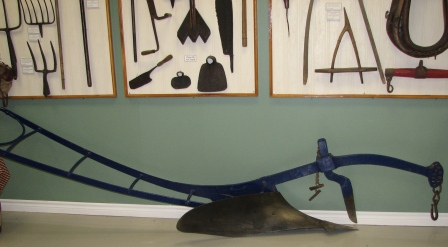 The plough was sold at Charles Kidd’s sale to George McGinnis, descendant of another pioneer Elmvale family. Mr. McGinnis, a regular ploughing match competitor, kept the plough for many years and, after his death, his widow sold the plough to Mr. Clubine. Mr. Clubine had competed in matches for most of his life, but he did not use this plough. On his death, his son transferred the plough to the Huronia Museum in Midland.
 Allan Lambie has kindly offered to demonstrate this plough today. Allan is from an old Elmvale Scottish family with a long tradition in match ploughing. Today he has set aside his usual match plough (his grandfather’s Massey Harris) to try the steel match plough. Allan’s family had a history similar to the Patersons, and his Davidson ancestors rented a farm to Robert Paterson when he first came to Canada. The Lambies settled in Flos Township about 1865.
Many thanks to Gary French for this article.


 Huronia Museum