A.Y. Jackson on William J. Wood (1877-1954)
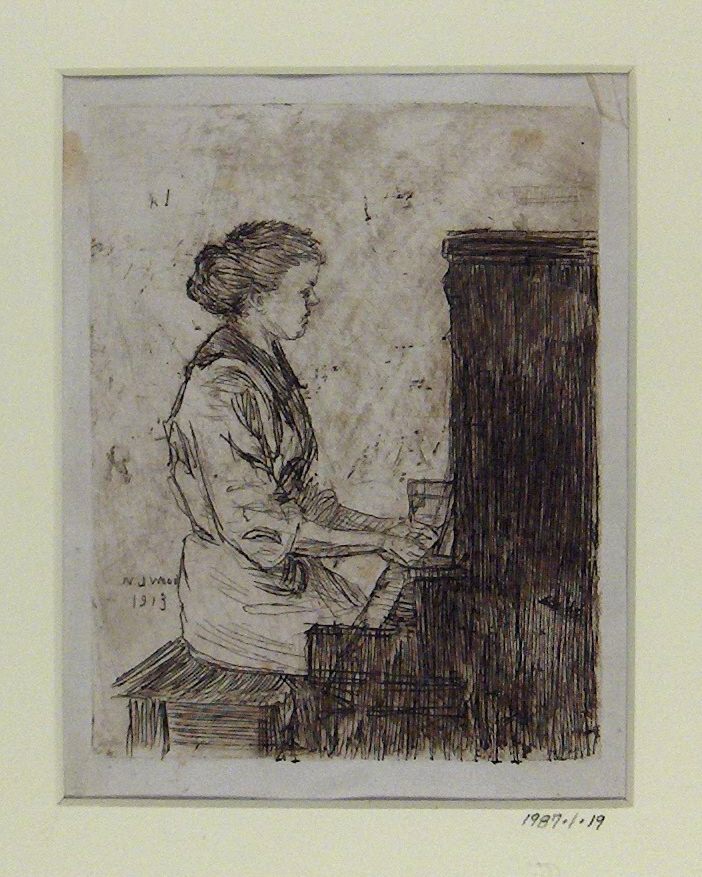
W.J. Wood is one of my favourite artists. I discovered his work at the Huronia Museum in Midland, Ontario, the town where Wood spent much of his life. The museum has an extensive collection of Wood’s etchings, drawings and paintings. He was a friend of the Group of Seven. Unlike the Group, much of Wood’s work deals with subjects of small town life and family, rather than “pure” Canadian wilderness landscape.
In his autobiography, A.Y. Jackson writes a chapter entitled, “Art Appreciation and Otherwise”. In it he describes the precarious living that Canadian artists faced in his lifetime. Among the people he writes about is Bill Wood. It is an illuminating passage.“Years ago I met Bill Wood, who worked in the shipyards at Midland. He had always wanted to be an artist, and he had managed to put in a few months’ training in Toronto in the winter-time when he was a Great Lakes sailor. Then he got married and raised a family. When he took up etching, he made his own press and prints. His efforts at etching and painting were all made after the day’s work or at week-ends.
“Hart House purchased one of Wood’s paintings of a girl playing a violin. His own letter regarding the painting appeared in Canadian Paintings in Hart House. ‘It represents’, he wrote, ‘more to me than a “Woman with a Violin”. The woman whom it recalls is a lassie playing by ear the songs and hymns of Auld Scotland, the homeland of my father. I painted “Memory’s Melodies” when the Grants visited us in the evening and Mrs Grant played her violin…after I had ten hours in the auto-body works in Penetang. The mellow colour of the canvas is due no doubt to its being done at night by the usual electric light. The paint is home brew from dry colours. Do I love a violin? Do I? it’s as beautiful as a bark canoe I once bought of an Indian at Byng Inlet and lost the next day as belonging to another Indian. My attitude towards the arts is that where your heart is, there your art is also.’
“In their modest little home at Midland, where his wife helped out by sewing and other work, Bill, painting signs, making etchings, talking like a philosopher, was a most cheerful soul. The Art Gallery of Toronto has one of his canvases, “On the Beach”. Whenever I see it I can’t help feeling that if he had only a quarter of the opportunities some of the young artists have today, he would have proved to be a genius.”
p. 147-148
A Painter’s Country: the autobiography of A.Y. Jackson. Clarke, Irwin & Company Ltd. Toronto, 1958