Huronia Museum – Looking Back 60 Years Ago in North Simcoe – April 8th to 14th, 1959

A reminder that we do not have the original negatives for the month of April 1959, “copy and paste” from the microfilm is the best we can do until May.


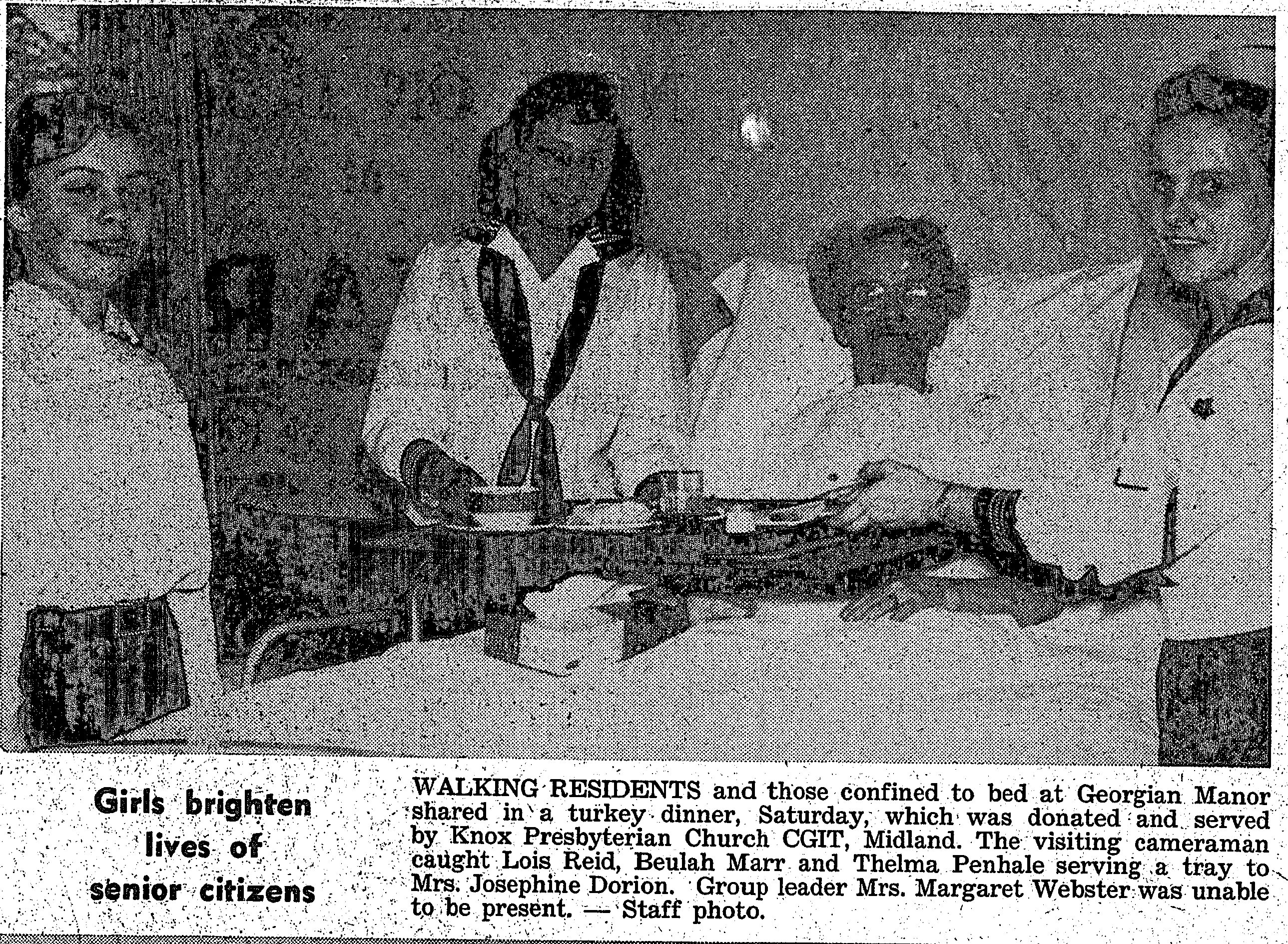
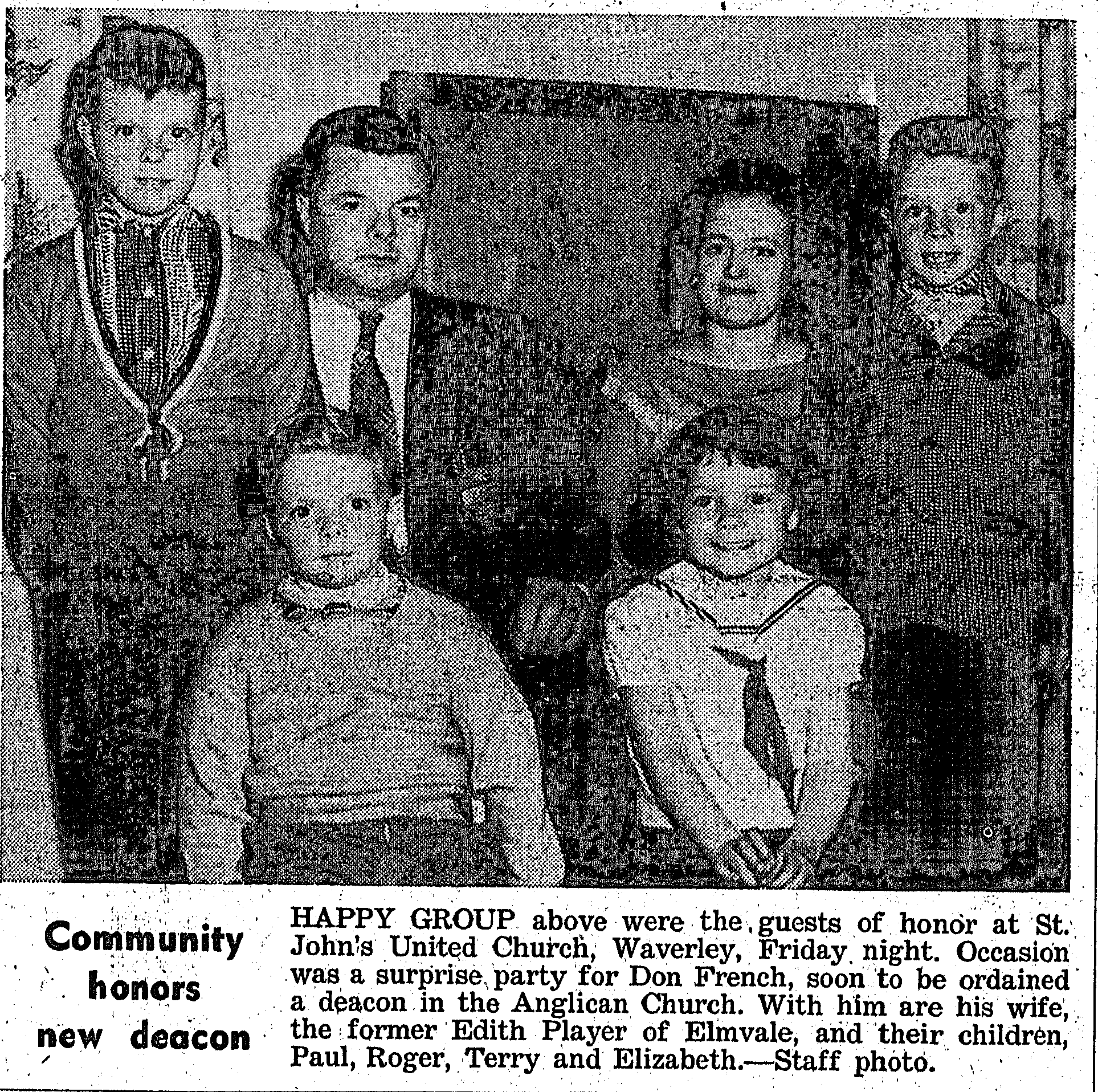
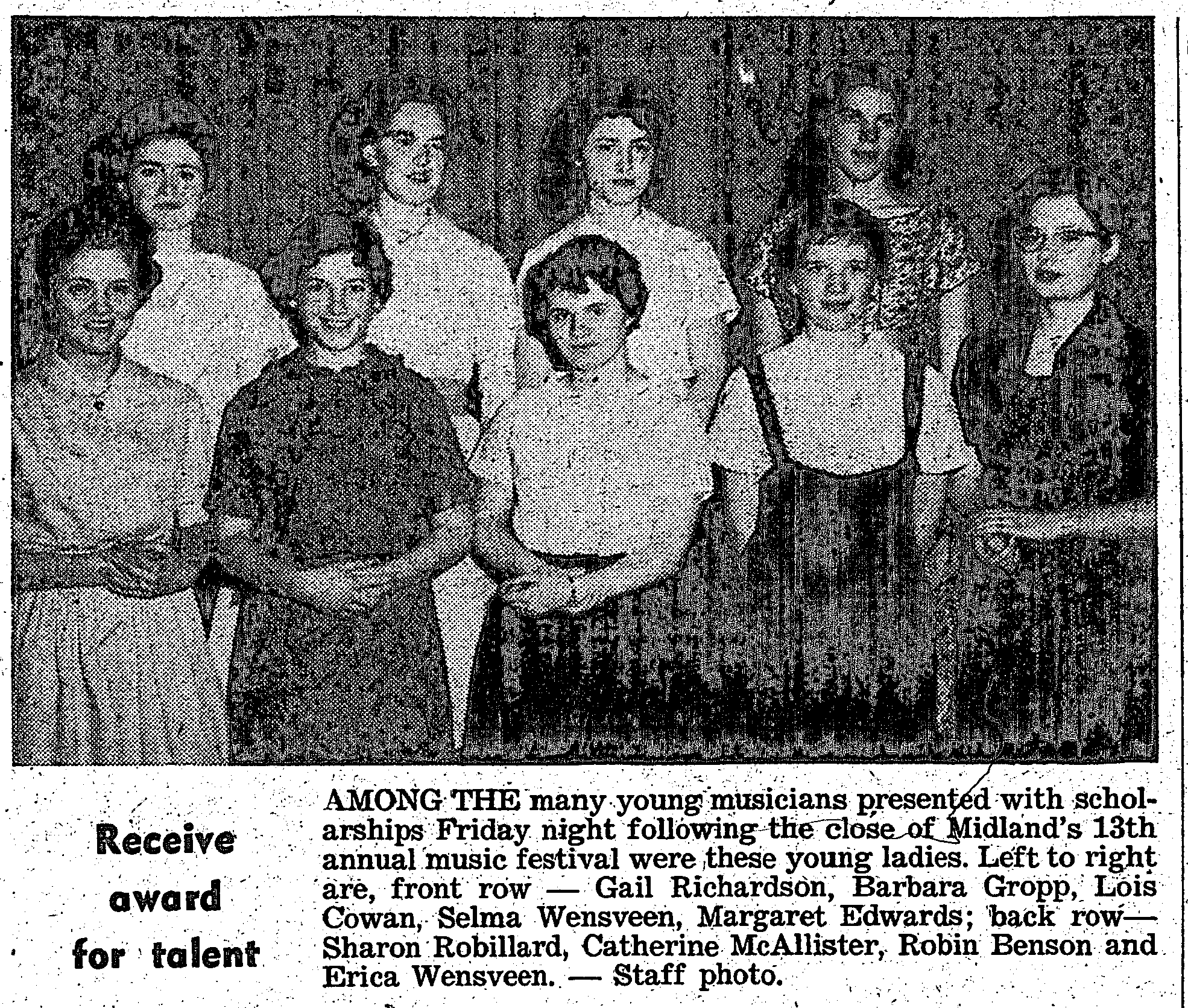
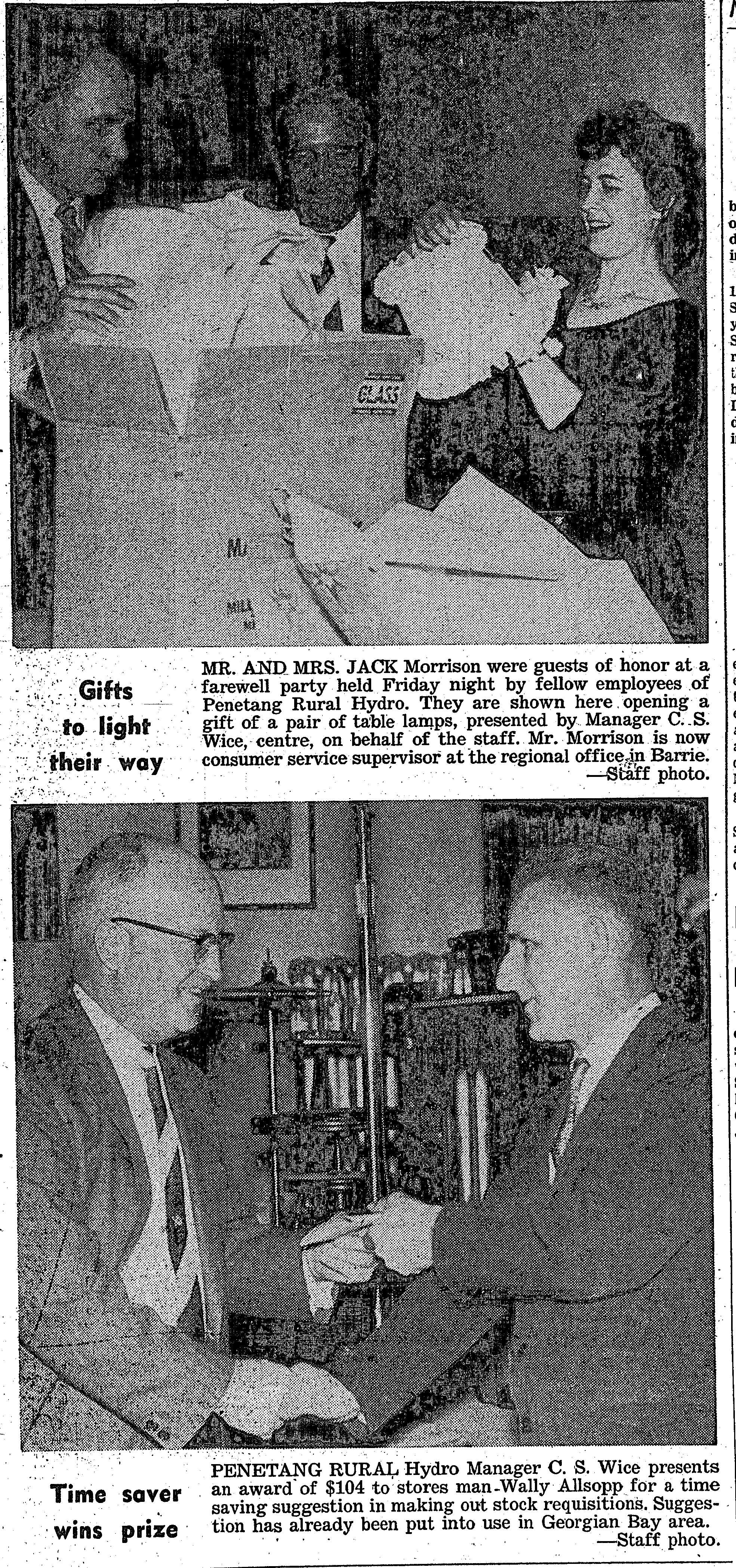
I included the photo above because I now live on the property where Brenda and Bonnie grew up with their brothers Bruce, Brian and Brent, the five B’s. Brenda, Bonnie, and Bruce still live in the area, Brent and Brian are deceased.

  • The Midland Free Press headline of April 8, 1959; Two Bayports Set Record for Water-Borne Freight. Port McNicoll and Midland, topped three other lake ports in the Georgian Bay area in the amount of water-borne freight handled in 1958, a report from F. K. McKean, district marine agent, Department of Transport reveals. The report shows that Midland and Port McNicoll combined handled a total of 1,141,000 tons. Port McNicoll topped four lakeports — Owen Sound, Midland, Collingwood, Parry Sound — with a total of 740,000 tons. Mr. McKean pointed out that grain cargoes made up most of the tonnage handled, except at Midland where 300,000 tons of coal were included in the total tonnage, and at Parry Sound where the bulk of freight was oil and oil products. Of the total tonnage at Port McNicoll, Mr. McKean said 112,000 tons was package freight and mill stuffs handled by the “Keewatin” and “Assiniboia.”
  • The County Herald headline of March 10, 1959; Budget Brings Tax Hikes for Most Wage Earners. North Simcoe residents will be paying more for cigarettes, liquor and in a special old-age security tax this year as a result of Finance Minister Donald Fleming’s budget, announced last night in Ottawa. According to statistics, the two percent increase on taxable income in excess of $3,000 will mean no change in the current income tax being paid by a married taxpayer with two children, until the $5,000 bracket is exceeded. The special two percent income and sales tax for old age security which was increased to three percent will, however, mean higher taxes on most incomes. Through this levy, a married taxpayer with two children, who earns $2,800 a year, will pay $2 more per year. The same tax-payer, if he earns $3,500 a year, will pay $9 more per year. Maximum tax payable for old age security was set at $90.
  • There will be a number of new faces on the staff of Midland-Penetang District High School when the 1959-60 term opens in September! Five members of the present staff have resigned. Replacements have already been hired for two of them. In addition, there is one new job open, that of mathematics and science teacher for Grades 9 to 12. Two teachers whose posts have already been filled are Bob Elliott, science, and Tom Cavanagh, English and history. They will be replaced by W. E. S. Denholme, of Saugeen District High School, Port Elgin, and Frank Schmalz, a graduate of OCE this year who comes from the Dunnville area. Mr. Elliott had also taught at Penetang High School and Elmvale District High School prior to coming to MPDHS. He will teach at Peterborough next year. Mr. Cavanagh, also a member of the MPDHS staff for several years, plans to take next year off, this paper learned. Two other teachers with several years of service who are leaving MPDHS for other fields are Mrs. I. Rayner, who is going to Stratford, and James Nopper, who moves to Sarnia. Member of the staff for only one year, Miss Mary Anne Nicholson will teach at Etobicoke next year. – Newspaper Ad – Required for September Male or Female TEACHERS For Primary and Junior Grades, SALARY ‘ Category’ System in effect. Minimum $3,000.00 Special Allowances for Experience Annual Increment $200.00 APPLY in own handwriting, stating age, years of experience and last Inspector to WM. A. HACK, Secretary-Treasurer, MIDLAND PUBLIC SCHOOLS BOARD Box 100,  Midland, Ontario.
  • Chief of Midland fire department for 20 years, Peter Grigg died in St. Andrews Hospital Sunday, he was in his 70th year. Funeral services will be held from Knox Presbyterian Church this afternoon, with temporary interment in the Lakeview Cemetery vault. Mr. Grigg joined the volunteer fire brigade in 1919 and was made chief in 1928. Poor health forced him to retire in March of 1956 after 37 years on the force. He was succeeded by Arnold Tippin who “came up the ladder” under his guidance.
  • Midland won its fourth provincial Little – League Hockey title since 1952 at Welland on the weekend when its AHL team swept through three games to win the Ontario crown. The win gave the Lions Club sponsored Little League organization a title in all three series, operated on a provincial basis. In 1952 Midland won the first NHL title ever decided on a provincial scale and followed up with victories in the junior OHA division in 1956 and 1957. Actually, the 1952 team claimed the All-Canadian title, after defeating Vince Leah’s Winnipeg team in games played here and in Maple Leaf Gardens. Midland secured its AHL title Saturday night by defeating Welland-Crowland Combines 4-2 in the final. They had edged past a strong Huntsville team 2-1 in the opener Friday and had then swamped Trenton 7-0 in the semi-finals.
  • Further dumping of garbage in the area at the 9th Line, Tay Township, and the CPR tracks will no longer be permitted, A. C. Forster, the owner of the property, advised today. The property has been closed, Mr. Forster stated, adding that he had advised Tay Township council some months ago of his decision but did not know if the council had arranged for any other garbage disposal area.
  • Births – BOUCHER— To Mr. and Mrs. Raymond Boucher, Brock St., Penetang, at St. Andrews Hospital, Midland, Tuesday, April 7, 1959, a daughter. GUTHRIE — To Mr. and Mrs. Edward Guthrie, 132 Colborne St., Midland, at St. Andrews Hospital, Friday, April 3, 1959, a daughter. JACKSON — to Mr. and Mrs. Harvey Jackson, 342 King St., Midland, at St. Andrews Hospital, Wednesday, April 1, 1959, a daughter. LACROIX — To Mr. and Mrs. Leonard Lacroix, 113 Fourth St., Midland, at St. Andrews, Hospital, Wednesday, April 1, 1959, a daughter. La VIGNE — To Mr. and Mrs. William La Vigne, of Ottawa, Ontario, at the Penetang General Hospital, Monday, March 30, 1959, a son. REYNOLDS — To Mr. and Mrs. Eric Reynolds, Waverley, at St. Andrews Hospital, Midland, Tuesday, April 7, 1959, a daughter. WOODS — To Mr. and Mrs. Jesse Woods, Port Severn, at St. Andrews Hospital, Midland, Saturday, April 4,,1959, a son.
  • Elmvale is proud of its young Lions, who won the OMHA juvenile “D” title this season with two straight wins over Lucknow in the finals. Members of the team are, left to right, front row, Ross French, Bill Marley, Larry Simpson (captain), Andy Copeland, Elvie Frankcom; middle row, Bill Crawford (coach), Gil Hall, Wayne McArthur, Bill Large, Lealand Rowat, Ross Heacock, Harry Rowley (manager); back row, Russell Ritchie, Nelson Jordan, Dave Cooper, Torry Stevens, Bob Greenlaw, David Campbell. (The photo in the newspaper was too dark to reproduce here.)
  • 25 Years Ago This Week – Two Penetang men played the first round of golf for the 1934 season at the Midland Golf and Country Club April 8. In the afternoon, two Midlanders played the course. * * * Flocks of wild geese were seen winging their way north. One large flock was heard passing over Midland about 10:00 p.m. April 9. * * * The federal government reported that tourists visiting Canada spent $117,214,000 in 1933. This was about $100,000,000 less than was spent in 1932. * * * Because of heavy ice conditions on the bay, shipping companies were predicting that navigation in Georgian Bay ports would not open before May 5. It was the latest opening since 1926 when the first ship left Midland May 6. * * * Ontario apple growers feared they would suffer heavy losses in trees because of the long severe winter. It was reported that 40 percent of the apple trees in Ontario were affected by the heavy frosts. * * * M. J. Asselin, reeve of Tiny Township, was elected honorary chairman of the newly-formed Simcoe County branch of the Ontario Swine Producers Association. The organizational meeting was held at Barrie. Robert Ego of Medonte was elected to the executive of the association! * * * Capt. Percy Beatty of Midland, master of the Coalhaven, was the skipper of the first ship into Oshawa harbor in 1934.
  • Assurances have been received by the Georgian Bay Development Association from Hon. Bryan Cathcart, minister of Travel and Publicity, that a permanent tourist information booth on highway 400 will be established. Expected to be located about two miles south of Barrie, the building probably will be started this year but will not be in operation until 1960.
  • Port McNicoll Hotel Limited will make application for four licences at a special meeting of the Liquor Licence Board of Ontario in Barrie council chambers May 8. The hotel firm, whose head office is in Kingston, will seek a lounge licence, a dining lounge licence, a public house licence for a men’s beverage room and a public house licence for a women’s beverage room. The hotel was formerly owned by the Canadian Pacific Railway Company and was operated as “The Inn.”
  • Movement of CSL freighters from the port of Midland will not start for at least another week, J. G. Hendrickson, CSL manager advised yesterday. While some of the ships’ engineers are here, “none of the captains have reported yet”, Mr. Hendrickson said. (This was in the May 10th 1959 paper. The Baie Comeau is not setting any records for being ice-bound in Midland.)
  • Midland assessor Ian McClung said yesterday the annual town assessment will begin next week. Two Midland men will be taking the census, Mr. McClung stressed that it is important that the census takers be given full information as to the number of persons in a home and their vital statistics such as age, marital status and the number of children. It is on the basis of the total population that the provincial grant of $3.50 per head is based, Mr. McClung stated. The information, which will take six weeks to two months to complete, is also the basis for preparation of the municipal voter’s list.
  • COLDWATER—At this week’s council meeting Councillor Gordon Chamberlain asked what council planned to do about raw sewage being dumped into the Coldwater River from a number of homes and business places on Main Street. Reeve Lawrence Devine said the issue had been raised some years ago and a program outlined at that time under which better sanitation would result. The plans were never completed, however. The Reeve said a comprehensive sewage treatment system had been considered too costly for the village. He would like to see the river “cleaned up” and would be glad to call a special meeting at any time to discuss the matter. Reeve Devine stated. No arrangements were made for a future meeting.

Ganton Dobson related this history to Herbert Cranston in 1939 as part of a series that the newspaper carried about the early days in Midland as told by the towns, senior citizens. Many parts of it reappeared in 1946 in another series in the paper. Some of the second article, which was posted in the Facebook groups “Midland Then and Now” and “Midland Area – Portraits of the Past”  in October of 2015, is verbatim but much of it is new.

Next week we will post the third part of the series which focuses on Ganton Dobson’s business career. 

“The first store in Midland was owned and operated by Nelson Courtemanche. His brother Alfred Courtemanche worked with him, and is still living here,” said Ganton Dobson in answer to a query as to the first commercial activities in this locality, “it was, of course, a general store, and it supplied all the needs of the little community. The next was one operated by Joseph Phillips, who built a shop on the site where the town hall now stands. “There was no relief in those days, and many workers would be out of employment after the mills closed down in the fall until they opened again in the spring. Consequently, a great deal of credit had to be given by the storekeepers, and that was a great hardship to them, for there were plenty who had no intention of settling, and when spring came around would depart for pastures new. There was nothing for the Merchant to do but to write the debt off to ‘profit and loss,’ and footnote “Gone but not forgotten.” “The storekeepers had other problems too to worry them. There were not many places to go in the evening’s, and the stores were generally packed with men in the evenings who came not to shop but to gab about the latest town scandal, politics, or grouse about the wages paid in the mills. They would make seats for themselves on the long counters, and if a lady should come in wanting to buy something she had trouble finding a vacant spot where she could speak to the storekeeper over the counter. “Alex Patterson and his brother had a store just about where the old fruit store recently vacated by Mrs. Gianetto now stands. They got a bit fed up with the way their counters were loaded with non-buying customers and decided to put an end to it. So they bored small holes the entire length of the counter, and with the help of a blacksmith rigged up a long wooden strip in which were fastened a number of darning needles just below the holes. Then when a customer appeared and no one offered to move Alex pulled a string, the needles went into action, and in less time than it takes to tell it a whole counter was cleared of its occupants. Alex didn’t say a word. He let the needles speak for themselves. After that, he did not have much trouble. In fact, it became a favorite trick of the mill men to bring in greenhorns and set them on the counter with the hope that Alex would open fire with his artillery. 

FIRST QUEEN’S HOTEL “I see by the paper that the old Queen’s Hotel may possibly be pulled down.” observed Mr. Dobson. “That reminds me that my father furnished the money for a man named Gleason to build the first Queen’s Hotel. It was a wooden affair, which was afterward burned down. Gleason could not make a success of it and meet the payments on his mortgage, so the hotel fell back into dad’s hands. He wanted to take the hotel over and run it, but mother would not hear of it. She wouldn’t take her children into the atmosphere of a hotel. Before a great while father was able to sell his equity in the hotel to James Duncan, father of Tom Duncan, chairman of the Park Commission, and Bill Duncan. “That recalls a good turn that James Duncan once did me and a chum of mine. There were not many shows or amusements of any kind which we youngsters could attend, and so when a traveling company came to the old skating rink and put on ‘Uncle Tom’s Cabin,’ we were, of course, anxious to see it. I had read the book, which made me all the more keen to see it. The rink at that time was owned by William Chew. We had no money, so resolved to steal in. We found a trap door near the stage which did not fit very snugly, and we tried to peep in through the cracks, but that was not at all satisfactory. Mr. Duncan was sitting inside with his back to the wall. We called to him but were afraid to make too much noise. Finally, we got his attention by tickling his ear with a long stalk of timothy hay. He reached down, turned the button, and let us in free, and we had a close-up of Little Eva, Topsy, the bloodhounds, Uncle Tom, Simon Legree and all the rest, and all for nothing. “That chum of mine is one of the stockholders of the Arena Gardens, but I am afraid he has forgotten the night that James Duncan let him into Uncle Tom’s Cabin, for he has not arranged any trap door at the Arena where penniless boys can obtain free admission.”

FIRST SAWMILL – The chief industry in the new Midland City was the sawing and finishing of timber. The first mill was that operated by the late H. H. Cook on the land where the Midland Shipbuilding Company buildings now stand. “I can remember going down through the swamp one Sunday morning to see the Cook mill burn down completely,” said Mr. Dobson. “It was rebuilt the following winter, and then Samuel Chew came along and erected a mill on the waterfront just opposite the late Mr. James Playfair’s residence. The railway came in 1879 and the trains were pulled by old fashioned wood burning locomotives. All along the tracks between here and Orillia were piled thousands of cords of wood. The cutting of the wood for the railway and for I. Burns of Toronto provided work for great gangs of men. Several other mills were established after the railway came. The British Canadian Lumber Company put up a large mill where the Letherby mill now stands. My second job was in Sam Chew’s mill. I pushed the lumber on the rollers in the yard. I got fifty cents a day but only worked there a month. The mills furnished plenty of employment for hundreds of men. Wages were small, and the hours were long, from six in the morning till six at night. There was a stop at 9 a.m. for oiling, another at noon for lunch, and another for oiling at three o’clock. The British Canadian mills installed the first electric lights to be put in anywhere in Canada, and people came from long distances to see them. There were even some excursions for that purpose. The lights were, of course, the old carbon lamps, but they gave enough illumination for work to be carried on at night during the rush season.

TOWN’S WORST TIMES – “Midland’s thriving lumber business suffered almost complete collapse when a change in the export regulations was made, and it was possible for American lumber companies to cut their logs in Canada and tow them to Sheboygan, Bay City and Saginaw for manufacture into timber. Talk about hard times in Midland. They have never been as bad since as they were then. The mills in the States were running night and day, while most of ours were shut down. Several deputations went to Ottawa to make complaints, and finally, an export duty was put on all unfinished timber in 1896. Then the lumber business boomed. I had bought some dressing lumber for $13 per thousand. Three months later I sold it for $30 per thousand. Laths jumped from $3.50 per thousand in June to $7.50 in November. There were altogether some eight mills cutting logs in Midland, three at Victoria Harbor, three at Waubaushene, four at Fesserton, two at Port Severn, two at Coldwater, and three on the Muskosh River. It was a great timber country. For sixteen years we had wonderful prosperity. The mills were busy all the time, some running day and night, and fair wages were paid. Then as the timber limits in the neighborhood became gradually exhausted it became less and less profitable to bring logs to Midland for cutting, and the sawmills were one after the other picked up and moved nearer the forests until now we have only one which operates only intermittently.

SMELTER A BOON – “The coming in 1900 of the Canada Iron Corporation Co., popularly known as the smelter was a great boon to Midland. It was located where the Midland Simcoe elevator now stands. The furnace had a capacity of 500 tons daily, and the rail and water shipments totaled over 400,000 tons annually. From 300 to 350 men were employed. George D. Drummond was the manager and superintendent of the Midland plant. “Before the coming of the railway,” continued Mr. Dobson, “we received our mail by stagecoach. The stage ran between Barrie and Penetanguishene, and the mail was dropped at Firth’s Corners, whence it was brought by horseback to the village. Then came the telegraph. It was installed in the post office, which was a small building at the rear of the McCartney block, where the barbershop owned by Arthur Macksey now stands. The first postmaster was Thomas Gladstane. He was succeeded by his son Walter, who held the post until his death not so many years ago. The first baker was H. S. Ruby, who arrived by team from Barrie. His business is now carried on by his son Albert W. The first elevator was the Midland House. It was built about 1881, and the grain trade boomed. The carriers were sailing ships which carried both grain and lumber and it was a great sight to see the harbor filled with these ships waiting at anchor for their turn to unload their cargoes.

REGATTA EVERY YEAR – In those days Midland had a regatta every year. I remember one in which the late James Playfair was very much interested, also the late Ed. Hanlan, champion sculler of the world. There were fishing boats from Collingwood and other places by the score, and they carried every inch of canvas possible. It was exciting to see those sailing vessels racing for first position at the elevator. I remember watching two coming round the point, the Emily B. Maxwell and Azoff in the lead with a beam wind. After coming, round a bit farther the captain of the Maxwell tacked off to the east, apparently taking the longest way. Getting his ship, a smart little craft into a better position, he soon overhauled and passed the other ship and sailed close up to the dock, so close we were sure he would strike. Then we heard him roar “Come hard over” and his ship answered at once and finished the winner by about 100 yards.

“At the time my parents first settled here there were no churches or places of worship. Missionaries of several denominations visited the settlement from time to time, coming from Penetanguishene where they had their headquarters. The first I can remember was Rev. Dr. McGilroy, who many years after was pastor of the Presbyterian Church which was located at the corner of Bathurst and College Streets, Toronto. He often conducted services at our home which were attended by the neighbors. There we committed to memory the Shorter Catechism, the Ten Commandments, and many verses of Scripture. We, youngsters, thought it was pretty irksome discipline at the time, but after years proved the worth of the training to us.  There was a Rev. Mr. Flood who came for the Anglicans. I was baptized by him. Another I recall was Rev. Mr. Anderson. Father Laboreau came to minister to the Catholics. There were many others whose names I have forgotten. Rev. Mr. Lambert was the first Baptist missionary. He built the first brick church on Manley Street for that denomination, just north of the school. A Union Sunday school was held in this church for some years with children of all denominations attending. The Presbyterians built a church a little farther north on Manley Street, the Anglicans on the corner of Queen and Elizabeth Street, and the Methodists at the corner of Midland Ave. and Elizabeth. The Baptists are now in possession of the first Methodist church. The Christian Brethren held services in the old Baptist church. “The Salvation Army arrived here just 54 years ago on March 25th. Their uniforms, their music and their strange form of service attracted a great deal of attention. There were a number of misunderstandings with the police, resulting in some of the members being hauled to the police-court several times. No one was imprisoned, however. The magistrate, J. B. Horrell, was a fine man and had a keen sense of justice. The first officer was Captain J. Langtry, now Mrs. Col. L. D. Southall.

Huronia Museum – Looking Back 60 Years Ago in North Simcoe – April 1st to 7th, 1959

The Free Press negatives came to the museum in their original Ilford film boxes, each box containing a month’s worth of negatives, roughly 100. It appears that the month of April 1959 was not included. We know that the photos are the most interesting part of these museum postings for many people and we will “copy and paste” from the newspaper whenever the quality permits. 

Saturday marked another milestone for Mrs. Elizabeth Archer of Waverley who marked her 91st birthday at the home of Mrs. James Truax. Born in Tecumseh, Township, she was married 72 years ago to William Archer, who passed on some ten years ago. The Archers had farmed on Con. 2 Medonte for many years, later retired to Elmvale. Mrs. Archer, who has no family, came to Waverley to live some three years ago. Aside from a slight defect in her hearing she still enjoys reasonably good health for her years. 

The second event in the 10th annual mixed bonspiel here last week produced an all-Midland final between rinks skipped by Dr. Jim Small and Lloyd Wilcox. Dr. Small emerged the winner. Left to right are; front row, Mrs. W. McConnell, Mrs. Lloyd Wilcox, Mrs. Ken Ellis, Mrs. Mac Perrin; back row, “Woody” McConnell, Lloyd Wilcox, Dr. Small, Mac. Perrin.

Unlike younger members of their sex, ladies at Georgian Manor don’t try to cut a few years off their age. Shown here celebrating her 81st birthday at the home of her niece Mrs. Wm Carr, is Miss Nellie Evans, seated, who lived near Victoria Harbour until about a year and a half ago. Standing left to right, Mrs. George Ingram, Mrs. A. B. Murcklen, Mrs. Wm. Carr, Mrs. Elsie Fountain, Mrs. Douglas Hardy, and Carol Anne, Mrs. Gordon Carr and Linda, and Mrs. W. A. Argue. 

  • Midland Free Press headline of April 1st, 1959; Midland Policemen Take Dispute to Arbitration. The above is the outcome of Midland council’s action Thursday night when it turned down for a second time the officers’ requests for wage increases. Alderman James Mackie, chairman of the police committee told council that Collingwood council had granted all ranks in its police department a $150 increase for 1959 and a $100 annual increase for 1960. A two-year agreement had been signed, he said. Reeve Keller asked Mr. Mackie what increase had Collingwood given to its police officers last year. Mr. Mackie replied, “None.” “Well we gave ours $300 each last year,” Mr. Keller said. Mr. Mackie then tabled a motion, seconded by Alderman Haig, that the Midland officers be given a $100 increase for 1959 and a $100 increase for 1960, on condition that all ranks signed a two-year contract.
  • County Herald headline of April 3, 1959; Midland Port Officer Reports Revenue Down. A big reduction in the amount of coal imported through Midland last year is reflected in the annual statement of customs and excise collections for the port of Midland for the fiscal year 1958-59, submitted to this paper by A. E. Martin, collector. The total revenue last year as $755,322.60 as compared with $798,647.99 the previous year, a decrease of $43,325.30.  The Century Coal dock imported only 138,000 tons, as against 331,000 tons the previous year.
  • Today may be April Fool’s Day, but it definitely is no day to be “fooling around”, on the highways with a motor vehicle. On trial for the past two months, Ontario’s new driver demerit system goes into effect today. It’s designed to root out careless and dangerous drivers and put them off the road altogether unless they reform their habits. Similar to demerit systems already in effect in three other provinces and 17 states of the U.S., the Ontario regulation provides three-month license suspensions for motorists who collect 12 demerits in any two year period. All 12 points can be “earned” at one swoop by convictions for criminal negligence, drunk or impaired driving, or obtaining a fraudulent driver’s license. Failing to remain at the scene of an accident is good for nine points. Careless driving, racing or exceeding the speed limit by 30 MPH or more counts five points. Three points can be “earned” by merely exceeding the speed limit by more than 10 and less than 30 MPH, failing to yield the right of way, failing to obey stop sign or signal. Exceeding the speed limit by 10 MPH or less, or any, other moving violation, costs two points. Motorists will receive a warning letter when they build up six points and will be called in for an interview when they reach nine points. Twelve points mean an automatic suspension for three months.
  • Chief Robert Cameron has asked Midland council to grant him a hearing following council’s action Thursday night, requesting that he resign. A motion calling for the chief’s resignation came after a lengthy discussion of police affairs. The motion received the unanimous support of council. The consensus of council was that the chief was not performing his duties satisfactorily and could no longer hold the confidence of the men on the force. Date of the hearing has not been set.
  • Subject to approval by the park’s commission, Midland council has approved a 25-year lease with the Midland Curling Club for the curling rink. Council was informed that the curling club was in accord with the changes in the lease which had been re-drafted by the town solicitor George S. Dudley, Q.C. The new lease grants the club the option of an additional 25-year lease when the present lease expires.
  • by JOHN BRIDGES Georgian Bay Hunters and Anglers meeting March 25 at Bourgeois’ dining room had the largest turn-out of the winter. There were 70 in attendance. Guest included Bruce Collins, the local conservation officer who succeeded Fred Chew, and Conservation Officer Fred Bowes. Also present was Mel Moreau, newly-appointed chairman of the Leaders Fellowship Council of Midland YMCA. He asked the Hunters and Anglers Club to assist with a new program for teen-aged youth, being sponsored by the ‘Y’. The program will include camping and hiking. He sought the club’s permission to use its property on the side road north of Old Fort School for the project. (Ogden’s Beach Road)
  • Ten Years Ago This Week – A set of carillonic bells, donated to St. Matthias’ Anglican Church, Coldwater, by the Gover and Tipping families in memory of Howard Gover and Mr. and Mrs. George Tipping, were dedicated at a special service. Archdeacon A. G. Emmett of Orillia was in charge of the service. (The church has now been sold into private hands) * * * A group of McGill University graduates and Orillia admirers of Stephen Leacock were seeking to raise $50,000 to preserve the old Leacock home and its 48-acre property near Orillia. * * * A number of Penetang businessmen had purchased the Georgian Bay Tourist Co. Ltd. boats “Midland City” and “City of Dover.” The purchase price was listed as $50,000 and included as well the “Waterbus,” two 36-foot launches and two scows. The two cruise ships were to operate out of Penetang. * * * Coldwater council, in a deadlock vote which had to be decided by Reeve Ernest Miller, turned down a proposal for Daylight Saving Time in the village. * * * Newfoundland became Canada’s newest and tenth province. The big island became part of the Dominion March 31. * * * First ship into Midland harbor was the S.S. Imperial Simcoe. She arrived here from Collingwood April 9. Several CSL freighters and the government lightship- St. Heliers has left the harbor April 7. * * * Simcoe County Health Unit reported two deaths from poliomyelitis in the county during March. A third polio case was under treatment at Toronto Isolation Hospital.
  • Licence to operate a radio station in Midland was granted last week by the Canadian Board of Broadcast Governors, it was announced today by J. E. Lounsbery, chairman of the chamber of commerce businessmen’s committee. The licence has been issued to a group of Toronto men, several of whom are at present employed by the Canadian Broadcasting Principals in the application for a licence were R. Bruce Armstrong and Grant Forsyth, both of Toronto. According to Mr. Lounsbery, the Toronto men and their families intend to take up residence in Midland. Ownership and management of the new station will be entirely based in Midland. It is understood the operators of the station have already earmarked a location for their transmitting unit just outside of town (The Cecil German farm on the southwest corner of Little Lake).  Arrangements will be underway immediately to locate suitable studio and office space somewhere in the downtown section of Midland (above Cumming & Nicholson Shoes, the Grise block). It is expected that about 12 persons will be employed by the station.
  • Obituaries – ROBERT L. STOTT A resident of Wyevale for most of his life, Robert Leonard Stott died at his residence lot 14, Concession 6, Tiny, on March 1. Funeral service was held, March 3, at Wyevale United Church, with Rev. R. Chapman officiating. Pallbearers were A. Martin, E. Nerpin, S. Lyons, A. Brock, R. Houghton, and G. Hall. Mr. Stott was born at Stroud March 23, 1880. A member of the United Church he had served on the Board of Stewards. He had also served as a school trustee and as representative from Tiny Township on the Elmvale High School Board. Predeceased by his wife, the former Muriel McCallum, he is survived by two daughters, Mrs. C. Blow (Margaret) of Wyevale and Mrs. Ralph Mertz (Grace) of Wyebridge. Two grandchildren also survive. Temporary entombment was in Elmvale Cemetery vault. * * * GAIL ANN BALL Following an attack of bronchitis, Gail Ann Ball, four-month-old daughter of Mr. and Mrs. Ewart Ball, Waverley, died in Penetang General Hospital March 18. Funeral services were held, March 21, at A. Barrie and Sons funeral home with Rev. W. Morden officiating. Pallbearers were four uncles; Grant Ball, Charles Ball, Earl Ball, and Roy Truax. Besides her parents, she is survived by both sets of grandparents; Mr. and Mrs. Wilbert Dingman, Burk’s Falls, and Mr. and Mrs. Langford Truax, Midland. Temporary entombment was in Lakeview Cemetery vault with burial to be made later in Allenwood Cemetery. * * * WILLIAM CRAWFORD – A Midland resident all his life, William Crawford died in Penetang March 17 after a lengthy illness. Funeral service was held March 20, at Nicholls funeral home with Rev. J. L. Self officiating. Pallbearers were Doug Martin, Fred Grigg, Ben Cowie, David Hudson, Harold Hamilton, and Francis Miller. Born at Wyebridge in 1885, Mr. Crawford married the former Katie Leona Connor at Midland in 1915. He was a member of Knox Presbyterian Church and a Conservative in politics. Surviving besides his wife are three daughters, Mrs. J. Scott (Norma) of California; Mrs. A. Hamelin (Eva), of Hamilton; Mrs. R. J. Frame (Arlene) Midland; seven sons, Douglas and Gerald, Toronto, and Oakley, Kinsman, Vernon, Morley and Barry of Midland, and 16 grandchildren. Also surviving are a brother, Jack of Midland, and two sisters, Mrs. Wm. Hutchinson (Bella) of Moonstone and Mrs. Wm. Hawkins (Rita) of Wyebridge. * * * Funeral services, under Masonic auspices, will be held this afternoon for Arthur I. (Doc) Merchant, who died at Penetang General Hospital early Wednesday morning. He was in his 67th year. The proprietor of French Dry Cleaners, Midland, for the past 16 years, Mr. Merchant lived just south of Wyebridge. His wife, the former Winifred Stine, survives. There are no children. Mr. Merchant had returned to Midland only recently after spending two months with relatives in California. In failing health in recent years, he entered Penetang Hospital shortly after his return for treatment for a heart condition. Born in Indiana, Mr. Merchant had been a superintendent for Presto-Lite, Niagara Falls, N.Y., and supervised the building of a new plant in Toronto when the firm expanded to Canada. He assumed management of the dry cleaning establishment here upon ‘his retirement’ some 12 years ago. During his years in Midland, Mr. Merchant took an active part in the life of the town. He was a past president of the Kiwanis Club and was also a member of the Lions Club, Midland Shrine Club, Caledonian Lodge, A.F. and A. M., Midland Golf and Country Club, Midland Curling Club, and St. Paul’s United Church. * * * MRS. IRA HILL – An esteemed resident of Midland for 75 years, Mrs. Ira Hill died at the Stewart Nursing Home, Penetang, on March 27. She was in her 85th year. Rev. Ralph Wright, of Calvary Baptist Church, Midland, where Mrs. Hill had played the organ for nearly four decades, conducted services held in A. Barrie and Sons funeral home on March 28. Temporary interment was made in Lakeview Cemetery vault. Pallbearers were Dr. H. M. Wallis, William Scheetz, Don Howard, James Clarkson, Fred Chew and Boy French. The former Josephine Arnold, Mrs. Hill was born at Bradford on Feb, 4, 1875. When still a young girl her family moved to Penetang and later still to Midland. She was married on February 21, 1894, in Hillsdale, to Capt. Ira Hill. The couple marked their diamond wedding anniversary in 1954 and Mr. Hill predeceased her in December 1955. Mrs. Hill’s daughter, Irene, and her granddaughter, Barbara Scheetz, also played the organ at various times in Calvary Church. Surviving is her daughter, Mrs. Irene Scheetz, Toronto; granddaughters Mrs. Barbara Wallis, Toronto, Mrs. Eleanor Chird, Germany; grandson William Scheetz, Port Credit; and seven great-grandchildren. MRS. HERBERT COUSINEAU * * * Resident of Honey Harbour all her life, Mrs. Herbert Cousineau died in St. Andrews Hospital, Midland, on Feb. 16. She was in her 39th year. Services were held from Our Lady of Mercy Church, Honey Harbour, on Feb. 19, with Rev. V. Perdue officiating. Temporary entombment was made at St. Ann’s Cemetery vault, Penetang. Pallbearers were Frank Òuelette, Albert Cousineau, Frank Cousineau, Frank Copegog, Michael Doyle and Donald Nicholson. The former Margaret Isabel Gendron, Mrs. Cousineau was born at Honey Harbour on April 19, 1920, and received her education there. Married to Herbert Cousineau in Honey Harbour on Dec. 13, 1942, she was a member of the Roman Catholic Church. In addition to her husband, Mrs. Cousineau is survived by Joanne (Mrs. Michael Doyle) of North River, and Winston, Valerie, Josie, Nancy, Frances, Frederick and Helené, all at home and a granddaughter, Margaret Anne Doyle. * * * JOHN HAMILTON STEWART – A valued member of Penetang volunteer fire department and a well-known sportsman, John Hamilton (Jack) Stewart died at his Robert Street home, following a lengthy illness during which he had been confined to his bed for more than two years. Born in Sault Ste. Marie in 1895, John Stewart moved to Penetang with his parents as a child and had lived there ever since. In 1917 he married Florida Gravelle, and they were devout members of the Roman Catholic Church. For more than 25 years Mr. Stewart was a member of the town’s volunteer fire department. He was very fond of children, and most of them knew him as “Uncle Jack.” He was a member of Huronia Council, Knights of Columbus. Surviving besides his wife are one son, Robert, of Penetang; a daughter, Claudia of Orillia; three grandchildren; two brothers, David of Toronto and William Cosgrove of Sault Ste. Marie; and four sisters, Mrs. Harry George (Irene), Penetang, Mrs. Earl Williams (Edna), Midland, Mrs. A. E. Nosworthy (Agnes), Toronto, and Miss Ellen Cosgrove, Toronto. For the funeral service, firemen from Orillia, Barrie, Midland, Coldwater, Waubaushene, Elmvale, and Penetang marched as a guard of honour from his home to St. Ann’s Memorial Church where Msgr, J. M. Castex officiated, assisted by Father R. J. Egan of Midland, Interment was in St. Ann’s Cemetery. Pallbearers were all fellow firemen: F. Dumais, E. Quesnelle, L. Dubeau, G. Deschambault, E. Paradis, and L. O’Leary. At the time of his retirement in 1957, Jack Stewart had been the local branch manager of the B.A. Oil Co. for 37 years. In recognition, officials of the company attended the service.
  • Measles headed the list of communicable diseases reported for February by Simcoe County Health Unit. Forty-three cases of measles were reported with chicken pox in second place with 33 cases. Jaundice, scarlet fever, and mumps each had six cases and whooping cough, German measles and, meningitis had five, two and one cases respectively.

A few items from the summer of 1952;

Dr. Lorenzo Marcolin, whose relatives are pictured above, was born in Port McNicoll and after a prestigious career as a surgeon has authored a book entitled “A Great Lakes Treasury of Old Postcards” which is available at the museum.  https://www.dundurn.com/books/Great-Lakes-Treasury-Old-Postcards

A  queen for sure!!


Bill and Eleanor Leitch.

Huronia Museum – Looking Back 60 Years Ago in North Simcoe – March 23rd to 31st, 1959

Only one newspaper this week due to the timing of Good Friday in 1959.Successful dance step skaters at Midland Arena Gardens Sunday afternoon, the group includes Jane Edwards, Sharon Stelter, Donna Cramm, Judy Lumsden, Margaret Lockhart, June Lumsden, Nancy Playfair, Louise Parker, Lynda Duggan, Selma Wensveen, Mary Lynn Boyd, Lynda Stewart, Dawn Annand, Judy Hack, John Svoboda, Maureen Mohan, Suzanne Ball, Barbara Spence, Jane Campbell, Angela Magnus and Beth Boyd. 

This happy sextet had received word from the judges that they had passed their compulsory figure tests at Midland arena Sunday afternoon. They are Jane Campbell, Judy Hack, Dawn Annand, Donna Cramm, Angela Magnus, and John Svoboda. 

Only four of the 34 horses which started in Saturday’s running of the Grand National steeplechase in Aintree, England, got back to the finish line and Golden Strong wasn’t one of them. That’s the horse Mrs. Mary Dodgson and friend, 2-year-old Johnny Kinnear, had their hopes pinned on for one of the big Irish sweepstake prizes. However, there will be a consolation prize for Mrs. Dodgson, who resides in Midland but works at the Ontario Hospital in Penetang. 

“Uschi”, who also carries the letters “Sch. H. 2” after her name, is a female German shepherd, imported from Germany a few months ago by Hans Albrecht. She made an auspicious debut to her new homeland recently by practically sweeping her class at the Canadian Sportsman’s Show in Toronto. 

Winners of the Graham Swales competition, bottom row, were Jim Clark, Bill Kennedy, Bill Bourrie and skip Ossie Downer. Top rink, which included Murray Yorke, Cecil Merkley, Harold Wilcox, skip, and Dave Milner, won the Adams Trophy. 

Inter-club competitions for male members of Midland Curling Club have been wound up for another year. Bottom row, won the Cumming-Nicholson Trophy, left to right are Graydon Rogers, Phil Fuller, Ross Hastings and Jim Lennox, skip. Top, a rink including Norman Shill, Armand Robillard, Stan Burton skip, and Frank Powell won the O’Keefe Trophy. 

First event of the season, the “Early Bird” bonspiel, was won by Dave Milner, Aaron Shulman, skip Al Steer and Jim Clark, seated. Industrial League winners were, at rear, Murray Yorke, Les Barber, skip Armand Robillard and Jack Duggan. 

These two lads, who will be moving up to Scouts in about two weeks time, have obtained the greatest number of Wolf Cub proficiency badges of any boys in South Georgian Bay District. On the left is Colin Williamson 11, and Fred Hacker 11, members of 3rd Midland (Knox Presbyterian Church) A Pack. Both have 12 badges. Cubmaster is George Williamson and his assistants are Catherine Williamson and Don Pringle. 

After this long hard winter, the flowers in Mac Perrin’s greenhouse were an even more welcome sight than usual during an open house sponsored by the Ladies’ Auxiliary of Midland YMCA Sunday. In the top picture Pat Cowden shows an eye-catching red emperor tulip to Mrs. E. Goldberg. Lower, Mrs. J. E. Lawlor couldn’t resist smelling the polyantha roses while Mrs. Charles Vent, Mrs. K. Huvers and her daughter, Debby Lawlor, await their turn. 

Every winter CPR Bridge and Building gangs go over the long trestle at Port McNicoll, keeping the near-mile-long bridge up to strength to handle the huge grain trains that pass over it almost daily. Similar care on other edifices around Ontario would have saved many dollars and lives this past winter. (Reference to the arena roof failure in Listowel) 

Dressings used in the operating room are first sterilized in this autoclave. St. Andrews nursing assistant Doreen Dupuis removes dressings from one of two autoclaves in the central supply room at the Midland hospital. 

An important part of our hospital is the laboratory. Hospital accountant Clarence Day watches lab technician Ronald Hamelin make a blood test in the centrifuge. 

Nursing assistant Kathryn McMillan demonstrates the use of the Gomco suction pump, right foreground. It was donated to St. Andrews by the Nurses’ Alumnae in 1958. 

Twenty-six head of cattle, 16 pigs and a Shetland pony perished Saturday night when a fire completely destroyed the large barn on the farm of Bert Desroches, Con. 4, Tay. Also lost was a quantity of hay and grain and considerable machinery, including dairy equipment. The loss, which will run into thousands of dollars, was covered by insurance in part at least. 


(I’m not believing that the wind did this!)

  • The Free Press Herald headline of March 25, 1959; New Municipal Building Proposed for Penetang. Discussion at Monday night’s meeting of Penetang council indicates strongly that Penetang will have a new town hall to replace the present 68-year-old building damaged by fire earlier this year. Three proposed plans for a new building were inspected without any being accepted as shown. Council did vote in favor of a building to be constructed on one level, with a basement.
  • A new business, Florence’s Tots-&-Teens was opened recently at 229 King Street, Midland, just two doors south of the Bank of Montreal. The proprietor of the shop is Miss Florence Gignac who is no stranger to North Simcoe. Born in Penetang, Miss Gignac received her early education in her home town and then enrolled at St. Michael’s Hospital where she graduated as a registered nurse. Following graduation, Miss Gignac nursed in Kapuskasing for eight years and then her travels took her to California, Michigan and finally Peoria, Illinois, where she has been for the past year and a half. “We have been fortunate in making arrangements to handle a number of the leading brands in our complete range from infants to fourteen,” the new shop owner told the Free Press Herald. Miss Gignac is a sister of Penetang’s Mayor Jerome Gignac.
  • Penetang Police were a bit unhappy Friday night when their cruiser disappeared as they were quelling a disturbance on the Main Street. As a result, two young men will appear in court Thursday on charges of car theft. According to Chief Jack Arbour, Constables Marcel Dorion and W. Lacroix were called to settle a disturbance on the Main Street around midnight Friday. Rather than making an attempt to get an inebriated man into the cruiser, they walked him the short distance to the cells. On their return, the cruiser, which had been parked with the keys in the ignition, had disappeared.
  • JACK STEWART —a member of the Penetang Volunteer Fire Department for more than 25 years died Tuesday morning following an illness of two years. Funeral Service will be held at St. Ann’s Memorial Church, Penetang, Thursday morning.
  • COLDWATER — A number of farmers in Coldwater district stand to benefit by a federal-provincial Simcoe County plan to compensate them for the loss of cattle by rabies since April 1, 1958. The latest count of deaths by rabies among wild, domestic and farm animals in Simcoe County is; 112 foxes; 8 dogs; 17 cats; 95 cattle; 3 horses; 12 sheep; 2 hogs; 2 raccoons; 22 skunks and one groundhog. The total is 274, the second worst-hit county in Ontario.
  • The committee which recently picked the most valuable players in Midland’s Little NHL has now completed its job by naming the most valuable goalies in the six divisions. They are as follows: Junior “B”, Lloyd Graham; junior “A”, Laurie Thomas; AHL “B”, Jurgen Baumann; AHL “A”, Gregory Somers; NHL “B”, Bill Black; NHL “A”, Bill Silvey.
  • 25 Years Ago This Week – Third Street, Midland, was lined with cars and trucks as district motorists sought to obtain their 1934 licence plates and drivers’ permits on deadline day. Licence issuer Joseph O’Shea reported it was the busiest day he had had in years. * * * Tay Township had entered suit against the town of Midland for $2,500 allegedly owed to the township in an adjustment of county levy made in 1931, plus interest of five percent per year from the date of the adjustment. * * * Inspector MacGregor of the Department of Game and Fisheries, whose patrol areas were in Simcoe County, reported that 62 dogs had been shot chasing deer. Sixteen of the dogs were hounds. The remainder comprised various other breeds. * * * Balmy spring weather which had encouraged district farmers to commence plowing their fields, ended abruptly with a storm that blanketed North Simcoe with several inches of snow. Snowplows were required to clear the roads and sidewalks after the two-day blow. * * * Penetang’s public health nurse reported that she had found 24 cases of defective teeth, 12 cases of enlarged glands but only one case of malnutrition among the town’s school children. * * * Capt. Reg Belcher of Victoria Harbour, master of the S. S. Collier, sailed the first ship out of Toronto harbor to officially open the 1934 navigation season for that port. The previous November Capt. Belcher brought the ice-coated Collier into Toronto and safety after bucking a severe storm on the lakes. She was the last ship to lay up in the fall. * * * Midland council and citizens were attempting to have the provincial government complete Highways 27 and 12 as a means of encouraging more tourists to visit the district.
  • Obituaries – MRS. EDMOND LACROIX A heart seizure suffered as she sat in a hair dresser’s chair, Wednesday, March 4, resulted in the unexpected death of Mrs. Edmond Lacroix, Penetang. Born in Penetang Nov. 14, 1899, she had spent her entire life in this community, marrying Edmond Lacroix there in 1916. A Roman Catholic, Mrs. Lacroix was a valued member of the General Hospital Ladies’ Auxiliary, Catholic Women’s League, and the Extension Society of the Roman Catholic Church. Besides her husband, Mrs. Lacroix leaves three daughters, Mrs. J. Fournier (Sylvia) and Mrs. H. J. Lefaive (Laivie) of Oshawa and Mrs. L. E. Quinn (Mona), Midland. There is also one sister, Mrs. Theo. Moreau, Penetang. Funeral services were held Saturday, March 7, from her Maria Street home to St. Ann’s Memorial Church, where Father L. Ramsperger, Father J. Marchand and Father J. Kelly officiated. Interment was in St. Ann’s Cemetery. Pallbearers were Alfred Beauchamp, Gordon Beauchamp, John and Wallace Lacroix, Henry and Bernard Deschamps. * * * CHARLES M. FLEMING A member of Midland Lions Club and Caledonian Lodge No. 249 AF and AM, Midland, Charles Morris Fleming died in St. Andrews Hospital March 14. Funeral service was held March 16, at Nicholls funeral home with Rev. J. L. Self officiating. Pallbearers were John Mackie, Lloyd Murday, Don Argue, Elmer Belfry, Bill Scott and Bob Bath. Born in Midland, Nov. I, l903, Mr. Fleming was a wholesale distributor of hardware and garage tools. He lived in Toronto for 12 years and in Montreal for four years and returned to Midland in 1948. Prior to going to Toronto, he had sailed on the Great Lakes out of Midland. Mr. Fleming was an ardent golfer and a member of Knox Presbyterian Church. On Oct. 31, 1931, he married the former Helen McKenzie of Jarvis, Ont., at Toronto. Besides his wife, he is survived by three brothers: Keith of Midland, Leslie of Cincinnati and Gerald of Toronto, and four sisters, Mrs. J. Lang (Jessie), Scarborough; Mrs. C. A. Ferguson (Jeanne), Toronto; Mrs. A. Kenyon (Edythe), New Liskeard and Lena, Toronto. 

Looking further back we find this article in the July 12th, 1944 Free Press describing a shrine that is familiar to many who boat on the Bay. I was probably 14 or 15 when I first saw the Madonna high up on a rock ledge at the entrance to McRae’s Lake and had always wondered about its story. There is another version circulating in which a trapper is mauled by a bear but this one seems more plausible.

By TED A. BECKER SR. BUFFALO, N.Y.

On a craggy cliff overlooking Georgian Bay a statue of the Virgin Mother may be seen, a mighty sentinel, watching the wild beauty of the realm below her. Justly may she claim the title, for, in the ten years of her guardianship, she has served as a beacon light to countless tourists, guiding their steps over the treacherous passes of the bay to safety, not once has there been an accident reported since. My own escape from death was a miraculous event 11 years ago.

Early in 1930, my six-year-old daughter Marjorie was stricken with severe whooping cough. Her condition was a cause of great worry to the family. Our family physician advised us to move near a body of fresh water. We had been in northern Canada before and remembered the beautiful sur­roundings and invigorating climate of the Georgian Bay where thirty thousand (30,000) islands of all sizes and shapes procure a beauti­ful treat for the human eye. It was there we decided to take Mar­jorie. The thought of going to this paradise raised the hopes and am­bitions of the entire family. Even Marjorie, weak from constant whooping, showed signs of bright hopes. We left Buffalo May 28, 1930, and travelled 200 miles by auto Midland Ont., where a chartered launch was ready to take us 20 miles north on the shore of Georgian Bay, where the Thirty Thousand Islands make their first appearance. With us came Dr. Weider and his wife; our party of six Ted Jr., Marjorie, my wife and I accompanied by our English setter Sporty.

The pilot of the launch took us to McRae’s Lake where it’s fresh spring waters flow into Georgian Bay. Here, on a huge almost bare rock, we unloaded our baggage and supplies with two small boats; from this point, we had to portage 300 feet to the higher lake with our entire needs for the trip. Being late in the day, we only took what was needed, leaving the balance for an early trip in the morning. We traveled about three miles on this peaceful and beautiful lake to the shore where an abandoned log cabin was ready to house us for an indefinite period of time. We were soon set up for the night and ready for bed. The ever calling Whippoorwill whipped us to sleep, being very tired from eighteen hours of travel.

Morning came with a delightful warm breeze and the sun out of a clear sky. The doctor, Ted Jr. and I, traveled by boat to the portage for the rest of our supplies and equipment. It was there, as we had left it. Just about noon of the first day we were well settled and ready to enjoy the camp. For three days our party enjoyed nature and outdoor meals. On the fourth day, Dr. Wieder, his wife, and Ted Jr. had to leave for Buffalo. With my small boat and motor, I took them to Midland where they used the car to drive to Buffalo. I returned safely in time to enjoy another fine, day at the camp. Now, we three with our dog “Sporty”, made plans to spend at least a month in this little paradise. Life went on peacefully until the eventful night of June 3rd. We retired about 10.30 p.m. Shortly after I was awakened by my daughter who heard something eating its way into one corner of the cabin. Taking my 22 rifle by the barrel I opened the door to locate the noise. Stepping out in the dark, a large animal came towards me. It was so close I could only strike for defense. When I hit this animal with the stock, the butt of my gun, the bullet in the chamber discharged, striking me in the abdomen, passing through the stomach and the liver, hitting the spine and finally lodging in the right thigh where it is still embedded. The shock and the terrific pain made me unconscious. Having regained consciousness I found myself lying on a rock, my whole right side paralyzed and causing great pain in my stomach. The blood rushed to my stomach producing frequent vomiting. I gathered all my strength and called my wife to come out of the cabin. I told her what had happened and begged her to be brave and to be prepared to see me die. Death I did not fear, knowing my family would be provided for after my death. I told my wife of my critical position and of the uselessness to seek help,  for a stretch of several miles separated us from any place where help could be obtained. Moreover, she did not know the outlet of our lake nor the treacherous rapids – one hundred yards long – we had to cross to get out. Normally we portage our boat over this point, but that means manpower which we could not muster at the present time.

Undaunted by the dismal situation, my faithful wife dragged my disabled body to our frail motorboat. Taking our six-year-old daughter and our English Setter pet with us we pushed offshore and by an act of divine help I cranked the motor and up the lake we started for the portage and rapids I feared most.

It was now 11 p.m. The darkness was relieved by the bright rays of a crescent moon, and by its light, we guided the boat to an unknown destiny. After 30 minutes of dodging rocks and shoals, our worst fears were realized as we entered a course that was leading us directly into this disastrous channel. Our little daughter was calm and useful. When peril was greatest she knelt down and prayed to the Blessed Mother, asking Her help a where no mortal help could be found.  Now we were but twenty-feet distance from the madly dashing waters which spelled death unless we change our course. The rocks threatened the safety of our boat. I had been continually vomiting much blood and my strength was ebbing away. Placed as it were between Scylla and Charybdis, in an imminent grasp of death, I made one superhuman effort to adjust the boat and the motor for a direct shoot into the rapids. At this moment I called on Marjorie to hold fast on to the dog-which would get her to shore should we capsize. The wise English Setter sensed the danger and gave a warning howl which still echoes in my ears when I think of this moment of a close call to a watery grave. Weakened by agonizing pain, and in view of impending danger, I prayed and waited for the outcome, trusting in Divine Providence. After what seemed to me a long time I opened my eyes. Our little boat passed the treacherous waters and we were floating safely to the other side in Georgian Bay. Once more I put my feeble strength to the task. I placed the outboard motor in position and the little boat was once again tugging along a channel in the direction of the nearest settlement where locals lived the year round. The greatest menace, the rapids, were behind us, but dangers still ahead of us. The shoals under water, rock, and shadows were like many hideous ghosts looming everywhere, ready to cripple the fragile boat. In ten minutes we were around Weber’s Island and could see Mrs. Herdman’s cottage on her island. All was dark, but I knew she was there so I headed for her shore. About two hundred yards from this island, I ran our boat on a shoal or underwater rock and there we stuck. We felt strangled, helpless. I collapsed from pain and exhaustion, little caring for the future. It was midnight. No light pierced the distance gloom on the shore. As the last resort, my wife and daughter began frantically calling for help, their voices echoing in the darkness deadened by the swishing water lapping the side of our boat. It was to our great joy that the shouts were answered from the cottage. Very soon Mrs. Herdman and her caretaker came with a boat and pulled us off the shoals and towed us to Fred Vasseur, about three miles down the Bay. I was transferred to a speed boat made ready for a 15 mile trip to the nearest hospital in the town of Midland. Mr. Fred Vasseur, a very capable guide and boatman, chose a short but dangerous course direct to the town. His task perfectly executed, we arrived at Midland dock at 1.30 am. Still vomiting blood and experiencing terrible pain, I was constantly fighting for my life.

    It was June 30th, 1.30 a.m. and the town was dark. No street lights only that crescent moon that played a great part to get us so far, gave aid to a guide messenger who leaped quickly to the dock and ran two miles for a doctor. Dr.  Johnston, a learned surgeon from the world war responded in his auto in less than fifteen minutes. He felt my pulse and encouragingly said: “Keep courage young man, you have a good pulse. I will arrange everything to save your life.”  He rushed to St. Andrew’s Hospital, aroused four nurses and two more doctors, sent for me and made ready to care for me.

The town clock struck two and soon an undertaker ready for any kind of service appeared at the dock. I was lifted from the boat into a long narrow basket that was hard and uncomfortable. Did this man get to the right scene? It happened he was the only service available, although not the best. They slid me in his worn out  Ford truck. He cranked the motor, jumped in and started for the hospital. The way led up an incline to get over the railroad tracks and before we got over the car stalled. Being an experienced undertaker, he took his time to get going. He got out and cranked, and cranked, but no start. At intervals, he would come to the back of the truck and say, “Are you still alive?” My pain was so intense that I could only groan. Fortunately, I could groan to have him try again. About ten minutes passed and the car started. It was a rough ride but we arrived safely. The doctors and nurses were anxiously waiting. Dr. Johnston inquired about the delay. An encouraging sight for me to see. Four doctors, six nurses and a modern hospital ready to serve and save a stranger! Not one person had seen or heard of me before this early hour of the morning. Out of the basket and on the X-ray table to locate the bullet— it was in a good place—to the operating room and soon I was in “paradise”. No more pain and in good care. The doctors and nurses did a fine job repairing the damage and leaving the bullet where it was and perhaps still is. The report reads that I made a good shot; the bullet missing all the vital parts, shooting through the stomach and the liver, striking the spine and grazing the right thigh and embedding itself in the tissue.

For three long weeks following the accident I hovered between life and death at this hospital. My right side and entire right leg was paralyzed. The fourth week I showed marked improvement and on the seventh week left the hospital. During the seven long weeks at the hospital, I had ample time to think of the past. I knew that my life was spared me by the miraculous help of God. I recalled my daughter’s kneeling figure in the boat, her praying to the Blessed Mother. Realizing the goodness of God and the protection of the Blessed Virgin, I made a promise that I will make a pilgrimage to the place where the miracle occurred and somewhere in a secluded spot erect a little shrine of our Blessed Mother and Her Divine Son in thanksgiving for having saved our lives.

In May 1931, this little shrine was erected high upon the above the rapids. Upon a crude foundation rises a statue of the Madonna and the Child Jesus, hidden in a natural cove behind birch and pine trees. My private place of adoration and thanksgiving to God.    Very soon after the shrine was made known by the guides who soon found it a treasure and encouraged others to visit it. In telling the story the locals have added fictitious tales. I found notes asking for the true story of the shrine, whenever I visited the place. Prior to this, I felt no necessity to disclose the secret which I guarded carefully. But upon the pressure of my friends, I hereby acknowledge in public the great favors received through the Divine Providence and loving care of the Blessed Mother Mary, the Madonna of Georgian Bay.